

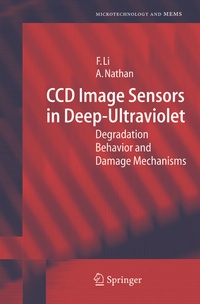
CCD Image Sensors in Deep-Ultraviolet
Description

As the deep-ultraviolet (DUV) laser technology continues to mature, an increasing number of industrial and manufacturing applications are emerging. For example, the new generation of semiconductor inspection systems is being pushed to image at increasingly shorter DUV wavelengths to facilitate inspection of deep sub-micron features in integrated circuits. DUV-sensitive charge-coupled device (CCD) cameras are in demand for these applications. Although CCD cameras that are responsive at DUV wavelengths are now available, their long-term stability is still a major concern. This book describes the degradation mechanisms and long-term performance of CCDs in the DUV, along with new results of device performance at these wavelengths.
More details
Other editions
Additional editions
Persons
Flora Li received her Bachelor of Applied Science degree in Electrical Engineering from University of Waterloo, Canada, in 2002. She completed her MASc degree in Electrical Engineering at University of Waterloo in 2003, where her research focus was on the investigation of deep-UV sensitive CCD image sensors and the related radiation damage issues. She is currently pursuing her Ph.D. degree in the field of organic electronics and polymer TFTs, under the supervision of Prof. Arokia Nathan at the University of Waterloo.
Arokia Nathan received his PhD in Electrical Engineering from the University of Alberta, Edmonton, Alberta, Canada, in 1988, where he was engaged in research related to the physics and numerical modeling of semiconductor microsensors. In 1987, he joined LSI Logic Corp., Santa Clara, CA where he worked on advanced multichip packaging techniques and related issues. Subsequently, he was at the Institute of Quantum Electronics, ETH Zürich, Switzerland. In 1989, he joined the Department of Electrical and Computer Engineering, University of Waterloo, where he is currently a Professor. In 1995, he was a Visiting Professor at the Physical Electronics Laboratory, ETH Zürich. His present research interests lie in fabrication of devices, circuits, and systems using disordered semiconductor, including organic, materials on rigid and mechanically flexible substrates for large area electronics. He held the DALSA/NSERC industrial research chair in sensor technology, and is a recipient of the Natural Sciences and Engineering Research Council E.W.R. Steacie Fellowship. He has published extensively in the field of sensor technology and CAD, and thin film transistor electronics, and is a co-author of the book, Microtransducer CAD, published by Springer in 1999.
