

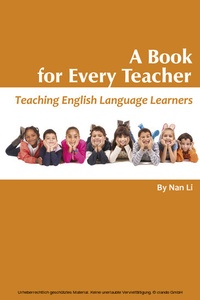
A Book For Every Teacher
Teaching English Language Learners
1st Edition
Published on 1. March 2015
261 pages
978-1-68123-052-8 (ISBN)
Description

A Book for Every Teacher: Teaching English Language Learners is a unique and compressive text written for mainstream classroom teachers. The passion for writing this book comes from our working experiences with the K-12 teachers in four school districts through our ELL Center professional development program. Through this program, we provide professional training through our federally funded research and service projects. The purpose of our professional training is to prepare general education teachers to work effectively with English language learners (ELLs). While working with the teachers on a daily basis, we know the immediate needs of the teachers. This motivated us to embark this book project. In recent years, the ELL school population has the highest increase among school populations. As the NEA data indicates, providing ELL students with high quality services and programs is an important investment in America's future (NEA, 2013). This book is our investment in helping teachers to meet their challenges and provide useful information and strategies for teaching ELLs.
The book is designed with K-12 teachers in mind. It is best used by teachers who have or will have ELLs in their classrooms and who seek information and strategies to better work with and serve their ELLs to achieve academic success. With this design, teachers can use the book as a text or reference tool. This book can also be adopted as text materials for professional training. Teachers are the most important factor for ELLs' academic success.
All prices
More details
Other editions
Additional editions
Book
03/2015
Information Age Publishing
€70.40
Shipment within 3-4 weeks
Content
1 - Front Cover [Seite 1]
2 - A Book for Every Teacher [Seite 2]
3 - Teaching English Language Learners [Seite 2]
4 - CONTENTS [Seite 6]
4.1 - Part I: ELL School Population [Seite 6]
4.1.1 - Chapter 1. Who Are the ELLs? 3 [Seite 6]
4.2 - Part II: Teaching ELLs [Seite 6]
4.2.1 - Chapter 2. Theoretical Perspectives in L2 Acquisition 25 [Seite 6]
4.2.2 - Chapter 3. Teaching ELLs in Classrooms 39 [Seite 7]
4.2.3 - Chapter 4. Ways to Involve ELL Participation 81 [Seite 8]
4.3 - Part III: Basic Vocabulary [Seite 8]
4.3.1 - Chapter 5. Academic Words For ELLs 105 [Seite 8]
4.3.2 - Chapter 6. Basic Daily Words for ELLs 143 [Seite 9]
4.3.3 - Chapter 7. Traditions and Holidays 169 [Seite 9]
4.4 - PART IV: Relevant Information [Seite 9]
4.4.1 - Chapter 8. Information for Professionals 185 [Seite 9]
4.4.2 - Appendix 227 [Seite 10]
4.4.3 - About the Author 241 [Seite 10]
4.5 - A Book for Every Teacher [Seite 4]
4.6 - Teaching English Language Learners [Seite 4]
4.6.1 - By [Seite 4]
4.6.2 - Nan Li Claflin University [Seite 4]
4.6.2.1 - Information Age Publishing, Inc. [Seite 4]
4.6.2.2 - Charlotte, North Carolina www.infoagepub.com [Seite 4]
4.6.2.3 - Preface [Seite 12]
4.6.2.3.1 - Uniqueness of the Handbook [Seite 12]
4.6.2.3.2 - Who Is the Audience for This Book [Seite 13]
4.6.2.3.3 - How to Use This Handbook [Seite 14]
4.6.2.3.4 - Chapter Summaries [Seite 15]
4.6.2.3.5 - REFERENCE [Seite 17]
4.6.2.4 - Acknowledgments [Seite 18]
4.7 - Part I [Seite 20]
4.7.1 - ELL School Population [Seite 20]
4.8 - CHAPTER 1 [Seite 22]
4.8.1 - Who Are the ELLs? [Seite 22]
4.8.1.1 - Case Scenario [Seite 22]
4.8.1.2 - Life Experiences and Cultures [Seite 23]
4.8.1.2.1 - Academic-Related Issues [Seite 29]
4.8.1.2.2 - ELL Profiles and Work Samples [Seite 30]
4.8.1.2.3 - Julio Gonzales Profile [Seite 30]
4.8.1.2.4 - Edwin Perez Profile [Seite 33]
4.8.1.2.5 - Ann Sanchez Profile [Seite 35]
4.8.1.3 - Summary [Seite 36]
4.8.1.4 - References [Seite 37]
4.8.2 - Table 1.1. Common Terms Related to ELLs and Programs [Seite 31]
4.8.3 - Table 1.2. Seven Common Myths With Truth Related to ELLs [Seite 32]
4.8.3.1 - Figure 1. 1. Julio focused on recognizing the letters in the above session. He was given many opportunities to practice in a meaningful way by reading, writing, listening, and playing the game. The drawing is his sample work after learning the Letter... [Seite 33]
4.8.3.2 - Figure 1. 2. This is Edwin's sample work. After reading the story The Fence by Debra Blenus, Edwin drew a picture of the different animals in the story. He also described what happened in the story with a brief summary. As a first grader, he was en... [Seite 34]
4.8.3.3 - Figure 1. 3. This is Ann's sample work. On the left is a story that Ann wrote in Spanish as an assignment on her first day in school. The teacher allows her to express in the language she understands. Under the story is the picture Ann drew, which ... [Seite 35]
4.8.3.4 - Figure 2. 1. Multiple meanings of an English word, such as "table." [Seite 47]
4.8.4 - Part II [Seite 42]
4.8.4.1 - Teaching ELLs [Seite 42]
4.9 - CHAPTER 2 [Seite 44]
4.9.1 - Theoretical Perspectives in L2 Acquisition [Seite 44]
4.9.1.1 - Case Scenario [Seite 44]
4.9.1.1.1 - BICS and CALP [Seite 45]
4.9.1.1.2 - Basic Interpersonal Communicative Skills (BICS) [Seite 46]
4.9.1.1.3 - Cognitive Academic Language Proficiency (CALP) [Seite 48]
4.9.1.1.3.1 - (a) Engaging in face-to-face social conversation with peers [Seite 51]
4.9.1.1.3.2 - (b) Ordering lunch from a picture menu in a fast food restaurant [Seite 51]
4.9.1.1.3.3 - (c) Listening to a presentation about pet animals with pictures and videos [Seite 51]
4.9.1.1.3.4 - (d) Participating in physical education classes [Seite 51]
4.9.1.1.3.5 - (e) Participating in shows and games [Seite 51]
4.9.1.1.3.6 - (f) Learning to play baseball with a coaching demonstration [Seite 51]
4.9.1.1.3.7 - (a) Engaging in social conversation on the telephone [Seite 51]
4.9.1.1.3.8 - (b) Getting travel direction via the telephone [Seite 51]
4.9.1.1.3.9 - (c) Ordering dinner from a menu in a formal restaurant with no picture clues [Seite 51]
4.9.1.1.3.10 - (d) Listening to a presentation about caring for pets without visual aids [Seite 51]
4.9.1.1.3.11 - (e) Reading a list of required school supplies [Seite 51]
4.9.1.1.3.12 - (f) talking with friends about shows and games [Seite 51]
4.9.1.1.3.13 - (a) Solving math word problems with manipulatives and/or pictures [Seite 51]
4.9.1.1.3.14 - (b) Solving simple math computation problems [Seite 51]
4.9.1.1.3.15 - (c) Doing a science experiment by following a demonstration [Seite 51]
4.9.1.1.3.16 - (d) Understanding written text through pictures, graphics, and small- group discussion [Seite 51]
4.9.1.1.3.17 - (e) Reading the illustrated (comic book) version of Shakespeare's Romeo and Juliet [Seite 52]
4.9.1.1.3.18 - (f) Listening to a lecture with visual aids [Seite 52]
4.9.1.1.3.19 - (g) Writing a report paper with a detailed explanation and ample examples [Seite 52]
4.9.1.1.3.20 - (a) Solving math word problems without manipulatives and/or pictures [Seite 52]
4.9.1.1.3.21 - (b) Doing a science experiment by reading directions from a textbook [Seite 52]
4.9.1.1.3.22 - (c) Writing research reports on assigned topics in social studies [Seite 52]
4.9.1.1.3.23 - (d) Listening to a lecture on an unfamiliar topic [Seite 52]
4.9.1.1.3.24 - (e) Reading Shakespeare's Romeo and Juliet in its original format [Seite 52]
4.9.1.1.3.25 - (f) Taking a standard test, such SAT, ACT, and TOFEL [Seite 52]
4.9.1.1.3.26 - Comprehensible Input and Affective Filter [Seite 52]
4.9.1.1.4 - Comprehensible Input Hypothesis [Seite 53]
4.9.1.1.5 - Affective Filter Hypothesis [Seite 54]
4.9.1.2 - Summary [Seite 55]
4.9.1.3 - References [Seite 56]
4.9.2 - Table 2.1. Examples of Social and Academic Language Based on Bloom's Taxonomy (1956) [Seite 49]
4.9.2.1 - Figure 2. 2. This is the modified format of Cummin's quadrants. Teachers can help their ELLs understand the information by providing contextual support. The chart is created based on Cummins's (1984) framework to evaluate language demand in conte... [Seite 50]
4.9.2.2 - Figure 2. 3. The Affective Filter Hypothesis Chart, based on Krashen (1982). [Seite 55]
4.10 - CHAPTER 3 [Seite 58]
4.10.1 - Teaching ELLs in Classrooms [Seite 58]
4.10.1.1 - Case Scenario [Seite 58]
4.10.1.1.1 - Planning to Teach [Seite 59]
4.10.1.1.2 - SIOP Lesson Model [Seite 60]
4.10.1.1.3 - Component #1: Lesson Preparation [Seite 61]
4.10.1.1.4 - Component #2: Building Background [Seite 63]
4.10.1.1.5 - Component #3: Comprehensible Input [Seite 63]
4.10.1.1.6 - Component #4: Strategies [Seite 65]
4.10.1.1.7 - Component #5: Interaction [Seite 66]
4.10.1.1.8 - Component #6: Practice and Application [Seite 67]
4.10.1.1.9 - Component #7: Lesson Delivery [Seite 68]
4.10.1.1.10 - Component #8: Review and Assessment [Seite 68]
4.10.1.1.10.1 - Total Physical Response [Seite 69]
4.10.1.1.10.2 - Teaching Strategies [Seite 71]
4.10.1.1.10.3 - Using Visual Aids [Seite 71]
4.10.1.1.10.4 - Using Pictures and Images [Seite 71]
4.10.1.1.10.5 - Using Graphic Organizers [Seite 72]
4.10.1.1.11 - Semantic Mapping [Seite 72]
4.10.1.1.12 - K-W-L Chart Strategy [Seite 73]
4.10.1.1.12.1 - 1. Venn Diagram: a graphic organizer with a set of diagrams that shows all possible logical relations between concepts. Venn diagrams were created around 1880 by John Venn, an English logician and philosopher. Here is a useful link on Venn Diagrams: ... [Seite 74]
4.10.1.1.12.2 - 2. K-W-L-S Chart: this is an extension of the KWL strategy and K-W- L-S stands for what I already know, what I want to know, what I have learned, and what I still want to know. Here is a link for the K-W-L-S chart: http://www.readwritethink.org/files... [Seite 75]
4.10.1.1.12.3 - 3. More useful graphic organizers that teachers can download from these links: http://edhelper.com/teachers/graphic_organizers.htm http://www.eduplace.com/graphicorganizer/ https://www.teachervision.com/graphic-organizers/printable/ 6293.html [Seite 75]
4.10.1.1.12.4 - Relating to Existing Knowledge [Seite 75]
4.10.1.1.13 - Providing Background Information [Seite 76]
4.10.1.1.13.1 - 1. Personal connection. Teachers need to help students connect learning to their personal experiences. Making personal connections can make learning accessible by connecting students' personal experiences. For example, teachers can use students' ... [Seite 76]
4.10.1.1.13.2 - 2. Academic content connection. Making academic connection means to connect learning content in a meaningful way and make it connected and accessible. For example, teachers can connect current learning to past learning by reviewing previous lessons o... [Seite 76]
4.10.1.1.13.3 - 3. Instructional connection. Instructional connection means that teachers provide instructional support to help students make connections by using instructional strategies to make learning productive. For example, teachers can invite guest speakers t... [Seite 76]
4.10.1.1.14 - Preteaching [Seite 77]
4.10.1.1.15 - Making Vocabulary Connections [Seite 78]
4.10.1.1.16 - Preview Survey [Seite 78]
4.10.1.1.16.1 - Presenting Contextual Information [Seite 79]
4.10.1.1.17 - Using Context and Modeling [Seite 79]
4.10.1.1.18 - Using Idiomatic Expressions Related to Cultural Context [Seite 80]
4.10.1.1.18.1 - Other Useful Tips and Integrating Technology [Seite 81]
4.10.1.1.19 - Thinking Aloud [Seite 81]
4.10.1.1.20 - Thumb Up and Thumb Down [Seite 82]
4.10.1.1.21 - Teaching Transitional Words and Phrases [Seite 82]
4.10.1.1.22 - Teaching Pronouns and Antecedents [Seite 83]
4.10.1.1.23 - Teaching Words Ending With -ed and -ing [Seite 84]
4.10.1.1.24 - Learning Prefixes and Suffixes [Seite 84]
4.10.1.1.24.1 - 1. At the beginning level, the teacher can introduce basic words with suffixes such as -er, -or, or -ress, which indicates the person who performs the job. act (v) [Seite 85]
4.10.1.1.24.2 - 2. At the intermediate level, the teacher can introduce more complicated words with suffixes such as -tion or -ment and add -er, and -or if they are from the same word stem. assess (v) [Seite 85]
4.10.1.1.24.3 - 3. At the advanced level, the teacher can teach those advanced words with suffixes such as -ion, -ship, -ist and add the related ending, for example, -ant or -sive in words such as act (v) [Seite 85]
4.10.1.1.25 - Teaching Bloom's Action Words [Seite 86]
4.10.1.1.26 - Visualizing the Characters in Reading [Seite 87]
4.10.1.1.27 - Making a Flip Book [Seite 88]
4.10.1.1.27.1 - 1. Provide each student with three pieces (or more) of colored paper (8 1/2 ´ 11 inches) or construction paper, which works even better, although regular copy paper works as well and can be written on clearly. Different colors make a flip book look ... [Seite 89]
4.10.1.1.27.2 - 2. Ask the students to line up the colored papers so that they overlap about 1 or 2 inches with a small "tab" left for each color (see Figure 3.4) so that on each page students can write a paragraph or illustrate ideas with pictures about reading. [Seite 89]
4.10.1.1.27.3 - 3. Guide the students to fold the paper over so that you get six tabs in all, and staple the top to make it into a flip book (see Figure 3.4). In addition to writing paragraphs or illustrating ideas, teachers can encourage students using the flip boo... [Seite 89]
4.10.1.1.28 - Writer's Workshop [Seite 89]
4.10.1.1.28.1 - (a) Prewriting: brainstorm, with a minilesson to help students with ideas [Seite 90]
4.10.1.1.28.2 - (b) Writing: writing and editing the first and second drafts [Seite 90]
4.10.1.1.28.3 - (c) Conferring: meeting with individuals to discuss their writing progress [Seite 90]
4.10.1.1.28.4 - (d) Publishing: sharing a clean final copy [Seite 90]
4.10.1.1.29 - Interactive Writing [Seite 90]
4.10.1.1.30 - Creating Word Walls [Seite 91]
4.10.1.1.30.1 - Integrating Technology With ELLs [Seite 92]
4.10.1.2 - Summary [Seite 98]
4.10.1.3 - References [Seite 98]
4.10.2 - Table 3.1. Writing Content and Language Objectives [Seite 62]
4.10.3 - Table 3.2. Story Map [Seite 73]
4.10.3.1 - Figure 3. 1. Example of the semantic map to teach food concepts. The orange color in the center is the main concept and green is for categories and blue is for specific food items. [Seite 74]
4.10.3.2 - Figure 3. 3. Example of a K-W-L chart to help students. [Seite 75]
4.10.4 - Table 3.3. Text-Self Chart to Make Personal Connections [Seite 77]
4.10.5 - Table 3.4. Making Vocabulary Connections: Connect Familiar Words With New Meanings [Seite 78]
4.10.6 - Table 3.5. English Idiom and Expression Dictionary [Seite 80]
4.10.6.1 - Figure 3. 3. Compare the revised version of Bloom's Taxonomy to the old version. Information can be found at http://ww2.odu.edu/educ/roverbau/Bloom/ blooms_taxonomy.htm [Seite 86]
4.10.6.2 - Figure 3. 4. Example of making a flip book. [Seite 89]
4.10.7 - Table 3.6. Basic Steps of Creating a Digital Story [Seite 93]
4.10.7.1 - 2. Search for image resources for the story, for example, pictures, drawings, photographs, maps, and charts [Seite 93]
4.10.7.2 - 3. Locate audio resources such as music, speeches, interviews, and sound effects [Seite 93]
4.10.7.3 - 4. Locate informational content, which might come from websites, word processed documents, or PowerPoint slides [Seite 93]
4.10.7.4 - 5. Decide the purpose of the story, that is, to inform, convince, provoke, question. [Seite 93]
4.10.7.5 - 2. Select the audio to be used for your digital story. [Seite 93]
4.10.7.6 - 3. Select the content and text to be used for your digital story. [Seite 93]
4.10.7.7 - 4. Import images into Photo Story (Note: Photo Story is free software available for download from Microsoft). [Seite 93]
4.10.7.8 - 5. Import audio into Photo Story. [Seite 93]
4.10.7.9 - 6. Modify images and image order as needed. [Seite 93]
4.10.7.10 - 7. Use a computer microphone and record the narration of the script and import the narration into Photo Story. [Seite 93]
4.10.7.11 - 8. Finalize the digital story and save it as a Windows Media Video file. [Seite 93]
4.11 - CHAPTER 4 [Seite 100]
4.11.1 - Ways to Involve ELL Participation [Seite 100]
4.11.1.1 - Case Scenario [Seite 100]
4.11.1.2 - Getting to Know ELLs [Seite 101]
4.11.1.2.1 - Ways to Encourage ELLs' Participation [Seite 103]
4.11.1.2.2 - Focus on Building Fluency [Seite 103]
4.11.1.2.3 - Meet ELLs' Individual Needs [Seite 103]
4.11.1.2.4 - Encourage, Praise, and Be Positive [Seite 104]
4.11.1.2.5 - Make Learning Exciting to Motivate Interest [Seite 104]
4.11.1.2.6 - Provide Modeling With Clear Instruction and Allow Time [Seite 105]
4.11.1.2.7 - Use Choral Responses, Switch Groups, and Choose the Right Topics [Seite 105]
4.11.1.2.7.1 - Useful Tips to Engage Your ELLs [Seite 106]
4.11.1.2.8 - Tip 1: Create a Language Learning Center for Newcomers [Seite 106]
4.11.1.2.8.1 - Prepare for a Language Learning Center [Seite 106]
4.11.1.2.8.2 - Gather Materials and Supplies for the LLC [Seite 106]
4.11.1.2.8.3 - Collect a Literacy Package [Seite 106]
4.11.1.2.8.4 - Establish a Regular Routine [Seite 108]
4.11.1.2.9 - Tip 2: Pair Your Newcomers With Buddies [Seite 108]
4.11.1.2.10 - Tip 3: Getting Started With Newcomers [Seite 109]
4.11.1.2.11 - Tip 4: Additional Activities for ELLs [Seite 111]
4.11.1.2.11.1 - 1. Introduce the classroom vocabulary to new students, point to some real objects in classrooms, and say each word in English. [Seite 111]
4.11.1.2.11.2 - 2. Have ELLs repeat these words verbally. Have each word written down on the cards in English and the native language or draw a picture of the object. [Seite 111]
4.11.1.2.11.3 - 3. Ask ELLs to point to each item as you name it. Or you point to an item while they name it. [Seite 111]
4.11.1.2.11.4 - 4. Indicate an item and ask ELLs, "What is this?" Gradually guide ELLs to know the classroom vocabulary. If ELLs are literate in their native language, teachers can use the school words as a basis for reading and writing activities in English. [Seite 111]
4.11.1.2.11.5 - 5. Have ELLs write these words with a sentence for each card, with the sentence pattern that you provide. For example, "This is a _______." [Seite 111]
4.11.1.2.11.6 - 6. Provide ELLs with a folder for keeping their cards and work together. Organizing the work will enable ELLs to more easily refer to the cards in other activities. [Seite 111]
4.11.1.2.11.7 - 7. If necessary, teachers can provide ELLs with a second set of cards. Have them use the cards to make flash cards, concentration games, and sorting activities. [Seite 111]
4.11.1.2.11.8 - 1. Put 6 to 10 items on a table and cover them with a cloth. Items may include a pen, pencil, eraser, marker, crayon, rubber band, stapler, ruler, scissors, book, paper, etc. [Seite 112]
4.11.1.2.11.9 - 2. Give the students a few minutes to look at the items. (The length of time will depend on the age and ability of the students.) [Seite 112]
4.11.1.2.11.10 - 3. Have students cover their eyes while you remove one item. [Seite 112]
4.11.1.2.11.11 - 4. Allow students to guess what was removed. The student who guesses correctly gets to remove the next item. [Seite 112]
4.11.1.2.11.12 - Working on Teacher-Student Relationships [Seite 112]
4.11.1.2.11.13 - Involving Parents and Family Support [Seite 117]
4.11.1.3 - Summary [Seite 119]
4.11.1.4 - References [Seite 119]
4.11.2 - Table 4.2. Materials and Supplies for the LLC [Seite 107]
4.11.3 - Table 4.1. Get to Know ELLs: Information Sheet on the First Day of School [Seite 102]
4.11.4 - Table 4.3. Correcting Students in a Constructive Way [Seite 114]
4.11.5 - Table 5.1. Teaching Numbers From 1 to 1,000 [Seite 126]
4.11.6 - Part III [Seite 122]
4.11.6.1 - Basic Vocabulary [Seite 122]
4.12 - CHAPTER 5 [Seite 124]
4.12.1 - Academic Words For ELLs [Seite 124]
4.12.1.1 - Case Scenario [Seite 124]
4.12.1.1.1 - Numbers [Seite 125]
4.12.1.1.2 - Day 1: Learn Numbers 1-10 [Seite 126]
4.12.1.1.2.1 - 1. Introduce numbers from 1 to 10 by using hand gestures to teach each number and help ELLs count each number as the number is written on the board/chart paper (see Table 5.1). Teachers can ask students to follow while the numbers are counted and wri... [Seite 126]
4.12.1.1.2.2 - 2. Ask students to incorporate their hands and practice the numbers several times until they are familiar with the sound and able to count them. ELLs might struggle with "th" (ð) sound in "three." Focus on rehearsal with hand gestures and sound [Seite 126]
4.12.1.1.2.3 - 3. Confirm these number words from 1 to 10 and be sure students are able to count each of the numbers fluently. Incorporate TPR, sound, graphics, and pictures if needed in order to help students. Count up and count down (i.e., 1 to 10 and 10 to 1). I... [Seite 126]
4.12.1.1.3 - Day 2: Learn Numbers 11-19 [Seite 126]
4.12.1.1.3.1 - 1. Help students review the numbers from 1 to 10 learned in Day 1. Be sure that the students know these numbers well and can count/ recognize them. Check understanding by asking the students tell the numbers as they are pointed randomly. [Seite 126]
4.12.1.1.3.2 - 2. Introduce new numbers from 11 to 19. Use the same procedure as used in Day 1. Ask the students to pay attention to the differences of the word ending, that is, "-teen" as from thirteen to nineteen, and help students to pronounce them correctly. [Seite 126]
4.12.1.1.3.3 - 3. Confirm the numbers from 11 to 19 with multiple practices. Review the numbers from 1 to 19 and ask ELLs to count up and count down with fluency as each number is pointed to randomly. Be sure they can count and recognize each number from 11 to 19. [Seite 127]
4.12.1.1.4 - Day 3: Learn Numbers 20-90 [Seite 127]
4.12.1.1.4.1 - 1. Help students review the numbers from 11 to 19. Be sure they can count the numbers fluently and practice as needed. Also, check understanding for numbers from 1 to 10. [Seite 127]
4.12.1.1.4.2 - 2. Introduce new numbers from 20 to 90. Use the same procedure in Day 2. Ask the students to pay attention to the differences in how each number ends, that is, "-ty" as from twenty to ninety. Practice as needed to count up and count down these nu... [Seite 127]
4.12.1.1.4.3 - 3. Help students to compare the difference by pointing out the endings between 20 and 90 and 13 and 19, that is, the difference between "-teen" and "-ty." Encourage them to count each number and practice in multiple ways with visual aids (Tab... [Seite 127]
4.12.1.1.4.4 - 4. Confirm the numbers 20-90, 11-19, and 1-10. ELLs should say each number as they are pointed to randomly. Remind them again of the differences in the endings between "-ty" and "-teen" as in thirty and thirteen. [Seite 127]
4.12.1.1.5 - Day 4: Learn Numbers 21-99 [Seite 127]
4.12.1.1.5.1 - 1. Review numbers 20-90, 11-19 and 1-10. Provide visual aids (Table 5.1) and make sure that ELLs can count all the numbers fluently as they are pointed to. [Seite 127]
4.12.1.1.5.2 - 2. Introduce new numbers from 21 to 99. As shown in Table 5.1, Day 4 is between Day 1 and Day 3. Begin with numbers from 21 to 29. Using a pointer, start with "20" and move the pointer to "1" and say "twenty-one." Use the same method for ... [Seite 127]
4.12.1.1.5.3 - 3. After 22-29, move the pointer to "30." Ask students how to say the numbers from 31 to 39 and practice each number with the pointer. By this time, students should be able to count the numbers without much difficulty. Move to the numbers 41-... [Seite 127]
4.12.1.1.5.4 - 4. Review, practice, and confirm all the numbers. Point at a number randomly, for example, "59," and ask students to speak aloud. Students can also write the numbers by their hand gestures. [Seite 127]
4.12.1.1.6 - Day 5: Learn Numbers 100-900 [Seite 128]
4.12.1.1.6.1 - 1. Review numbers from 1 to 99 with the visual support (Table 5.1). Practice these numbers randomly by asking students to count the numbers aloud as they are pointed to randomly. [Seite 128]
4.12.1.1.6.2 - 2. Introduce the new numbers from 100 to 900. Focus on the spelling, "hundred." Repeat the procedures in Day 4. Start with one hundred twenty to one hundred ninety. [Seite 128]
4.12.1.1.6.3 - 3. Help ELLs add single numbers to the numbers. For example, "one hundred twenty-one," "one hundred twenty-two." Use the same procedure for "two hundred thirty-one" until "nine hundred ninety-nine." Then move the pointer to the final ... [Seite 128]
4.12.1.1.6.4 - 4. Guide students how to say 101 through 109. Write it on the board, "one hundred and one" and remind students to add "and" between numbers. Review all the numbers from 1 to 1,000. [Seite 128]
4.12.1.1.7 - Extended Activity [Seite 128]
4.12.1.1.7.1 - Shapes and Colors [Seite 129]
4.12.1.1.7.1.1 - 1. Words for plane figures: Plane figures refer to any two-dimensional (2-D) shapes such as lines, circles, squares, or triangles that can be drawn on a surface (see Figure 5.1). [Seite 129]
4.12.1.1.7.1.2 - 2. Solid figures: Solid figures refer to any three-dimensional (3-D) shapes that have width, depth, and height. Examples of solid figures are cone, cube, cylinder, sphere, and rectangle. The following figures can appear and are used in math and geome... [Seite 129]
4.12.1.1.8 - Extended Activity [Seite 131]
4.12.1.1.8.1 - 1. Basic color words: Basic colors refer to the primary, secondary, and tertiary colors. The primary colors are red, yellow, and blue. The secondary colors, a mixture of two primary colors, are green, orange, and purple. Tertiary colors are combinati... [Seite 132]
4.12.1.1.8.2 - 2. Neutral color words: Neutral color literally refers to a color that does not attract attention or appear to be without color. Yet, in many applications, they refer to the undertones of color, such as beige, ivory, taupe, black, and gray (see Figur... [Seite 132]
4.12.1.1.9 - Activities [Seite 132]
4.12.1.1.9.1 - 1. Beginning level: Incorporate the Total Physical Response (TPR) approach in Chapter 3 and ask students to respond to the teachers' command such as [Seite 133]
4.12.1.1.9.1.1 - (a) Touch your shoulders with your hands if you're wearing blue. [Seite 133]
4.12.1.1.9.1.2 - (b) Clap your hands twice if you're wearing green. [Seite 133]
4.12.1.1.9.1.3 - (c) Walk to the front of the room if you're wearing red. [Seite 133]
4.12.1.1.9.1.4 - (d) Walk to the back of the room if you're wearing orange. [Seite 133]
4.12.1.1.9.2 - 2. Intermediate level: Guide ELLs in the following activities: [Seite 133]
4.12.1.1.9.2.1 - (a) Ask ELLs to use color words to describe the color of the objects in school and classrooms and talk about these colors with their peers in classrooms. [Seite 133]
4.12.1.1.9.2.2 - (b) Encourage ELLs to draw the shapes of different colors with colored markers and name a real object that matches the shape and color (i.e., red for apple and circle). Incorporate visual aids for colors and shapes provided in this section. [Seite 133]
4.12.1.1.9.3 - 3. Advanced level: Teachers can encourage students to talk about how colors are represented in their home cultures that may different from the United States. Students can also describe how color is associated with moods and represents feelings. For e... [Seite 133]
4.12.1.1.9.4 - Subject Content Words [Seite 133]
4.12.1.1.9.4.1 - 1. Words in Equations: An equation means that two things are equal. It is often represented with an equal sign "=" such as 7 + 3 = 10. [Seite 134]
4.12.1.1.9.4.1.1 - (a) Addition (+): add, sum, find the total amount or numbers, plus, total [Seite 134]
4.12.1.1.9.4.1.2 - (b) Subtraction (-): subtract, take away, deduct, minus, loss, find the difference, [Seite 134]
4.12.1.1.9.4.1.3 - (c) Multiplication (x): multiply, combine, reduplicate, reproduce, times [Seite 134]
4.12.1.1.9.4.1.4 - (d) Division (÷): divide, separate, split, dividend, divisor, remainder [Seite 134]
4.12.1.1.9.4.2 - 2. Money Concept Words: See Figure 5.6. [Seite 134]
4.12.1.1.9.4.3 - 3. Words in Geometry: Geometry is the branch of mathematics concerned with the properties and relations of points, lines, surfaces, solids, and higher dimensional analogs (see Figure 5.6). [Seite 135]
4.12.1.1.9.4.3.1 - (a) Points: Read as Point A and Point B [Seite 135]
4.12.1.1.9.4.3.2 - (b) Line: Read as Line A and B [Seite 135]
4.12.1.1.9.4.3.3 - (c) Line segment: Read as Line segment A and B [Seite 135]
4.12.1.1.9.4.3.4 - (d) Rays AB: Read as Ray AB [Seite 135]
4.12.1.1.9.4.3.5 - (e) Parallel: Read as parallel lines [Seite 135]
4.12.1.1.9.4.3.6 - (f) Perpendicular: Read as perpendicular lines [Seite 135]
4.12.1.1.9.4.3.7 - (g) Angle: An angle is formed by two rays, sharing a common endpoint, called the vertex of the angle. An acute angle is less than 90° [Seite 136]
4.12.1.1.9.4.3.8 - (h) Right angle: A right angle is an internal angle which is equal to 90° [Seite 136]
4.12.1.1.9.4.4 - 4. Words for Capacity: Capacity is the a maximum mount that something can contain. [Seite 136]
4.12.1.1.10 - Activities [Seite 136]
4.12.1.1.10.1 - 1. Weight and Length Measures: America is a country that does not use the metric system. Yet ELLs from other countries may have used or are familiar with the metric system. The frequently used metric measuring words are listed below. [Seite 137]
4.12.1.1.10.1.1 - (a) Length: Metric System [Seite 137]
4.12.1.1.10.1.2 - (b) Length: American/British Units [Seite 137]
4.12.1.1.10.1.3 - (c) Weight: Metric System [Seite 137]
4.12.1.1.10.1.4 - (d) Area measure: Metric System [Seite 137]
4.12.1.1.10.1.5 - (e) Area measure: American/British Units [Seite 137]
4.12.1.1.10.1.6 - (f) Volume and Capacity Measure [Seite 138]
4.12.1.1.10.1.7 - (g) Length and Weight: American/British Units [Seite 138]
4.12.1.1.10.2 - 2. Telling the Time and Date: Telling time and date is a skill that is as essential as any other real-life skill, such as addition and subtraction, in the digital world. There are different ways of teaching ELLs how to tell the time and date. See exa... [Seite 138]
4.12.1.1.10.2.1 - (a) Quarter hour: 7:15 a.m.: Read as seven fifteen or a quarter after seven [Seite 138]
4.12.1.1.10.2.2 - (b) Three quarters: 10:45 a.m.: Read as ten forty-five or a quarter to ten [Seite 138]
4.12.1.1.10.2.3 - (c) Half an hour: 2:30 p.m.: Read as two thirty. [Seite 138]
4.12.1.1.10.2.4 - (d) Date: October 4, 2014: Read as October the fourth, two thousand fourteen [Seite 138]
4.12.1.1.10.2.5 - (e) Date: 4 October 2014: read as the fourth of October, two thousand fourteen [Seite 138]
4.12.1.1.10.2.6 - (a) Use visual aids, such as hand clocks, number letters, or other objects [Seite 139]
4.12.1.1.10.2.7 - (b) Use BINGO game to teach students' skill at telling time. Teachers can write different times on a board or chart. Students select random times on the list and then write a different time in each square of Telling Time BINGO card. [Seite 139]
4.12.1.1.10.2.8 - (c) Resourceful websites: The se websites provide activities for telling time. Click the first link and scroll down to find free online time games that help ELLs of all levels learn to tell time. The games are matching analog to digital clocks, start... [Seite 139]
4.12.1.1.11 - Science [Seite 139]
4.12.1.1.12 - Activities [Seite 140]
4.12.1.1.13 - Activities [Seite 140]
4.12.1.1.13.1 - (a) Categorize and classify animals from reading texts about insects and animals. [Seite 140]
4.12.1.1.13.2 - (b) Prepare a report about their findings in the categories such as insects and animals. [Seite 140]
4.12.1.1.13.3 - (c) Discuss animals and insects, for example, animal skin coverings and body parts. [Seite 140]
4.12.1.1.13.4 - (d) Incorporate reading selected children's books about a variety of animals. [Seite 140]
4.12.1.1.13.5 - (e) Observe the change of caterpillars or other insects. [Seite 141]
4.12.1.1.13.6 - (f) Use visual aids to compare and contrast the differences and similarities between insects and animals observed and write a description. [Seite 141]
4.12.1.1.13.7 - (g) Incorporate drawings, paintings, and other art forms to tell stories about insects and animals you are familiar with and describe verbally. [Seite 142]
4.12.1.1.14 - Activities [Seite 142]
4.12.1.1.14.1 - (a) Help ELLs plant flower seeds to observe how plants grow. Divide students into small groups for this project and watch the process, taking notes in journals. [Seite 142]
4.12.1.1.14.2 - (b) Conduct research and seek useful tips on how to grow plants in a scientific way, for example, plants need sun, water, and the proper temperature to help the process. [Seite 142]
4.12.1.1.14.3 - (c) Name categories of plants using graphic organizers (K-W-L, Venn diagram) to categorize plants. List familiar plants and unfamiliar ones. [Seite 142]
4.12.1.1.14.4 - (d) Describe the differences between these words: bud, bulb, petal, pistil [Seite 142]
4.12.1.1.15 - Activities [Seite 143]
4.12.1.1.15.1 - (a) Stand up and sing the "Head, Shoulders, Knees, and Toes" song. While singing, ask ELLs to touch different parts of body following the song. [Seite 143]
4.12.1.1.15.2 - (b) Students sit on the floor, and each student has at least one body flashcard. Say a random flashcard word (e.g., "ears"). All students with the ears flashcards must do the action. Continue with other words and different actions (e.g., jump up ... [Seite 143]
4.12.1.1.15.3 - (c) Use TPR and ask ELLs to respond to teachers' commend, such as, "Put your hands on your head," "Put up your right hands up if . and your left hands up if ." Or point to the nose, eyes, toes, legs, head, and shoulder for action. [Seite 144]
4.12.1.1.15.4 - (d) Practice using body part names in sentences: I use my hands to touch, my nose to smell, my ears to listen, my eyes to see, my mouth to eat, etc. Students can take turns. [Seite 144]
4.12.1.1.15.5 - (e) Ask students to close their eyes. Teachers make a noise with the body parts, for example, clap hands, snap fingers, click tongue. Then ask students to name the body part. [Seite 144]
4.12.1.1.16 - Activities [Seite 144]
4.12.1.1.17 - Activities [Seite 145]
4.12.1.1.17.1 - (a) Use the shared events of students' lives in their community to discuss and write about what they have experienced,. For example, how was their experience to visit a doctor, eat dinner in a restaurant, mail a letter at the post office. [Seite 145]
4.12.1.1.17.2 - (b) Generate topics to discuss on a community service that the students and their families may need to use, such as banking, ordering food in a restaurant, going to park, with the purpose of helping ELLs familiarize the process. [Seite 145]
4.12.1.1.17.3 - (c) Teachers can verbally describe a place and provide basic features. Then ask ELLs to guess what this place is, such as, "This place is for financial activities, such as depositing or borrowing money or other activities." [Seite 145]
4.12.1.1.17.4 - (d) Prepare cards with pictures and names of different places where the community service is received. Ask each student to randomly select a card and take turns to describe the place on his or her card, such as, "This is a restaurant." "A resta... [Seite 145]
4.12.1.1.18 - Activities [Seite 146]
4.12.1.1.18.1 - (a) A doctor is someone who . [Seite 146]
4.12.1.1.18.2 - (b) A teacher is someone who . [Seite 146]
4.12.1.1.18.3 - (c) A writer is someone who . [Seite 146]
4.12.1.1.18.4 - (d) A singer is someone who . [Seite 146]
4.12.1.1.18.5 - (e) A nurse is someone who . [Seite 146]
4.12.1.1.18.6 - (f) A chef is someone who . [Seite 146]
4.12.1.1.18.7 - (g) A policeman is someone who . [Seite 146]
4.12.1.1.18.8 - (h) A plumber is someone who . [Seite 146]
4.12.1.1.18.9 - (i) A hairdresser is someone who . [Seite 147]
4.12.1.1.18.10 - (j) A pharmacist is someone who . [Seite 147]
4.12.1.1.19 - Activities [Seite 147]
4.12.1.1.20 - Activities [Seite 148]
4.12.1.1.20.1 - (a) Engage students in discussion about the causes and consequences of those most commonly occurring natural disasters. Also, discuss nature's role versus the impact of human activity in contributing to natural disasters. [Seite 148]
4.12.1.1.20.2 - (b) List five different natural disasters and divide students into small groups with each group responsible for doing research on one disaster and present their findings. [Seite 148]
4.12.1.1.20.3 - (c) Use visual graphics, for example, sematic mapping or a Venn diagram, to brainstorm the related words associated with a disaster (see Figure 5.17 as an example). [Seite 148]
4.12.1.1.21 - Activities [Seite 148]
4.12.1.1.21.1 - (a) Ask each other this question and respond, "How did you get here today?" The purpose is to practice using different means of transportation and the response can be, "I got there _______ (on foot, bus, bicycle, car, train, boat)." [Seite 148]
4.12.1.1.21.2 - (b) Guide students in the role-play of buying tickets for going to some places by air, bus, or boat. The purpose is to help ELLs become familiar with the transportation process. [Seite 149]
4.12.1.1.21.3 - (c) Ask real questions related to students' life and talk about what transportation they have been using to travel, and describe their experiences. [Seite 150]
4.12.1.1.22 - Activities [Seite 150]
4.12.1.1.22.1 - (a) The teacher points to the body parts and says, "We use our eyes to .?" Ask students to respond and have more practice: "We use our ears to ." "We use our hands to ." and "We use our noses to ." [Seite 150]
4.12.1.1.22.2 - (b) Have one group of students lie on the floor with one ear to the ground while the other group jumps up and down to "hear" the vibrations and describe it. [Seite 150]
4.12.1.1.22.3 - (c) Place about 10 common objects on a tray, for example, glue, scissors, eraser, pen, pencil, and ask ELLs to observe and tell what they "see" in the tray. Then hide the tray and remove one object and ask students what they "see" now. [Seite 150]
4.12.1.1.22.4 - (d) Using the old technique of tin cans and string to play telephone, teachers can help ELLs do the same by using plastic cups tied with string to help students understand hearing. [Seite 150]
4.12.1.1.23 - Activities [Seite 150]
4.12.1.1.23.1 - (a) Working in pairs or small groups, compare the different features between a river and an ocean, a forest and a rainforest, an island and peninsula, a valley and a mountain. Tell the popular ones in their home country. [Seite 151]
4.12.1.1.23.2 - (b) Students fill in a Post-it note for each feature [Seite 151]
4.12.1.1.23.3 - (c) Prepare students for a BINGO game by listing geographic features or topics related to students' culture and backgrounds. When students have a horizontal or vertical row of examples, they have "Bingo." [Seite 151]
4.12.1.1.24 - Activities [Seite 151]
4.12.1.1.24.1 - (a) Guide ELL students to respond to these questions: The United States is in which hemisphere (Northern or Southern Hemisphere)? Which continent is in the Southern Hemisphere (Asia or Australia)? [Seite 151]
4.12.1.1.24.2 - (b) Practice these sentences in pairs: Where are you from? I am from ____________, which is located in _________ (continent) and close to the ___________ Ocean. [Seite 151]
4.12.1.1.24.3 - (c) Using worksheets, ask ELLs to label the continents and oceans. Then describe the location of a continent or an ocean on the map or globe. For examples, "The Atlantic Ocean is surrounded by the continents of Africa, Europe, North America, and So... [Seite 152]
4.12.1.1.25 - Activities [Seite 152]
4.12.1.1.25.1 - (a) Describe the capital city by using, for example, "The capital city of Arizona is Phoenix." [Seite 154]
4.12.1.1.25.2 - (b) Describe the location of states for example, "Arizona is located southeast of California." [Seite 154]
4.12.1.1.25.3 - (c) Practice writing an address, such as, 300 Magnolia Street, Orangeburg, SC 29115. [Seite 154]
4.12.1.1.26 - Activity [Seite 155]
4.12.1.1.26.1 - (a) Guide students to talk about the issues related to water conservation or recycling. Ask students to discuss what things can be done in school and classrooms and at home to protect the environment? [Seite 155]
4.12.1.1.26.2 - (b) Students work in pairs to list things that can be recycled in school and at home to protect the environment and save energy, for example, "Turn off the light when leaving," "Turn off the water when finished using," "Recycle glass, cans,... [Seite 155]
4.12.1.1.26.3 - Descriptive Words in Classrooms [Seite 155]
4.12.1.1.27 - Activity [Seite 155]
4.12.1.1.27.1 - (a) Hunting Game: Prepare 10 big flashcards with pictures and names of school subjects on each card. Hide these flashcards around the classroom while students have their eyes closed. Ask students to hunt for these cards. Then work in pairs to write o... [Seite 155]
4.12.1.1.27.2 - (b) Drill Practice: Ask ELLs to speak verbally with sentences such as I like _________ (a subject) because I am really good at __________ (the subject). I also like ________ (a subject) because ____________ (give a reason). [Seite 155]
4.12.1.1.28 - Activities [Seite 155]
4.12.1.1.28.1 - (a) Play a fun wheel game to help ELLs practice words related to school supplies. This game helps teaching especially young or beginner ELLs. This link is useful: http://www.eslgamesplus .com/school-vocabulary-game-practice-school-supplies- subjects-... [Seite 155]
4.12.1.1.28.2 - (b) Help ELLs identify objects and supplies in the classroom and model them to say, This is ______________ (e.g., paper clip) and it can clip the paper together, this is _________ (e.g., envelope) and it is for mailing a letter, and this is _________. [Seite 156]
4.12.1.1.28.3 - (c) Activity "What Kelly has in Her Bag": Use Figure 5.27 and ask ELLs to describe items in her school bag. ELLs can also name/ describe items in their own bags. [Seite 156]
4.12.1.1.29 - Activities [Seite 158]
4.12.1.1.29.1 - (a) Point to objects in the classrooms and ask students to tell the names. [Seite 158]
4.12.1.1.29.2 - (b) Help students prepare labels for objects in the classroom or different learning centers and guide them to label these objects. [Seite 158]
4.12.1.1.30 - Activities [Seite 158]
4.12.1.1.30.1 - (a) Use the TPR method to model these words and students respond to each command. [Seite 158]
4.12.1.1.30.2 - (b) Use visual aids, for example, K-W-L, semantic map, or Venn diagram, to organize information and practice the use of words, for example, raise hand, listening, speaking. [Seite 159]
4.12.1.2 - Summary [Seite 159]
4.12.1.3 - References [Seite 160]
4.12.2 - Table 5.2. A Hundred Chart Method for the Word Wall [Seite 128]
4.12.2.1 - Figure 5. 1. [Seite 130]
4.12.2.2 - Figure 5. 2. [Seite 130]
4.12.2.3 - Figure 5. 3. My Shape Book. Students can add more pages as they learn new shapes. [Seite 131]
4.12.2.4 - Figure 5. 4. [Seite 132]
4.12.2.5 - Figure 5. 5. [Seite 133]
4.12.2.6 - Figure 5. 6. [Seite 134]
4.12.2.7 - Figure 5. 8. Use a Venn diagram to compare the differences and similarities of the animals. [Seite 141]
4.12.2.8 - Figure 5. 7. [Seite 140]
4.12.2.9 - Figure 5. 9. [Seite 141]
4.12.2.10 - Figure 5. 10. [Seite 142]
4.12.2.11 - Figure 5. 11. [Seite 143]
4.12.2.12 - Figure 5. 12. [Seite 144]
4.12.2.13 - Figure 5. 13. [Seite 145]
4.12.2.14 - Figure 5. 14. [Seite 146]
4.12.2.15 - Figure 5. 15 [Seite 147]
4.12.2.16 - Figure 5. 16. [Seite 148]
4.12.2.17 - Figure 5. 17. Use the semantic map to learn words associated with earthquakes. [Seite 149]
4.12.2.18 - Figure 5. 18. [Seite 149]
4.12.2.19 - Figure 5. 19. [Seite 150]
4.12.2.20 - Figure 5. 20. [Seite 151]
4.12.2.21 - Figure 5. 21 [Seite 152]
4.12.2.22 - Figure 5. 22. [Seite 153]
4.12.3 - Table 5.3. The 50 States of the United States With Abbreviations and Capital Cities [Seite 153]
4.12.3.1 - 1. Alabama [Seite 153]
4.12.3.2 - 26. Montana [Seite 153]
4.12.3.3 - 2. Alaska [Seite 153]
4.12.3.4 - 27. Nebraska [Seite 153]
4.12.3.5 - 3. Arizona [Seite 153]
4.12.3.6 - 28. Nevada [Seite 153]
4.12.3.7 - 4. Arkansas [Seite 153]
4.12.3.8 - 29. New Hampshire [Seite 153]
4.12.3.9 - 5. California [Seite 153]
4.12.3.10 - 30. New Jersey [Seite 153]
4.12.3.11 - 6. Colorado [Seite 153]
4.12.3.12 - 31. New Mexico [Seite 153]
4.12.3.13 - 7. Connecticut [Seite 153]
4.12.3.14 - 32. New York [Seite 153]
4.12.3.15 - 8. Delaware [Seite 153]
4.12.3.16 - 33. North Carolina [Seite 153]
4.12.3.17 - 9. Florida [Seite 153]
4.12.3.18 - 34. North Dakota [Seite 153]
4.12.3.19 - 10. Georgia [Seite 153]
4.12.3.20 - 35. Ohio [Seite 153]
4.12.3.21 - 11. Hawaii [Seite 153]
4.12.3.22 - 36. Oklahoma [Seite 153]
4.12.3.23 - 12. Idaho [Seite 153]
4.12.3.24 - 37. Oregon [Seite 153]
4.12.3.25 - 13. Illinois [Seite 153]
4.12.3.26 - 38. Pennsylvania [Seite 153]
4.12.3.27 - 14. Indiana [Seite 153]
4.12.3.28 - 39. Rhode Island [Seite 153]
4.12.3.29 - 15. Iowa [Seite 153]
4.12.3.30 - 40. South Carolina [Seite 153]
4.12.3.31 - 16. Kansas [Seite 153]
4.12.3.32 - 41. South Dakota [Seite 153]
4.12.3.33 - 17. Kentucky [Seite 153]
4.12.3.34 - 42. Tennessee [Seite 153]
4.12.3.35 - 18. Louisiana [Seite 153]
4.12.3.36 - 43. Texas [Seite 153]
4.12.3.37 - 19. Maine [Seite 153]
4.12.3.38 - 44. Utah [Seite 153]
4.12.3.39 - 20. Maryland [Seite 153]
4.12.3.40 - 45. Vermont [Seite 153]
4.12.3.41 - 21. Massachusetts [Seite 153]
4.12.3.42 - 46. Virginia [Seite 153]
4.12.3.43 - 22. Michigan [Seite 153]
4.12.3.44 - 47. Washington [Seite 153]
4.12.3.45 - 23. Minnesota [Seite 153]
4.12.3.46 - 48. West Virginia [Seite 153]
4.12.3.47 - 24. Mississippi [Seite 153]
4.12.3.48 - 49. Wisconsin [Seite 153]
4.12.3.49 - 25. Missouri [Seite 153]
4.12.3.50 - 50. Wyoming [Seite 153]
4.12.3.51 - Figure 5. 23. [Seite 154]
4.12.3.52 - Figure 5. 24. [Seite 154]
4.12.3.53 - Figure 5. 25. [Seite 156]
4.12.3.54 - Figure 5. 26. [Seite 157]
4.12.3.55 - Figure 5. 28. [Seite 158]
4.12.3.56 - Figure 5. 27. [Seite 157]
4.12.3.57 - Figure 5. 29. [Seite 159]
4.12.4 - Table 6.1. Ways to Say Daily Greetings [Seite 164]
4.13 - CHAPTER 6 [Seite 162]
4.13.1 - Basic Daily Words For ELLs [Seite 162]
4.13.1.1 - Case Scenario [Seite 162]
4.13.1.1.1 - Greetings [Seite 163]
4.13.1.1.2 - Directions [Seite 166]
4.13.1.1.3 - Food and Cafeteria [Seite 169]
4.13.1.1.4 - Families and Relatives [Seite 176]
4.13.1.1.5 - First-, Second-, and Third-Degree Relatives [Seite 178]
4.13.1.1.5.1 - Weather and Sports [Seite 179]
4.13.1.2 - Summary [Seite 183]
4.13.2 - Table 6.2. Using Small Talk in Different Situations for Conversation [Seite 165]
4.13.3 - Table 6.4. Food Words With Ingredients and Pictures [Seite 171]
4.13.4 - Table 6.4. (Continued) [Seite 172]
4.13.5 - Table 6.4. (Continued) [Seite 173]
4.13.6 - Table 6.4. (Continued) [Seite 174]
4.13.7 - Table 6.4. (Continued) [Seite 175]
4.13.8 - Table 6.3. Direction Words With Meanings and Examples [Seite 167]
4.13.8.1 - Figure 6. 1. Pair the food activity: Draw lines or write the number to match the food names. [Seite 176]
4.13.9 - Table 6.5. Words Related to Families and Relatives [Seite 177]
4.13.9.1 - Figure 6. 2. Teachers can use My Family Tree to practice the words related to family members orally or ask the Ells to draw their own family tree and tell the story. [Seite 178]
4.13.10 - Table 6.6. Commonly Used Words Related to the Weather [Seite 180]
4.13.11 - Table 6.6. (Continued) [Seite 181]
4.13.12 - Table 6.6. (Continued) [Seite 182]
4.13.13 - Table 6.7. Words Related to Major Sports in the United States [Seite 184]
4.13.14 - Table 6.7. (Continued) [Seite 185]
4.13.15 - Table 6.7. (Continued) [Seite 186]
4.13.16 - Table 7.1. Major Holidays and Traditions in the United States [Seite 190]
4.13.17 - Table 7.1. (Continued) [Seite 191]
4.14 - CHAPTER 7 [Seite 188]
4.14.1 - Traditions and Holidays [Seite 188]
4.14.1.1 - Case Scenario [Seite 188]
4.14.1.1.1 - Tradition and Holiday Words [Seite 189]
4.14.1.1.2 - American Traditions and Holidays [Seite 191]
4.14.1.1.3 - Lesson Ideas With Words for Traditions and Holidays [Seite 194]
4.14.1.1.3.1 - Other Useful Traditional Words [Seite 196]
4.14.1.1.3.2 - Words for Special Events and Seasons [Seite 199]
4.14.1.2 - Summary [Seite 200]
4.14.1.3 - References [Seite 200]
4.14.2 - Table 7.2. Questions for Interaction Related to New Year's Concepts [Seite 195]
4.14.3 - Table 7.3. Other Words Related to Special Events or Traditions [Seite 197]
4.14.4 - Table 7.3. (Continued) [Seite 198]
4.14.5 - Table 7.3. (Continued) [Seite 199]
4.14.5.1 - Figure 8. 1. States that have adopted CCSS. For more information related to CCSS or to review the current status of the states that have adopted the CCSS, please see http://www.corestandards.org/ [Seite 206]
4.14.6 - PART IV [Seite 202]
4.14.6.1 - Relevant Information [Seite 202]
4.15 - CHAPTER 8 [Seite 204]
4.15.1 - Information for Professionals [Seite 204]
4.15.1.1 - Case Scenario [Seite 204]
4.15.1.1.1 - Who Is Responsible for Teaching ELLs? [Seite 205]
4.15.1.1.2 - Common Core and the Challenging Role of Teachers [Seite 206]
4.15.1.1.3 - Common Core [Seite 206]
4.15.1.1.4 - Challenging Role of Teachers [Seite 207]
4.15.1.1.4.1 - Trends and Programs in L2 Teaching [Seite 210]
4.15.1.1.5 - Different Programs for ELLs [Seite 211]
4.15.1.1.6 - Bilingual Programs [Seite 211]
4.15.1.1.7 - Inclusion Program [Seite 212]
4.15.1.1.8 - Pull-Out Programs [Seite 214]
4.15.1.1.9 - Sheltered Instruction [Seite 215]
4.15.1.1.10 - Content-Based ESOL Programs [Seite 215]
4.15.1.1.10.1 - Assessing ELLs and Related Issues [Seite 217]
4.15.1.1.10.2 - Factors Affecting Assessment of ELLs [Seite 218]
4.15.1.1.11 - Language Factors [Seite 218]
4.15.1.1.12 - Educational Background Factors [Seite 219]
4.15.1.1.13 - Cultural Factors [Seite 219]
4.15.1.1.14 - Planning the Assessment [Seite 220]
4.15.1.1.15 - Types of Assessment for ELLs [Seite 221]
4.15.1.1.16 - Formative Assessment [Seite 223]
4.15.1.1.17 - Performance-Based Assessment [Seite 223]
4.15.1.1.18 - Portfolios [Seite 224]
4.15.1.1.19 - Summative Assessment [Seite 224]
4.15.1.1.19.1 - Appropriately Assessing ELLs [Seite 225]
4.15.1.1.20 - ELLs' Language Development [Seite 225]
4.15.1.1.21 - Stage I: Preproduction Stage [Seite 225]
4.15.1.1.22 - Stage II: Early Production [Seite 226]
4.15.1.1.23 - Stage III: Speech Emergence [Seite 226]
4.15.1.1.24 - Stage IV: Intermediate Fluency [Seite 227]
4.15.1.1.25 - Stage V: Advanced Fluency [Seite 227]
4.15.1.1.25.1 - ELL Population Data and Statistics [Seite 228]
4.15.1.1.25.2 - Suggestions for Teacher Education Programs [Seite 233]
4.15.1.1.26 - Professional Development for In-Service Teachers [Seite 235]
4.15.1.1.27 - Preservice Teacher Education Program [Seite 236]
4.15.1.1.27.1 - 1. Only 4 States have specific coursework or certification 1 requirements and they are Arizona, California, Florida, and New York. [Seite 238]
4.15.1.1.27.2 - 2. 17 states have reference relating to the special needs of ELLs: Alabama, Colorado, Idaho, Illinois, Iowa, Louisiana, Maryland, Massachusetts, Michigan, Minnesota Nevada, New Jersey, North Dakota, Rhode Island, Tennessee, Vermont, and Virginia. [Seite 238]
4.15.1.1.27.3 - 3. 7 States are pending to use the NCATE standards related to teaching ELLs: Alaska, Connecticut, Delaware, Georgia, Kansas, Mississippi, and South Carolina. [Seite 238]
4.15.1.1.27.4 - 4. 8 States have reference to "language" as an example of diversity: Arkansas, Montana, New Mexico, North Carolina, Ohio, Oregon, West Virginia, and Wyoming. [Seite 238]
4.15.1.1.27.5 - 5. 15 States have no requirement at all on teachers' expertise or training to work with ELLs: Hawaii, Indiana, Kentucky, Maine, Missouri, Nebraska, New Hampshire, Oklahoma, Pennsylvania, South Dakota, Texas, Utah Washington, Wisconsin, and the Dist... [Seite 238]
4.15.1.2 - Summary [Seite 240]
4.15.1.3 - References [Seite 240]
4.15.2 - Table 8.1. All Teachers of ELLs Must Understand These Three Areas of Basic Knowledge [Seite 209]
4.15.3 - Table 8.2. Factors Affecting Assessment of ELLs [Seite 218]
4.15.4 - Table 8.3. Examples of Teacher Prompts for Each Stage of L2 Development [Seite 229]
4.15.4.1 - Figure 8. 2. The states with the fastest growth of ELL population. Data source from U.S. Department of Education's Survey of the States' Limited English Proficient Students and Available Educational Programs and Services. [Seite 230]
4.15.5 - Table 8.4. Six States With Greatest Growth in ELL Population From 1994-1995 to 2004-2005 [Seite 231]
4.15.6 - Table 8.5. Six States With The Fastest Growth of the ELL Population (1997-2008 to 2007-2008) [Seite 231]
4.15.6.1 - Appendix [Seite 246]
4.15.6.1.1 - Subject Glossary [Seite 246]
4.15.6.2 - About the Author [Seite 260]
4.16 - Appendix [Seite 246]
4.17 - About the Author [Seite 260]
4.18 - Back Cover [Seite 262]
2 - A Book for Every Teacher [Seite 2]
3 - Teaching English Language Learners [Seite 2]
4 - CONTENTS [Seite 6]
4.1 - Part I: ELL School Population [Seite 6]
4.1.1 - Chapter 1. Who Are the ELLs? 3 [Seite 6]
4.2 - Part II: Teaching ELLs [Seite 6]
4.2.1 - Chapter 2. Theoretical Perspectives in L2 Acquisition 25 [Seite 6]
4.2.2 - Chapter 3. Teaching ELLs in Classrooms 39 [Seite 7]
4.2.3 - Chapter 4. Ways to Involve ELL Participation 81 [Seite 8]
4.3 - Part III: Basic Vocabulary [Seite 8]
4.3.1 - Chapter 5. Academic Words For ELLs 105 [Seite 8]
4.3.2 - Chapter 6. Basic Daily Words for ELLs 143 [Seite 9]
4.3.3 - Chapter 7. Traditions and Holidays 169 [Seite 9]
4.4 - PART IV: Relevant Information [Seite 9]
4.4.1 - Chapter 8. Information for Professionals 185 [Seite 9]
4.4.2 - Appendix 227 [Seite 10]
4.4.3 - About the Author 241 [Seite 10]
4.5 - A Book for Every Teacher [Seite 4]
4.6 - Teaching English Language Learners [Seite 4]
4.6.1 - By [Seite 4]
4.6.2 - Nan Li Claflin University [Seite 4]
4.6.2.1 - Information Age Publishing, Inc. [Seite 4]
4.6.2.2 - Charlotte, North Carolina www.infoagepub.com [Seite 4]
4.6.2.3 - Preface [Seite 12]
4.6.2.3.1 - Uniqueness of the Handbook [Seite 12]
4.6.2.3.2 - Who Is the Audience for This Book [Seite 13]
4.6.2.3.3 - How to Use This Handbook [Seite 14]
4.6.2.3.4 - Chapter Summaries [Seite 15]
4.6.2.3.5 - REFERENCE [Seite 17]
4.6.2.4 - Acknowledgments [Seite 18]
4.7 - Part I [Seite 20]
4.7.1 - ELL School Population [Seite 20]
4.8 - CHAPTER 1 [Seite 22]
4.8.1 - Who Are the ELLs? [Seite 22]
4.8.1.1 - Case Scenario [Seite 22]
4.8.1.2 - Life Experiences and Cultures [Seite 23]
4.8.1.2.1 - Academic-Related Issues [Seite 29]
4.8.1.2.2 - ELL Profiles and Work Samples [Seite 30]
4.8.1.2.3 - Julio Gonzales Profile [Seite 30]
4.8.1.2.4 - Edwin Perez Profile [Seite 33]
4.8.1.2.5 - Ann Sanchez Profile [Seite 35]
4.8.1.3 - Summary [Seite 36]
4.8.1.4 - References [Seite 37]
4.8.2 - Table 1.1. Common Terms Related to ELLs and Programs [Seite 31]
4.8.3 - Table 1.2. Seven Common Myths With Truth Related to ELLs [Seite 32]
4.8.3.1 - Figure 1. 1. Julio focused on recognizing the letters in the above session. He was given many opportunities to practice in a meaningful way by reading, writing, listening, and playing the game. The drawing is his sample work after learning the Letter... [Seite 33]
4.8.3.2 - Figure 1. 2. This is Edwin's sample work. After reading the story The Fence by Debra Blenus, Edwin drew a picture of the different animals in the story. He also described what happened in the story with a brief summary. As a first grader, he was en... [Seite 34]
4.8.3.3 - Figure 1. 3. This is Ann's sample work. On the left is a story that Ann wrote in Spanish as an assignment on her first day in school. The teacher allows her to express in the language she understands. Under the story is the picture Ann drew, which ... [Seite 35]
4.8.3.4 - Figure 2. 1. Multiple meanings of an English word, such as "table." [Seite 47]
4.8.4 - Part II [Seite 42]
4.8.4.1 - Teaching ELLs [Seite 42]
4.9 - CHAPTER 2 [Seite 44]
4.9.1 - Theoretical Perspectives in L2 Acquisition [Seite 44]
4.9.1.1 - Case Scenario [Seite 44]
4.9.1.1.1 - BICS and CALP [Seite 45]
4.9.1.1.2 - Basic Interpersonal Communicative Skills (BICS) [Seite 46]
4.9.1.1.3 - Cognitive Academic Language Proficiency (CALP) [Seite 48]
4.9.1.1.3.1 - (a) Engaging in face-to-face social conversation with peers [Seite 51]
4.9.1.1.3.2 - (b) Ordering lunch from a picture menu in a fast food restaurant [Seite 51]
4.9.1.1.3.3 - (c) Listening to a presentation about pet animals with pictures and videos [Seite 51]
4.9.1.1.3.4 - (d) Participating in physical education classes [Seite 51]
4.9.1.1.3.5 - (e) Participating in shows and games [Seite 51]
4.9.1.1.3.6 - (f) Learning to play baseball with a coaching demonstration [Seite 51]
4.9.1.1.3.7 - (a) Engaging in social conversation on the telephone [Seite 51]
4.9.1.1.3.8 - (b) Getting travel direction via the telephone [Seite 51]
4.9.1.1.3.9 - (c) Ordering dinner from a menu in a formal restaurant with no picture clues [Seite 51]
4.9.1.1.3.10 - (d) Listening to a presentation about caring for pets without visual aids [Seite 51]
4.9.1.1.3.11 - (e) Reading a list of required school supplies [Seite 51]
4.9.1.1.3.12 - (f) talking with friends about shows and games [Seite 51]
4.9.1.1.3.13 - (a) Solving math word problems with manipulatives and/or pictures [Seite 51]
4.9.1.1.3.14 - (b) Solving simple math computation problems [Seite 51]
4.9.1.1.3.15 - (c) Doing a science experiment by following a demonstration [Seite 51]
4.9.1.1.3.16 - (d) Understanding written text through pictures, graphics, and small- group discussion [Seite 51]
4.9.1.1.3.17 - (e) Reading the illustrated (comic book) version of Shakespeare's Romeo and Juliet [Seite 52]
4.9.1.1.3.18 - (f) Listening to a lecture with visual aids [Seite 52]
4.9.1.1.3.19 - (g) Writing a report paper with a detailed explanation and ample examples [Seite 52]
4.9.1.1.3.20 - (a) Solving math word problems without manipulatives and/or pictures [Seite 52]
4.9.1.1.3.21 - (b) Doing a science experiment by reading directions from a textbook [Seite 52]
4.9.1.1.3.22 - (c) Writing research reports on assigned topics in social studies [Seite 52]
4.9.1.1.3.23 - (d) Listening to a lecture on an unfamiliar topic [Seite 52]
4.9.1.1.3.24 - (e) Reading Shakespeare's Romeo and Juliet in its original format [Seite 52]
4.9.1.1.3.25 - (f) Taking a standard test, such SAT, ACT, and TOFEL [Seite 52]
4.9.1.1.3.26 - Comprehensible Input and Affective Filter [Seite 52]
4.9.1.1.4 - Comprehensible Input Hypothesis [Seite 53]
4.9.1.1.5 - Affective Filter Hypothesis [Seite 54]
4.9.1.2 - Summary [Seite 55]
4.9.1.3 - References [Seite 56]
4.9.2 - Table 2.1. Examples of Social and Academic Language Based on Bloom's Taxonomy (1956) [Seite 49]
4.9.2.1 - Figure 2. 2. This is the modified format of Cummin's quadrants. Teachers can help their ELLs understand the information by providing contextual support. The chart is created based on Cummins's (1984) framework to evaluate language demand in conte... [Seite 50]
4.9.2.2 - Figure 2. 3. The Affective Filter Hypothesis Chart, based on Krashen (1982). [Seite 55]
4.10 - CHAPTER 3 [Seite 58]
4.10.1 - Teaching ELLs in Classrooms [Seite 58]
4.10.1.1 - Case Scenario [Seite 58]
4.10.1.1.1 - Planning to Teach [Seite 59]
4.10.1.1.2 - SIOP Lesson Model [Seite 60]
4.10.1.1.3 - Component #1: Lesson Preparation [Seite 61]
4.10.1.1.4 - Component #2: Building Background [Seite 63]
4.10.1.1.5 - Component #3: Comprehensible Input [Seite 63]
4.10.1.1.6 - Component #4: Strategies [Seite 65]
4.10.1.1.7 - Component #5: Interaction [Seite 66]
4.10.1.1.8 - Component #6: Practice and Application [Seite 67]
4.10.1.1.9 - Component #7: Lesson Delivery [Seite 68]
4.10.1.1.10 - Component #8: Review and Assessment [Seite 68]
4.10.1.1.10.1 - Total Physical Response [Seite 69]
4.10.1.1.10.2 - Teaching Strategies [Seite 71]
4.10.1.1.10.3 - Using Visual Aids [Seite 71]
4.10.1.1.10.4 - Using Pictures and Images [Seite 71]
4.10.1.1.10.5 - Using Graphic Organizers [Seite 72]
4.10.1.1.11 - Semantic Mapping [Seite 72]
4.10.1.1.12 - K-W-L Chart Strategy [Seite 73]
4.10.1.1.12.1 - 1. Venn Diagram: a graphic organizer with a set of diagrams that shows all possible logical relations between concepts. Venn diagrams were created around 1880 by John Venn, an English logician and philosopher. Here is a useful link on Venn Diagrams: ... [Seite 74]
4.10.1.1.12.2 - 2. K-W-L-S Chart: this is an extension of the KWL strategy and K-W- L-S stands for what I already know, what I want to know, what I have learned, and what I still want to know. Here is a link for the K-W-L-S chart: http://www.readwritethink.org/files... [Seite 75]
4.10.1.1.12.3 - 3. More useful graphic organizers that teachers can download from these links: http://edhelper.com/teachers/graphic_organizers.htm http://www.eduplace.com/graphicorganizer/ https://www.teachervision.com/graphic-organizers/printable/ 6293.html [Seite 75]
4.10.1.1.12.4 - Relating to Existing Knowledge [Seite 75]
4.10.1.1.13 - Providing Background Information [Seite 76]
4.10.1.1.13.1 - 1. Personal connection. Teachers need to help students connect learning to their personal experiences. Making personal connections can make learning accessible by connecting students' personal experiences. For example, teachers can use students' ... [Seite 76]
4.10.1.1.13.2 - 2. Academic content connection. Making academic connection means to connect learning content in a meaningful way and make it connected and accessible. For example, teachers can connect current learning to past learning by reviewing previous lessons o... [Seite 76]
4.10.1.1.13.3 - 3. Instructional connection. Instructional connection means that teachers provide instructional support to help students make connections by using instructional strategies to make learning productive. For example, teachers can invite guest speakers t... [Seite 76]
4.10.1.1.14 - Preteaching [Seite 77]
4.10.1.1.15 - Making Vocabulary Connections [Seite 78]
4.10.1.1.16 - Preview Survey [Seite 78]
4.10.1.1.16.1 - Presenting Contextual Information [Seite 79]
4.10.1.1.17 - Using Context and Modeling [Seite 79]
4.10.1.1.18 - Using Idiomatic Expressions Related to Cultural Context [Seite 80]
4.10.1.1.18.1 - Other Useful Tips and Integrating Technology [Seite 81]
4.10.1.1.19 - Thinking Aloud [Seite 81]
4.10.1.1.20 - Thumb Up and Thumb Down [Seite 82]
4.10.1.1.21 - Teaching Transitional Words and Phrases [Seite 82]
4.10.1.1.22 - Teaching Pronouns and Antecedents [Seite 83]
4.10.1.1.23 - Teaching Words Ending With -ed and -ing [Seite 84]
4.10.1.1.24 - Learning Prefixes and Suffixes [Seite 84]
4.10.1.1.24.1 - 1. At the beginning level, the teacher can introduce basic words with suffixes such as -er, -or, or -ress, which indicates the person who performs the job. act (v) [Seite 85]
4.10.1.1.24.2 - 2. At the intermediate level, the teacher can introduce more complicated words with suffixes such as -tion or -ment and add -er, and -or if they are from the same word stem. assess (v) [Seite 85]
4.10.1.1.24.3 - 3. At the advanced level, the teacher can teach those advanced words with suffixes such as -ion, -ship, -ist and add the related ending, for example, -ant or -sive in words such as act (v) [Seite 85]
4.10.1.1.25 - Teaching Bloom's Action Words [Seite 86]
4.10.1.1.26 - Visualizing the Characters in Reading [Seite 87]
4.10.1.1.27 - Making a Flip Book [Seite 88]
4.10.1.1.27.1 - 1. Provide each student with three pieces (or more) of colored paper (8 1/2 ´ 11 inches) or construction paper, which works even better, although regular copy paper works as well and can be written on clearly. Different colors make a flip book look ... [Seite 89]
4.10.1.1.27.2 - 2. Ask the students to line up the colored papers so that they overlap about 1 or 2 inches with a small "tab" left for each color (see Figure 3.4) so that on each page students can write a paragraph or illustrate ideas with pictures about reading. [Seite 89]
4.10.1.1.27.3 - 3. Guide the students to fold the paper over so that you get six tabs in all, and staple the top to make it into a flip book (see Figure 3.4). In addition to writing paragraphs or illustrating ideas, teachers can encourage students using the flip boo... [Seite 89]
4.10.1.1.28 - Writer's Workshop [Seite 89]
4.10.1.1.28.1 - (a) Prewriting: brainstorm, with a minilesson to help students with ideas [Seite 90]
4.10.1.1.28.2 - (b) Writing: writing and editing the first and second drafts [Seite 90]
4.10.1.1.28.3 - (c) Conferring: meeting with individuals to discuss their writing progress [Seite 90]
4.10.1.1.28.4 - (d) Publishing: sharing a clean final copy [Seite 90]
4.10.1.1.29 - Interactive Writing [Seite 90]
4.10.1.1.30 - Creating Word Walls [Seite 91]
4.10.1.1.30.1 - Integrating Technology With ELLs [Seite 92]
4.10.1.2 - Summary [Seite 98]
4.10.1.3 - References [Seite 98]
4.10.2 - Table 3.1. Writing Content and Language Objectives [Seite 62]
4.10.3 - Table 3.2. Story Map [Seite 73]
4.10.3.1 - Figure 3. 1. Example of the semantic map to teach food concepts. The orange color in the center is the main concept and green is for categories and blue is for specific food items. [Seite 74]
4.10.3.2 - Figure 3. 3. Example of a K-W-L chart to help students. [Seite 75]
4.10.4 - Table 3.3. Text-Self Chart to Make Personal Connections [Seite 77]
4.10.5 - Table 3.4. Making Vocabulary Connections: Connect Familiar Words With New Meanings [Seite 78]
4.10.6 - Table 3.5. English Idiom and Expression Dictionary [Seite 80]
4.10.6.1 - Figure 3. 3. Compare the revised version of Bloom's Taxonomy to the old version. Information can be found at http://ww2.odu.edu/educ/roverbau/Bloom/ blooms_taxonomy.htm [Seite 86]
4.10.6.2 - Figure 3. 4. Example of making a flip book. [Seite 89]
4.10.7 - Table 3.6. Basic Steps of Creating a Digital Story [Seite 93]
4.10.7.1 - 2. Search for image resources for the story, for example, pictures, drawings, photographs, maps, and charts [Seite 93]
4.10.7.2 - 3. Locate audio resources such as music, speeches, interviews, and sound effects [Seite 93]
4.10.7.3 - 4. Locate informational content, which might come from websites, word processed documents, or PowerPoint slides [Seite 93]
4.10.7.4 - 5. Decide the purpose of the story, that is, to inform, convince, provoke, question. [Seite 93]
4.10.7.5 - 2. Select the audio to be used for your digital story. [Seite 93]
4.10.7.6 - 3. Select the content and text to be used for your digital story. [Seite 93]
4.10.7.7 - 4. Import images into Photo Story (Note: Photo Story is free software available for download from Microsoft). [Seite 93]
4.10.7.8 - 5. Import audio into Photo Story. [Seite 93]
4.10.7.9 - 6. Modify images and image order as needed. [Seite 93]
4.10.7.10 - 7. Use a computer microphone and record the narration of the script and import the narration into Photo Story. [Seite 93]
4.10.7.11 - 8. Finalize the digital story and save it as a Windows Media Video file. [Seite 93]
4.11 - CHAPTER 4 [Seite 100]
4.11.1 - Ways to Involve ELL Participation [Seite 100]
4.11.1.1 - Case Scenario [Seite 100]
4.11.1.2 - Getting to Know ELLs [Seite 101]
4.11.1.2.1 - Ways to Encourage ELLs' Participation [Seite 103]
4.11.1.2.2 - Focus on Building Fluency [Seite 103]
4.11.1.2.3 - Meet ELLs' Individual Needs [Seite 103]
4.11.1.2.4 - Encourage, Praise, and Be Positive [Seite 104]
4.11.1.2.5 - Make Learning Exciting to Motivate Interest [Seite 104]
4.11.1.2.6 - Provide Modeling With Clear Instruction and Allow Time [Seite 105]
4.11.1.2.7 - Use Choral Responses, Switch Groups, and Choose the Right Topics [Seite 105]
4.11.1.2.7.1 - Useful Tips to Engage Your ELLs [Seite 106]
4.11.1.2.8 - Tip 1: Create a Language Learning Center for Newcomers [Seite 106]
4.11.1.2.8.1 - Prepare for a Language Learning Center [Seite 106]
4.11.1.2.8.2 - Gather Materials and Supplies for the LLC [Seite 106]
4.11.1.2.8.3 - Collect a Literacy Package [Seite 106]
4.11.1.2.8.4 - Establish a Regular Routine [Seite 108]
4.11.1.2.9 - Tip 2: Pair Your Newcomers With Buddies [Seite 108]
4.11.1.2.10 - Tip 3: Getting Started With Newcomers [Seite 109]
4.11.1.2.11 - Tip 4: Additional Activities for ELLs [Seite 111]
4.11.1.2.11.1 - 1. Introduce the classroom vocabulary to new students, point to some real objects in classrooms, and say each word in English. [Seite 111]
4.11.1.2.11.2 - 2. Have ELLs repeat these words verbally. Have each word written down on the cards in English and the native language or draw a picture of the object. [Seite 111]
4.11.1.2.11.3 - 3. Ask ELLs to point to each item as you name it. Or you point to an item while they name it. [Seite 111]
4.11.1.2.11.4 - 4. Indicate an item and ask ELLs, "What is this?" Gradually guide ELLs to know the classroom vocabulary. If ELLs are literate in their native language, teachers can use the school words as a basis for reading and writing activities in English. [Seite 111]
4.11.1.2.11.5 - 5. Have ELLs write these words with a sentence for each card, with the sentence pattern that you provide. For example, "This is a _______." [Seite 111]
4.11.1.2.11.6 - 6. Provide ELLs with a folder for keeping their cards and work together. Organizing the work will enable ELLs to more easily refer to the cards in other activities. [Seite 111]
4.11.1.2.11.7 - 7. If necessary, teachers can provide ELLs with a second set of cards. Have them use the cards to make flash cards, concentration games, and sorting activities. [Seite 111]
4.11.1.2.11.8 - 1. Put 6 to 10 items on a table and cover them with a cloth. Items may include a pen, pencil, eraser, marker, crayon, rubber band, stapler, ruler, scissors, book, paper, etc. [Seite 112]
4.11.1.2.11.9 - 2. Give the students a few minutes to look at the items. (The length of time will depend on the age and ability of the students.) [Seite 112]
4.11.1.2.11.10 - 3. Have students cover their eyes while you remove one item. [Seite 112]
4.11.1.2.11.11 - 4. Allow students to guess what was removed. The student who guesses correctly gets to remove the next item. [Seite 112]
4.11.1.2.11.12 - Working on Teacher-Student Relationships [Seite 112]
4.11.1.2.11.13 - Involving Parents and Family Support [Seite 117]
4.11.1.3 - Summary [Seite 119]
4.11.1.4 - References [Seite 119]
4.11.2 - Table 4.2. Materials and Supplies for the LLC [Seite 107]
4.11.3 - Table 4.1. Get to Know ELLs: Information Sheet on the First Day of School [Seite 102]
4.11.4 - Table 4.3. Correcting Students in a Constructive Way [Seite 114]
4.11.5 - Table 5.1. Teaching Numbers From 1 to 1,000 [Seite 126]
4.11.6 - Part III [Seite 122]
4.11.6.1 - Basic Vocabulary [Seite 122]
4.12 - CHAPTER 5 [Seite 124]
4.12.1 - Academic Words For ELLs [Seite 124]
4.12.1.1 - Case Scenario [Seite 124]
4.12.1.1.1 - Numbers [Seite 125]
4.12.1.1.2 - Day 1: Learn Numbers 1-10 [Seite 126]
4.12.1.1.2.1 - 1. Introduce numbers from 1 to 10 by using hand gestures to teach each number and help ELLs count each number as the number is written on the board/chart paper (see Table 5.1). Teachers can ask students to follow while the numbers are counted and wri... [Seite 126]
4.12.1.1.2.2 - 2. Ask students to incorporate their hands and practice the numbers several times until they are familiar with the sound and able to count them. ELLs might struggle with "th" (ð) sound in "three." Focus on rehearsal with hand gestures and sound [Seite 126]
4.12.1.1.2.3 - 3. Confirm these number words from 1 to 10 and be sure students are able to count each of the numbers fluently. Incorporate TPR, sound, graphics, and pictures if needed in order to help students. Count up and count down (i.e., 1 to 10 and 10 to 1). I... [Seite 126]
4.12.1.1.3 - Day 2: Learn Numbers 11-19 [Seite 126]
4.12.1.1.3.1 - 1. Help students review the numbers from 1 to 10 learned in Day 1. Be sure that the students know these numbers well and can count/ recognize them. Check understanding by asking the students tell the numbers as they are pointed randomly. [Seite 126]
4.12.1.1.3.2 - 2. Introduce new numbers from 11 to 19. Use the same procedure as used in Day 1. Ask the students to pay attention to the differences of the word ending, that is, "-teen" as from thirteen to nineteen, and help students to pronounce them correctly. [Seite 126]
4.12.1.1.3.3 - 3. Confirm the numbers from 11 to 19 with multiple practices. Review the numbers from 1 to 19 and ask ELLs to count up and count down with fluency as each number is pointed to randomly. Be sure they can count and recognize each number from 11 to 19. [Seite 127]
4.12.1.1.4 - Day 3: Learn Numbers 20-90 [Seite 127]
4.12.1.1.4.1 - 1. Help students review the numbers from 11 to 19. Be sure they can count the numbers fluently and practice as needed. Also, check understanding for numbers from 1 to 10. [Seite 127]
4.12.1.1.4.2 - 2. Introduce new numbers from 20 to 90. Use the same procedure in Day 2. Ask the students to pay attention to the differences in how each number ends, that is, "-ty" as from twenty to ninety. Practice as needed to count up and count down these nu... [Seite 127]
4.12.1.1.4.3 - 3. Help students to compare the difference by pointing out the endings between 20 and 90 and 13 and 19, that is, the difference between "-teen" and "-ty." Encourage them to count each number and practice in multiple ways with visual aids (Tab... [Seite 127]
4.12.1.1.4.4 - 4. Confirm the numbers 20-90, 11-19, and 1-10. ELLs should say each number as they are pointed to randomly. Remind them again of the differences in the endings between "-ty" and "-teen" as in thirty and thirteen. [Seite 127]
4.12.1.1.5 - Day 4: Learn Numbers 21-99 [Seite 127]
4.12.1.1.5.1 - 1. Review numbers 20-90, 11-19 and 1-10. Provide visual aids (Table 5.1) and make sure that ELLs can count all the numbers fluently as they are pointed to. [Seite 127]
4.12.1.1.5.2 - 2. Introduce new numbers from 21 to 99. As shown in Table 5.1, Day 4 is between Day 1 and Day 3. Begin with numbers from 21 to 29. Using a pointer, start with "20" and move the pointer to "1" and say "twenty-one." Use the same method for ... [Seite 127]
4.12.1.1.5.3 - 3. After 22-29, move the pointer to "30." Ask students how to say the numbers from 31 to 39 and practice each number with the pointer. By this time, students should be able to count the numbers without much difficulty. Move to the numbers 41-... [Seite 127]
4.12.1.1.5.4 - 4. Review, practice, and confirm all the numbers. Point at a number randomly, for example, "59," and ask students to speak aloud. Students can also write the numbers by their hand gestures. [Seite 127]
4.12.1.1.6 - Day 5: Learn Numbers 100-900 [Seite 128]
4.12.1.1.6.1 - 1. Review numbers from 1 to 99 with the visual support (Table 5.1). Practice these numbers randomly by asking students to count the numbers aloud as they are pointed to randomly. [Seite 128]
4.12.1.1.6.2 - 2. Introduce the new numbers from 100 to 900. Focus on the spelling, "hundred." Repeat the procedures in Day 4. Start with one hundred twenty to one hundred ninety. [Seite 128]
4.12.1.1.6.3 - 3. Help ELLs add single numbers to the numbers. For example, "one hundred twenty-one," "one hundred twenty-two." Use the same procedure for "two hundred thirty-one" until "nine hundred ninety-nine." Then move the pointer to the final ... [Seite 128]
4.12.1.1.6.4 - 4. Guide students how to say 101 through 109. Write it on the board, "one hundred and one" and remind students to add "and" between numbers. Review all the numbers from 1 to 1,000. [Seite 128]
4.12.1.1.7 - Extended Activity [Seite 128]
4.12.1.1.7.1 - Shapes and Colors [Seite 129]
4.12.1.1.7.1.1 - 1. Words for plane figures: Plane figures refer to any two-dimensional (2-D) shapes such as lines, circles, squares, or triangles that can be drawn on a surface (see Figure 5.1). [Seite 129]
4.12.1.1.7.1.2 - 2. Solid figures: Solid figures refer to any three-dimensional (3-D) shapes that have width, depth, and height. Examples of solid figures are cone, cube, cylinder, sphere, and rectangle. The following figures can appear and are used in math and geome... [Seite 129]
4.12.1.1.8 - Extended Activity [Seite 131]
4.12.1.1.8.1 - 1. Basic color words: Basic colors refer to the primary, secondary, and tertiary colors. The primary colors are red, yellow, and blue. The secondary colors, a mixture of two primary colors, are green, orange, and purple. Tertiary colors are combinati... [Seite 132]
4.12.1.1.8.2 - 2. Neutral color words: Neutral color literally refers to a color that does not attract attention or appear to be without color. Yet, in many applications, they refer to the undertones of color, such as beige, ivory, taupe, black, and gray (see Figur... [Seite 132]
4.12.1.1.9 - Activities [Seite 132]
4.12.1.1.9.1 - 1. Beginning level: Incorporate the Total Physical Response (TPR) approach in Chapter 3 and ask students to respond to the teachers' command such as [Seite 133]
4.12.1.1.9.1.1 - (a) Touch your shoulders with your hands if you're wearing blue. [Seite 133]
4.12.1.1.9.1.2 - (b) Clap your hands twice if you're wearing green. [Seite 133]
4.12.1.1.9.1.3 - (c) Walk to the front of the room if you're wearing red. [Seite 133]
4.12.1.1.9.1.4 - (d) Walk to the back of the room if you're wearing orange. [Seite 133]
4.12.1.1.9.2 - 2. Intermediate level: Guide ELLs in the following activities: [Seite 133]
4.12.1.1.9.2.1 - (a) Ask ELLs to use color words to describe the color of the objects in school and classrooms and talk about these colors with their peers in classrooms. [Seite 133]
4.12.1.1.9.2.2 - (b) Encourage ELLs to draw the shapes of different colors with colored markers and name a real object that matches the shape and color (i.e., red for apple and circle). Incorporate visual aids for colors and shapes provided in this section. [Seite 133]
4.12.1.1.9.3 - 3. Advanced level: Teachers can encourage students to talk about how colors are represented in their home cultures that may different from the United States. Students can also describe how color is associated with moods and represents feelings. For e... [Seite 133]
4.12.1.1.9.4 - Subject Content Words [Seite 133]
4.12.1.1.9.4.1 - 1. Words in Equations: An equation means that two things are equal. It is often represented with an equal sign "=" such as 7 + 3 = 10. [Seite 134]
4.12.1.1.9.4.1.1 - (a) Addition (+): add, sum, find the total amount or numbers, plus, total [Seite 134]
4.12.1.1.9.4.1.2 - (b) Subtraction (-): subtract, take away, deduct, minus, loss, find the difference, [Seite 134]
4.12.1.1.9.4.1.3 - (c) Multiplication (x): multiply, combine, reduplicate, reproduce, times [Seite 134]
4.12.1.1.9.4.1.4 - (d) Division (÷): divide, separate, split, dividend, divisor, remainder [Seite 134]
4.12.1.1.9.4.2 - 2. Money Concept Words: See Figure 5.6. [Seite 134]
4.12.1.1.9.4.3 - 3. Words in Geometry: Geometry is the branch of mathematics concerned with the properties and relations of points, lines, surfaces, solids, and higher dimensional analogs (see Figure 5.6). [Seite 135]
4.12.1.1.9.4.3.1 - (a) Points: Read as Point A and Point B [Seite 135]
4.12.1.1.9.4.3.2 - (b) Line: Read as Line A and B [Seite 135]
4.12.1.1.9.4.3.3 - (c) Line segment: Read as Line segment A and B [Seite 135]
4.12.1.1.9.4.3.4 - (d) Rays AB: Read as Ray AB [Seite 135]
4.12.1.1.9.4.3.5 - (e) Parallel: Read as parallel lines [Seite 135]
4.12.1.1.9.4.3.6 - (f) Perpendicular: Read as perpendicular lines [Seite 135]
4.12.1.1.9.4.3.7 - (g) Angle: An angle is formed by two rays, sharing a common endpoint, called the vertex of the angle. An acute angle is less than 90° [Seite 136]
4.12.1.1.9.4.3.8 - (h) Right angle: A right angle is an internal angle which is equal to 90° [Seite 136]
4.12.1.1.9.4.4 - 4. Words for Capacity: Capacity is the a maximum mount that something can contain. [Seite 136]
4.12.1.1.10 - Activities [Seite 136]
4.12.1.1.10.1 - 1. Weight and Length Measures: America is a country that does not use the metric system. Yet ELLs from other countries may have used or are familiar with the metric system. The frequently used metric measuring words are listed below. [Seite 137]
4.12.1.1.10.1.1 - (a) Length: Metric System [Seite 137]
4.12.1.1.10.1.2 - (b) Length: American/British Units [Seite 137]
4.12.1.1.10.1.3 - (c) Weight: Metric System [Seite 137]
4.12.1.1.10.1.4 - (d) Area measure: Metric System [Seite 137]
4.12.1.1.10.1.5 - (e) Area measure: American/British Units [Seite 137]
4.12.1.1.10.1.6 - (f) Volume and Capacity Measure [Seite 138]
4.12.1.1.10.1.7 - (g) Length and Weight: American/British Units [Seite 138]
4.12.1.1.10.2 - 2. Telling the Time and Date: Telling time and date is a skill that is as essential as any other real-life skill, such as addition and subtraction, in the digital world. There are different ways of teaching ELLs how to tell the time and date. See exa... [Seite 138]
4.12.1.1.10.2.1 - (a) Quarter hour: 7:15 a.m.: Read as seven fifteen or a quarter after seven [Seite 138]
4.12.1.1.10.2.2 - (b) Three quarters: 10:45 a.m.: Read as ten forty-five or a quarter to ten [Seite 138]
4.12.1.1.10.2.3 - (c) Half an hour: 2:30 p.m.: Read as two thirty. [Seite 138]
4.12.1.1.10.2.4 - (d) Date: October 4, 2014: Read as October the fourth, two thousand fourteen [Seite 138]
4.12.1.1.10.2.5 - (e) Date: 4 October 2014: read as the fourth of October, two thousand fourteen [Seite 138]
4.12.1.1.10.2.6 - (a) Use visual aids, such as hand clocks, number letters, or other objects [Seite 139]
4.12.1.1.10.2.7 - (b) Use BINGO game to teach students' skill at telling time. Teachers can write different times on a board or chart. Students select random times on the list and then write a different time in each square of Telling Time BINGO card. [Seite 139]
4.12.1.1.10.2.8 - (c) Resourceful websites: The se websites provide activities for telling time. Click the first link and scroll down to find free online time games that help ELLs of all levels learn to tell time. The games are matching analog to digital clocks, start... [Seite 139]
4.12.1.1.11 - Science [Seite 139]
4.12.1.1.12 - Activities [Seite 140]
4.12.1.1.13 - Activities [Seite 140]
4.12.1.1.13.1 - (a) Categorize and classify animals from reading texts about insects and animals. [Seite 140]
4.12.1.1.13.2 - (b) Prepare a report about their findings in the categories such as insects and animals. [Seite 140]
4.12.1.1.13.3 - (c) Discuss animals and insects, for example, animal skin coverings and body parts. [Seite 140]
4.12.1.1.13.4 - (d) Incorporate reading selected children's books about a variety of animals. [Seite 140]
4.12.1.1.13.5 - (e) Observe the change of caterpillars or other insects. [Seite 141]
4.12.1.1.13.6 - (f) Use visual aids to compare and contrast the differences and similarities between insects and animals observed and write a description. [Seite 141]
4.12.1.1.13.7 - (g) Incorporate drawings, paintings, and other art forms to tell stories about insects and animals you are familiar with and describe verbally. [Seite 142]
4.12.1.1.14 - Activities [Seite 142]
4.12.1.1.14.1 - (a) Help ELLs plant flower seeds to observe how plants grow. Divide students into small groups for this project and watch the process, taking notes in journals. [Seite 142]
4.12.1.1.14.2 - (b) Conduct research and seek useful tips on how to grow plants in a scientific way, for example, plants need sun, water, and the proper temperature to help the process. [Seite 142]
4.12.1.1.14.3 - (c) Name categories of plants using graphic organizers (K-W-L, Venn diagram) to categorize plants. List familiar plants and unfamiliar ones. [Seite 142]
4.12.1.1.14.4 - (d) Describe the differences between these words: bud, bulb, petal, pistil [Seite 142]
4.12.1.1.15 - Activities [Seite 143]
4.12.1.1.15.1 - (a) Stand up and sing the "Head, Shoulders, Knees, and Toes" song. While singing, ask ELLs to touch different parts of body following the song. [Seite 143]
4.12.1.1.15.2 - (b) Students sit on the floor, and each student has at least one body flashcard. Say a random flashcard word (e.g., "ears"). All students with the ears flashcards must do the action. Continue with other words and different actions (e.g., jump up ... [Seite 143]
4.12.1.1.15.3 - (c) Use TPR and ask ELLs to respond to teachers' commend, such as, "Put your hands on your head," "Put up your right hands up if . and your left hands up if ." Or point to the nose, eyes, toes, legs, head, and shoulder for action. [Seite 144]
4.12.1.1.15.4 - (d) Practice using body part names in sentences: I use my hands to touch, my nose to smell, my ears to listen, my eyes to see, my mouth to eat, etc. Students can take turns. [Seite 144]
4.12.1.1.15.5 - (e) Ask students to close their eyes. Teachers make a noise with the body parts, for example, clap hands, snap fingers, click tongue. Then ask students to name the body part. [Seite 144]
4.12.1.1.16 - Activities [Seite 144]
4.12.1.1.17 - Activities [Seite 145]
4.12.1.1.17.1 - (a) Use the shared events of students' lives in their community to discuss and write about what they have experienced,. For example, how was their experience to visit a doctor, eat dinner in a restaurant, mail a letter at the post office. [Seite 145]
4.12.1.1.17.2 - (b) Generate topics to discuss on a community service that the students and their families may need to use, such as banking, ordering food in a restaurant, going to park, with the purpose of helping ELLs familiarize the process. [Seite 145]
4.12.1.1.17.3 - (c) Teachers can verbally describe a place and provide basic features. Then ask ELLs to guess what this place is, such as, "This place is for financial activities, such as depositing or borrowing money or other activities." [Seite 145]
4.12.1.1.17.4 - (d) Prepare cards with pictures and names of different places where the community service is received. Ask each student to randomly select a card and take turns to describe the place on his or her card, such as, "This is a restaurant." "A resta... [Seite 145]
4.12.1.1.18 - Activities [Seite 146]
4.12.1.1.18.1 - (a) A doctor is someone who . [Seite 146]
4.12.1.1.18.2 - (b) A teacher is someone who . [Seite 146]
4.12.1.1.18.3 - (c) A writer is someone who . [Seite 146]
4.12.1.1.18.4 - (d) A singer is someone who . [Seite 146]
4.12.1.1.18.5 - (e) A nurse is someone who . [Seite 146]
4.12.1.1.18.6 - (f) A chef is someone who . [Seite 146]
4.12.1.1.18.7 - (g) A policeman is someone who . [Seite 146]
4.12.1.1.18.8 - (h) A plumber is someone who . [Seite 146]
4.12.1.1.18.9 - (i) A hairdresser is someone who . [Seite 147]
4.12.1.1.18.10 - (j) A pharmacist is someone who . [Seite 147]
4.12.1.1.19 - Activities [Seite 147]
4.12.1.1.20 - Activities [Seite 148]
4.12.1.1.20.1 - (a) Engage students in discussion about the causes and consequences of those most commonly occurring natural disasters. Also, discuss nature's role versus the impact of human activity in contributing to natural disasters. [Seite 148]
4.12.1.1.20.2 - (b) List five different natural disasters and divide students into small groups with each group responsible for doing research on one disaster and present their findings. [Seite 148]
4.12.1.1.20.3 - (c) Use visual graphics, for example, sematic mapping or a Venn diagram, to brainstorm the related words associated with a disaster (see Figure 5.17 as an example). [Seite 148]
4.12.1.1.21 - Activities [Seite 148]
4.12.1.1.21.1 - (a) Ask each other this question and respond, "How did you get here today?" The purpose is to practice using different means of transportation and the response can be, "I got there _______ (on foot, bus, bicycle, car, train, boat)." [Seite 148]
4.12.1.1.21.2 - (b) Guide students in the role-play of buying tickets for going to some places by air, bus, or boat. The purpose is to help ELLs become familiar with the transportation process. [Seite 149]
4.12.1.1.21.3 - (c) Ask real questions related to students' life and talk about what transportation they have been using to travel, and describe their experiences. [Seite 150]
4.12.1.1.22 - Activities [Seite 150]
4.12.1.1.22.1 - (a) The teacher points to the body parts and says, "We use our eyes to .?" Ask students to respond and have more practice: "We use our ears to ." "We use our hands to ." and "We use our noses to ." [Seite 150]
4.12.1.1.22.2 - (b) Have one group of students lie on the floor with one ear to the ground while the other group jumps up and down to "hear" the vibrations and describe it. [Seite 150]
4.12.1.1.22.3 - (c) Place about 10 common objects on a tray, for example, glue, scissors, eraser, pen, pencil, and ask ELLs to observe and tell what they "see" in the tray. Then hide the tray and remove one object and ask students what they "see" now. [Seite 150]
4.12.1.1.22.4 - (d) Using the old technique of tin cans and string to play telephone, teachers can help ELLs do the same by using plastic cups tied with string to help students understand hearing. [Seite 150]
4.12.1.1.23 - Activities [Seite 150]
4.12.1.1.23.1 - (a) Working in pairs or small groups, compare the different features between a river and an ocean, a forest and a rainforest, an island and peninsula, a valley and a mountain. Tell the popular ones in their home country. [Seite 151]
4.12.1.1.23.2 - (b) Students fill in a Post-it note for each feature [Seite 151]
4.12.1.1.23.3 - (c) Prepare students for a BINGO game by listing geographic features or topics related to students' culture and backgrounds. When students have a horizontal or vertical row of examples, they have "Bingo." [Seite 151]
4.12.1.1.24 - Activities [Seite 151]
4.12.1.1.24.1 - (a) Guide ELL students to respond to these questions: The United States is in which hemisphere (Northern or Southern Hemisphere)? Which continent is in the Southern Hemisphere (Asia or Australia)? [Seite 151]
4.12.1.1.24.2 - (b) Practice these sentences in pairs: Where are you from? I am from ____________, which is located in _________ (continent) and close to the ___________ Ocean. [Seite 151]
4.12.1.1.24.3 - (c) Using worksheets, ask ELLs to label the continents and oceans. Then describe the location of a continent or an ocean on the map or globe. For examples, "The Atlantic Ocean is surrounded by the continents of Africa, Europe, North America, and So... [Seite 152]
4.12.1.1.25 - Activities [Seite 152]
4.12.1.1.25.1 - (a) Describe the capital city by using, for example, "The capital city of Arizona is Phoenix." [Seite 154]
4.12.1.1.25.2 - (b) Describe the location of states for example, "Arizona is located southeast of California." [Seite 154]
4.12.1.1.25.3 - (c) Practice writing an address, such as, 300 Magnolia Street, Orangeburg, SC 29115. [Seite 154]
4.12.1.1.26 - Activity [Seite 155]
4.12.1.1.26.1 - (a) Guide students to talk about the issues related to water conservation or recycling. Ask students to discuss what things can be done in school and classrooms and at home to protect the environment? [Seite 155]
4.12.1.1.26.2 - (b) Students work in pairs to list things that can be recycled in school and at home to protect the environment and save energy, for example, "Turn off the light when leaving," "Turn off the water when finished using," "Recycle glass, cans,... [Seite 155]
4.12.1.1.26.3 - Descriptive Words in Classrooms [Seite 155]
4.12.1.1.27 - Activity [Seite 155]
4.12.1.1.27.1 - (a) Hunting Game: Prepare 10 big flashcards with pictures and names of school subjects on each card. Hide these flashcards around the classroom while students have their eyes closed. Ask students to hunt for these cards. Then work in pairs to write o... [Seite 155]
4.12.1.1.27.2 - (b) Drill Practice: Ask ELLs to speak verbally with sentences such as I like _________ (a subject) because I am really good at __________ (the subject). I also like ________ (a subject) because ____________ (give a reason). [Seite 155]
4.12.1.1.28 - Activities [Seite 155]
4.12.1.1.28.1 - (a) Play a fun wheel game to help ELLs practice words related to school supplies. This game helps teaching especially young or beginner ELLs. This link is useful: http://www.eslgamesplus .com/school-vocabulary-game-practice-school-supplies- subjects-... [Seite 155]
4.12.1.1.28.2 - (b) Help ELLs identify objects and supplies in the classroom and model them to say, This is ______________ (e.g., paper clip) and it can clip the paper together, this is _________ (e.g., envelope) and it is for mailing a letter, and this is _________. [Seite 156]
4.12.1.1.28.3 - (c) Activity "What Kelly has in Her Bag": Use Figure 5.27 and ask ELLs to describe items in her school bag. ELLs can also name/ describe items in their own bags. [Seite 156]
4.12.1.1.29 - Activities [Seite 158]
4.12.1.1.29.1 - (a) Point to objects in the classrooms and ask students to tell the names. [Seite 158]
4.12.1.1.29.2 - (b) Help students prepare labels for objects in the classroom or different learning centers and guide them to label these objects. [Seite 158]
4.12.1.1.30 - Activities [Seite 158]
4.12.1.1.30.1 - (a) Use the TPR method to model these words and students respond to each command. [Seite 158]
4.12.1.1.30.2 - (b) Use visual aids, for example, K-W-L, semantic map, or Venn diagram, to organize information and practice the use of words, for example, raise hand, listening, speaking. [Seite 159]
4.12.1.2 - Summary [Seite 159]
4.12.1.3 - References [Seite 160]
4.12.2 - Table 5.2. A Hundred Chart Method for the Word Wall [Seite 128]
4.12.2.1 - Figure 5. 1. [Seite 130]
4.12.2.2 - Figure 5. 2. [Seite 130]
4.12.2.3 - Figure 5. 3. My Shape Book. Students can add more pages as they learn new shapes. [Seite 131]
4.12.2.4 - Figure 5. 4. [Seite 132]
4.12.2.5 - Figure 5. 5. [Seite 133]
4.12.2.6 - Figure 5. 6. [Seite 134]
4.12.2.7 - Figure 5. 8. Use a Venn diagram to compare the differences and similarities of the animals. [Seite 141]
4.12.2.8 - Figure 5. 7. [Seite 140]
4.12.2.9 - Figure 5. 9. [Seite 141]
4.12.2.10 - Figure 5. 10. [Seite 142]
4.12.2.11 - Figure 5. 11. [Seite 143]
4.12.2.12 - Figure 5. 12. [Seite 144]
4.12.2.13 - Figure 5. 13. [Seite 145]
4.12.2.14 - Figure 5. 14. [Seite 146]
4.12.2.15 - Figure 5. 15 [Seite 147]
4.12.2.16 - Figure 5. 16. [Seite 148]
4.12.2.17 - Figure 5. 17. Use the semantic map to learn words associated with earthquakes. [Seite 149]
4.12.2.18 - Figure 5. 18. [Seite 149]
4.12.2.19 - Figure 5. 19. [Seite 150]
4.12.2.20 - Figure 5. 20. [Seite 151]
4.12.2.21 - Figure 5. 21 [Seite 152]
4.12.2.22 - Figure 5. 22. [Seite 153]
4.12.3 - Table 5.3. The 50 States of the United States With Abbreviations and Capital Cities [Seite 153]
4.12.3.1 - 1. Alabama [Seite 153]
4.12.3.2 - 26. Montana [Seite 153]
4.12.3.3 - 2. Alaska [Seite 153]
4.12.3.4 - 27. Nebraska [Seite 153]
4.12.3.5 - 3. Arizona [Seite 153]
4.12.3.6 - 28. Nevada [Seite 153]
4.12.3.7 - 4. Arkansas [Seite 153]
4.12.3.8 - 29. New Hampshire [Seite 153]
4.12.3.9 - 5. California [Seite 153]
4.12.3.10 - 30. New Jersey [Seite 153]
4.12.3.11 - 6. Colorado [Seite 153]
4.12.3.12 - 31. New Mexico [Seite 153]
4.12.3.13 - 7. Connecticut [Seite 153]
4.12.3.14 - 32. New York [Seite 153]
4.12.3.15 - 8. Delaware [Seite 153]
4.12.3.16 - 33. North Carolina [Seite 153]
4.12.3.17 - 9. Florida [Seite 153]
4.12.3.18 - 34. North Dakota [Seite 153]
4.12.3.19 - 10. Georgia [Seite 153]
4.12.3.20 - 35. Ohio [Seite 153]
4.12.3.21 - 11. Hawaii [Seite 153]
4.12.3.22 - 36. Oklahoma [Seite 153]
4.12.3.23 - 12. Idaho [Seite 153]
4.12.3.24 - 37. Oregon [Seite 153]
4.12.3.25 - 13. Illinois [Seite 153]
4.12.3.26 - 38. Pennsylvania [Seite 153]
4.12.3.27 - 14. Indiana [Seite 153]
4.12.3.28 - 39. Rhode Island [Seite 153]
4.12.3.29 - 15. Iowa [Seite 153]
4.12.3.30 - 40. South Carolina [Seite 153]
4.12.3.31 - 16. Kansas [Seite 153]
4.12.3.32 - 41. South Dakota [Seite 153]
4.12.3.33 - 17. Kentucky [Seite 153]
4.12.3.34 - 42. Tennessee [Seite 153]
4.12.3.35 - 18. Louisiana [Seite 153]
4.12.3.36 - 43. Texas [Seite 153]
4.12.3.37 - 19. Maine [Seite 153]
4.12.3.38 - 44. Utah [Seite 153]
4.12.3.39 - 20. Maryland [Seite 153]
4.12.3.40 - 45. Vermont [Seite 153]
4.12.3.41 - 21. Massachusetts [Seite 153]
4.12.3.42 - 46. Virginia [Seite 153]
4.12.3.43 - 22. Michigan [Seite 153]
4.12.3.44 - 47. Washington [Seite 153]
4.12.3.45 - 23. Minnesota [Seite 153]
4.12.3.46 - 48. West Virginia [Seite 153]
4.12.3.47 - 24. Mississippi [Seite 153]
4.12.3.48 - 49. Wisconsin [Seite 153]
4.12.3.49 - 25. Missouri [Seite 153]
4.12.3.50 - 50. Wyoming [Seite 153]
4.12.3.51 - Figure 5. 23. [Seite 154]
4.12.3.52 - Figure 5. 24. [Seite 154]
4.12.3.53 - Figure 5. 25. [Seite 156]
4.12.3.54 - Figure 5. 26. [Seite 157]
4.12.3.55 - Figure 5. 28. [Seite 158]
4.12.3.56 - Figure 5. 27. [Seite 157]
4.12.3.57 - Figure 5. 29. [Seite 159]
4.12.4 - Table 6.1. Ways to Say Daily Greetings [Seite 164]
4.13 - CHAPTER 6 [Seite 162]
4.13.1 - Basic Daily Words For ELLs [Seite 162]
4.13.1.1 - Case Scenario [Seite 162]
4.13.1.1.1 - Greetings [Seite 163]
4.13.1.1.2 - Directions [Seite 166]
4.13.1.1.3 - Food and Cafeteria [Seite 169]
4.13.1.1.4 - Families and Relatives [Seite 176]
4.13.1.1.5 - First-, Second-, and Third-Degree Relatives [Seite 178]
4.13.1.1.5.1 - Weather and Sports [Seite 179]
4.13.1.2 - Summary [Seite 183]
4.13.2 - Table 6.2. Using Small Talk in Different Situations for Conversation [Seite 165]
4.13.3 - Table 6.4. Food Words With Ingredients and Pictures [Seite 171]
4.13.4 - Table 6.4. (Continued) [Seite 172]
4.13.5 - Table 6.4. (Continued) [Seite 173]
4.13.6 - Table 6.4. (Continued) [Seite 174]
4.13.7 - Table 6.4. (Continued) [Seite 175]
4.13.8 - Table 6.3. Direction Words With Meanings and Examples [Seite 167]
4.13.8.1 - Figure 6. 1. Pair the food activity: Draw lines or write the number to match the food names. [Seite 176]
4.13.9 - Table 6.5. Words Related to Families and Relatives [Seite 177]
4.13.9.1 - Figure 6. 2. Teachers can use My Family Tree to practice the words related to family members orally or ask the Ells to draw their own family tree and tell the story. [Seite 178]
4.13.10 - Table 6.6. Commonly Used Words Related to the Weather [Seite 180]
4.13.11 - Table 6.6. (Continued) [Seite 181]
4.13.12 - Table 6.6. (Continued) [Seite 182]
4.13.13 - Table 6.7. Words Related to Major Sports in the United States [Seite 184]
4.13.14 - Table 6.7. (Continued) [Seite 185]
4.13.15 - Table 6.7. (Continued) [Seite 186]
4.13.16 - Table 7.1. Major Holidays and Traditions in the United States [Seite 190]
4.13.17 - Table 7.1. (Continued) [Seite 191]
4.14 - CHAPTER 7 [Seite 188]
4.14.1 - Traditions and Holidays [Seite 188]
4.14.1.1 - Case Scenario [Seite 188]
4.14.1.1.1 - Tradition and Holiday Words [Seite 189]
4.14.1.1.2 - American Traditions and Holidays [Seite 191]
4.14.1.1.3 - Lesson Ideas With Words for Traditions and Holidays [Seite 194]
4.14.1.1.3.1 - Other Useful Traditional Words [Seite 196]
4.14.1.1.3.2 - Words for Special Events and Seasons [Seite 199]
4.14.1.2 - Summary [Seite 200]
4.14.1.3 - References [Seite 200]
4.14.2 - Table 7.2. Questions for Interaction Related to New Year's Concepts [Seite 195]
4.14.3 - Table 7.3. Other Words Related to Special Events or Traditions [Seite 197]
4.14.4 - Table 7.3. (Continued) [Seite 198]
4.14.5 - Table 7.3. (Continued) [Seite 199]
4.14.5.1 - Figure 8. 1. States that have adopted CCSS. For more information related to CCSS or to review the current status of the states that have adopted the CCSS, please see http://www.corestandards.org/ [Seite 206]
4.14.6 - PART IV [Seite 202]
4.14.6.1 - Relevant Information [Seite 202]
4.15 - CHAPTER 8 [Seite 204]
4.15.1 - Information for Professionals [Seite 204]
4.15.1.1 - Case Scenario [Seite 204]
4.15.1.1.1 - Who Is Responsible for Teaching ELLs? [Seite 205]
4.15.1.1.2 - Common Core and the Challenging Role of Teachers [Seite 206]
4.15.1.1.3 - Common Core [Seite 206]
4.15.1.1.4 - Challenging Role of Teachers [Seite 207]
4.15.1.1.4.1 - Trends and Programs in L2 Teaching [Seite 210]
4.15.1.1.5 - Different Programs for ELLs [Seite 211]
4.15.1.1.6 - Bilingual Programs [Seite 211]
4.15.1.1.7 - Inclusion Program [Seite 212]
4.15.1.1.8 - Pull-Out Programs [Seite 214]
4.15.1.1.9 - Sheltered Instruction [Seite 215]
4.15.1.1.10 - Content-Based ESOL Programs [Seite 215]
4.15.1.1.10.1 - Assessing ELLs and Related Issues [Seite 217]
4.15.1.1.10.2 - Factors Affecting Assessment of ELLs [Seite 218]
4.15.1.1.11 - Language Factors [Seite 218]
4.15.1.1.12 - Educational Background Factors [Seite 219]
4.15.1.1.13 - Cultural Factors [Seite 219]
4.15.1.1.14 - Planning the Assessment [Seite 220]
4.15.1.1.15 - Types of Assessment for ELLs [Seite 221]
4.15.1.1.16 - Formative Assessment [Seite 223]
4.15.1.1.17 - Performance-Based Assessment [Seite 223]
4.15.1.1.18 - Portfolios [Seite 224]
4.15.1.1.19 - Summative Assessment [Seite 224]
4.15.1.1.19.1 - Appropriately Assessing ELLs [Seite 225]
4.15.1.1.20 - ELLs' Language Development [Seite 225]
4.15.1.1.21 - Stage I: Preproduction Stage [Seite 225]
4.15.1.1.22 - Stage II: Early Production [Seite 226]
4.15.1.1.23 - Stage III: Speech Emergence [Seite 226]
4.15.1.1.24 - Stage IV: Intermediate Fluency [Seite 227]
4.15.1.1.25 - Stage V: Advanced Fluency [Seite 227]
4.15.1.1.25.1 - ELL Population Data and Statistics [Seite 228]
4.15.1.1.25.2 - Suggestions for Teacher Education Programs [Seite 233]
4.15.1.1.26 - Professional Development for In-Service Teachers [Seite 235]
4.15.1.1.27 - Preservice Teacher Education Program [Seite 236]
4.15.1.1.27.1 - 1. Only 4 States have specific coursework or certification 1 requirements and they are Arizona, California, Florida, and New York. [Seite 238]
4.15.1.1.27.2 - 2. 17 states have reference relating to the special needs of ELLs: Alabama, Colorado, Idaho, Illinois, Iowa, Louisiana, Maryland, Massachusetts, Michigan, Minnesota Nevada, New Jersey, North Dakota, Rhode Island, Tennessee, Vermont, and Virginia. [Seite 238]
4.15.1.1.27.3 - 3. 7 States are pending to use the NCATE standards related to teaching ELLs: Alaska, Connecticut, Delaware, Georgia, Kansas, Mississippi, and South Carolina. [Seite 238]
4.15.1.1.27.4 - 4. 8 States have reference to "language" as an example of diversity: Arkansas, Montana, New Mexico, North Carolina, Ohio, Oregon, West Virginia, and Wyoming. [Seite 238]
4.15.1.1.27.5 - 5. 15 States have no requirement at all on teachers' expertise or training to work with ELLs: Hawaii, Indiana, Kentucky, Maine, Missouri, Nebraska, New Hampshire, Oklahoma, Pennsylvania, South Dakota, Texas, Utah Washington, Wisconsin, and the Dist... [Seite 238]
4.15.1.2 - Summary [Seite 240]
4.15.1.3 - References [Seite 240]
4.15.2 - Table 8.1. All Teachers of ELLs Must Understand These Three Areas of Basic Knowledge [Seite 209]
4.15.3 - Table 8.2. Factors Affecting Assessment of ELLs [Seite 218]
4.15.4 - Table 8.3. Examples of Teacher Prompts for Each Stage of L2 Development [Seite 229]
4.15.4.1 - Figure 8. 2. The states with the fastest growth of ELL population. Data source from U.S. Department of Education's Survey of the States' Limited English Proficient Students and Available Educational Programs and Services. [Seite 230]
4.15.5 - Table 8.4. Six States With Greatest Growth in ELL Population From 1994-1995 to 2004-2005 [Seite 231]
4.15.6 - Table 8.5. Six States With The Fastest Growth of the ELL Population (1997-2008 to 2007-2008) [Seite 231]
4.15.6.1 - Appendix [Seite 246]
4.15.6.1.1 - Subject Glossary [Seite 246]
4.15.6.2 - About the Author [Seite 260]
4.16 - Appendix [Seite 246]
4.17 - About the Author [Seite 260]
4.18 - Back Cover [Seite 262]

