

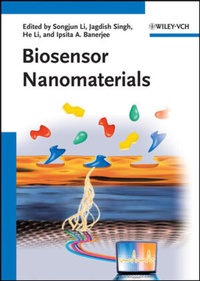
Biosensor Nanomaterials
1st Edition
Published on 28. February 2011
XVIII, 278 pages
978-3-527-63517-7 (ISBN)
Description

Biosensors are devices that detect the presence of microbials such as bacteria, viruses or a range biomolecules, including proteins, enzymes, DNA and RNA. For example, they are routinely applied for monitoring the glucose concentration in blood, quality analysis of fresh and waste water and for food control. Nanomaterials are ideal candidates for building sensor devces: where in just a few molecules can alter the properties so drastically that these changes may be easily detected by optical, electrical or chemical means. Recent advantages have radically increased the sensitivity of nanomaterial-based biosensors, making it possible to detect one particular molecule against a background of billions of others.
Focusing on the materials suitable for biosensor applications, such as nanoparticles, quantum dots, meso- and nanoporous materials and nanotbues, this text enables the reader to prepare the respective nanomaterials for use in actual devices by appropriate functionalization, surface processing or directed self-assembly. The emphasis throughout is on electrochemical, optical and mechancial detection methods, leading to solutions for today's most challenging tasks.
The result is a reference for researchers and developers, disseminating first-hand information on which nanomaterial is best suited to a particular application - and why.
Focusing on the materials suitable for biosensor applications, such as nanoparticles, quantum dots, meso- and nanoporous materials and nanotbues, this text enables the reader to prepare the respective nanomaterials for use in actual devices by appropriate functionalization, surface processing or directed self-assembly. The emphasis throughout is on electrochemical, optical and mechancial detection methods, leading to solutions for today's most challenging tasks.
The result is a reference for researchers and developers, disseminating first-hand information on which nanomaterial is best suited to a particular application - and why.
More details
Other editions
Additional editions
Songjun Li | Jagdish Singh | He Li
Biosensor Nanomaterials
Book
02/2011
Wiley-VCH
€155.00
Article exhausted; check different version
Persons
Dr. Songjun Li currently serves as president of the International Association of Advanced Materials and Editor-in-Chief of the international Journal Advanced Materials Letters. He is also Chair of the 1st International Congress on Advanced Materials, 13-16 May 2011, Jinan, China. Since his PhD in polymer chemistry, received from Chinese Academy of Sciences, his scientific interests focus on the chemistry of biosensors and molecularly imprinted polymers. Dr. Li was appointed by the Central China Normal University as an associate professor of chemistry in 2005. He was further appointed as an invited professor by the University of Jinan (China) in 2009 and a part-time professor by Jiangsu University in 2010. He is currently the specially appointed professor in the University of Allahabad (India).
Jagdish Singh is Professor and Chair of the Department of Pharmaceutical Sciences at NDSU College of Pharmacy, North Dakota, USA, and Fellow of the American Association of Pharmaceutical Scientists (AAPS). His research efforts focus on the mechanistic studies for developing and testing novel methods to deliver biotechnology-derived molecules. Jagdish Singh received twice the NDSU College of Pharmacy Researcher of the Year awards and was recognized with the Fred Waldron Research Award in 2002 in recognition of his outstanding contributions to research and creative activities at NDSU.
Dr. He Li, associated editor for Advanced Materials Letters, is an associate Professor of Chemistry in the School of Medical and Life Sciences at University of Jinan (UJN), China. He got his PhD degree in 2004 in Chengdu Institute of Organic Chemistry, Chinese Academy of Sciences. Subsequently, he was appointed by UJN as an associate professor with research interests in biosensor and nanomedicine. He worked as the dean of Pharmaceutical Engineering Department of UJN since 2007.
Ipsita A. Banerjee is an Associate Professor of Chemistry at Fordham University, New York, USA. She did her Ph.D in Chemistry from the University of Connecticut, USA and Postdoctoral research from the University of Notre Dame, South Bend, Indiana and from Hunter College, City University of New York in Bionanotechnology. Her research efforts are geared toward the study of molecular self-assembly and formation of supramolecular nanostructures for the development of biomaterials for tissue-engineering, and biosensors particularly for examining cellular interactions in vitro. Efforts are also on going for the green-synthesis of nanoparticles for optoelectronics applications.
Jagdish Singh is Professor and Chair of the Department of Pharmaceutical Sciences at NDSU College of Pharmacy, North Dakota, USA, and Fellow of the American Association of Pharmaceutical Scientists (AAPS). His research efforts focus on the mechanistic studies for developing and testing novel methods to deliver biotechnology-derived molecules. Jagdish Singh received twice the NDSU College of Pharmacy Researcher of the Year awards and was recognized with the Fred Waldron Research Award in 2002 in recognition of his outstanding contributions to research and creative activities at NDSU.
Dr. He Li, associated editor for Advanced Materials Letters, is an associate Professor of Chemistry in the School of Medical and Life Sciences at University of Jinan (UJN), China. He got his PhD degree in 2004 in Chengdu Institute of Organic Chemistry, Chinese Academy of Sciences. Subsequently, he was appointed by UJN as an associate professor with research interests in biosensor and nanomedicine. He worked as the dean of Pharmaceutical Engineering Department of UJN since 2007.
Ipsita A. Banerjee is an Associate Professor of Chemistry at Fordham University, New York, USA. She did her Ph.D in Chemistry from the University of Connecticut, USA and Postdoctoral research from the University of Notre Dame, South Bend, Indiana and from Hunter College, City University of New York in Bionanotechnology. Her research efforts are geared toward the study of molecular self-assembly and formation of supramolecular nanostructures for the development of biomaterials for tissue-engineering, and biosensors particularly for examining cellular interactions in vitro. Efforts are also on going for the green-synthesis of nanoparticles for optoelectronics applications.
Content
Preface
NEW MICRO- AND NANOTECHNOLOGIES FOR ELECTROCHEMICAL BIOSENSOR DEVELOPMENT
Introduction
Carbon Nanotubes
Conductive Polymer Nanostructures
Nanoparticles
Conclusions
ADVANCED NANOPARTICLES IN MEDICAL BIOSENSORS
Introduction
Nanoparticles
Conclusions and Outlook
SMART POLYMERIC NANOFIBERS RESOLVING BIORECOGNITION ISSUES
Introduction
Nanofibers
Electrospinning of Nanofibers
Biorecognition Devices
Conclusions
FABRICATION AND EVALUATION OF NANOPARTICLE-BASED BIOSENSRS
Introduction
Nanoparticle-Based Biosensors and their Fabrication
Evaluation of Nanoparticle-Based Nanosensors
Applications of Nanoparticle-Based Biosensors
Conclusions
ENZYME-BASED BIOSENSORS: SYNTHESIS AND APPLICATIONS
Introduction
Synthesis and Characterization of Biosensor Supports
Aplication of Enzyme-Based Biosensors
Conclusions
ENERGY HARVESTING FOR BIOSENSORS USING BIOFRIENDLY MATERIALS
Introduction
Energy Production and Consumption
Classification of Energy-Harvesting Devices
Conclusions
CARBON NANOTUBES: IN VITRO AND IN VIVO SENSING AND IMAGING
Introduction
Carbon Nanotubes: Structure, Physical and Chemical Properties, and Applications
Near-IR Absorption of Carbon Nanotubes
Near-IR Photoluminescence of Single-Walled Carbon Nanotubes
Raman Scattering of Carbon Nanotubes
Conclusions and Outlook
LIPID NANOPARTICLE-MEDIATED DETECTION OF PROTEINS
Introduction to Liposomes
Saturated Liposomes
Polymerized Liposomes
Conclusions
NANOMATERIALS FOR OPTICAL IMAGING
Introduction
Doped Nanoparticles
Conclusions and Outlook
SEMICONDUCTOR QUANTUM DOTS FOR ELECTROCHEMICAL BIOSENSORS
Introduction
Attachment of Biomolecules to Quantum Dots
Quantum Dot-Based Redox Proteins Biosensor
Quantum Dot-Based Electrochemical Biosensors of Proteins and DNA
Conclusions
FUNCTIONALIZED GRAPHENE FOR BIOSENSING APPLICATIONS
Introduction
Preparation of Graphene
Functionalized Graphene with Metal Nanoparticles
Glucose Biosensors Based on Graphene
Immunosensors Based on Graphene
Other Electrochemical Biosensors Based on Graphene
Conclusions
CURRENT FRONTIERS IN ELECTROCHEMICAL BIOSENSORS USING CHITOSAN NANOCOMPOSITES
Introduction
Chitosan
Chitosan Nanocomposite-Based Electrochemical Biosensors
Chitosan Nanocomposite-Based Amperometric Biosensors
Chitosan Nanocomposite-Based Potentiometric Biosensors
Chitosan Nanocomposite-Based Conductimetric Biosensors
Conclusions and Future Aspects
NANOMATERIALS AS PROMISING DNA BIOSENSORS
Introduction
Nanomaterials as Single Amplifiers for Hybridization
Conclusions
NANOCOMPOSITES AND THEIR BIOSENSOR APPLICATIONS
Introduction
Nanocomposites
Biosensors
Types of Biosensors
Biosensors Applications
Nanocomposites for Biosensor Applications
Conclusions
NEW MICRO- AND NANOTECHNOLOGIES FOR ELECTROCHEMICAL BIOSENSOR DEVELOPMENT
Introduction
Carbon Nanotubes
Conductive Polymer Nanostructures
Nanoparticles
Conclusions
ADVANCED NANOPARTICLES IN MEDICAL BIOSENSORS
Introduction
Nanoparticles
Conclusions and Outlook
SMART POLYMERIC NANOFIBERS RESOLVING BIORECOGNITION ISSUES
Introduction
Nanofibers
Electrospinning of Nanofibers
Biorecognition Devices
Conclusions
FABRICATION AND EVALUATION OF NANOPARTICLE-BASED BIOSENSRS
Introduction
Nanoparticle-Based Biosensors and their Fabrication
Evaluation of Nanoparticle-Based Nanosensors
Applications of Nanoparticle-Based Biosensors
Conclusions
ENZYME-BASED BIOSENSORS: SYNTHESIS AND APPLICATIONS
Introduction
Synthesis and Characterization of Biosensor Supports
Aplication of Enzyme-Based Biosensors
Conclusions
ENERGY HARVESTING FOR BIOSENSORS USING BIOFRIENDLY MATERIALS
Introduction
Energy Production and Consumption
Classification of Energy-Harvesting Devices
Conclusions
CARBON NANOTUBES: IN VITRO AND IN VIVO SENSING AND IMAGING
Introduction
Carbon Nanotubes: Structure, Physical and Chemical Properties, and Applications
Near-IR Absorption of Carbon Nanotubes
Near-IR Photoluminescence of Single-Walled Carbon Nanotubes
Raman Scattering of Carbon Nanotubes
Conclusions and Outlook
LIPID NANOPARTICLE-MEDIATED DETECTION OF PROTEINS
Introduction to Liposomes
Saturated Liposomes
Polymerized Liposomes
Conclusions
NANOMATERIALS FOR OPTICAL IMAGING
Introduction
Doped Nanoparticles
Conclusions and Outlook
SEMICONDUCTOR QUANTUM DOTS FOR ELECTROCHEMICAL BIOSENSORS
Introduction
Attachment of Biomolecules to Quantum Dots
Quantum Dot-Based Redox Proteins Biosensor
Quantum Dot-Based Electrochemical Biosensors of Proteins and DNA
Conclusions
FUNCTIONALIZED GRAPHENE FOR BIOSENSING APPLICATIONS
Introduction
Preparation of Graphene
Functionalized Graphene with Metal Nanoparticles
Glucose Biosensors Based on Graphene
Immunosensors Based on Graphene
Other Electrochemical Biosensors Based on Graphene
Conclusions
CURRENT FRONTIERS IN ELECTROCHEMICAL BIOSENSORS USING CHITOSAN NANOCOMPOSITES
Introduction
Chitosan
Chitosan Nanocomposite-Based Electrochemical Biosensors
Chitosan Nanocomposite-Based Amperometric Biosensors
Chitosan Nanocomposite-Based Potentiometric Biosensors
Chitosan Nanocomposite-Based Conductimetric Biosensors
Conclusions and Future Aspects
NANOMATERIALS AS PROMISING DNA BIOSENSORS
Introduction
Nanomaterials as Single Amplifiers for Hybridization
Conclusions
NANOCOMPOSITES AND THEIR BIOSENSOR APPLICATIONS
Introduction
Nanocomposites
Biosensors
Types of Biosensors
Biosensors Applications
Nanocomposites for Biosensor Applications
Conclusions
