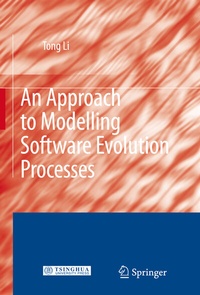
An Approach to Modelling Software Evolution Processes
Description

An Approach to Modelling Software Evolution Processes describes formal software processes that effectively support software evolution. The importance and popularity of software evolution increase as more and more successful software systems become legacy systems. For one thing, software evolution has become an important characteristic in the software life cycle; for another, software processes play an important role in increasing efficiency and quality of software evolution. Therefore, the software evolution process, the inter-discipline of software process and software evolution, becomes a key area in software engineering.
The book is intended for software engineers and researchers in computer science.
Prof. Tong Li earned his Ph.D. in Software Engineering at De Montfort University, U.K.; he has published five monographs and over one hundred papers.
Reviews / Votes
From the reviews:
"This book is based on the author's Ph.D. thesis accomplished in February 2007 at De Montfort University, UK. It aims to model and describe formal software processes that effectively support software evolution. . The book is intended for software engineers and researchers in computer science who are interested in evolution of software processes." (G. Bauer, Zentralblatt MATH, Vol. 1161, 2009)
More details
Other editions
Additional editions