

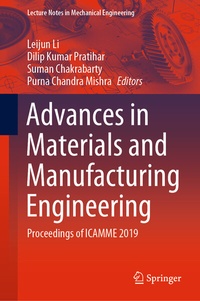
Advances in Materials and Manufacturing Engineering
Description

This book gathers outstanding papers presented at the International Conference on Advances in Materials and Manufacturing Engineering (ICAMME 2019), held at KIIT Deemed to be University, Bhubaneswar, India, from 15 to 17 March 2019. It covers theoretical and empirical developments in various areas of mechanical engineering, including manufacturing, production, machine design, fluid/thermal engineering, and materials.
More details
Other editions
Additional editions
Persons
Leijun Li received his B.S. degree in Welding Engineering from Huazhong University of Science and Technology, China and his M.S. degree in Mechanical Engineering from Xi'an Jiaotong University, China. He subsequently completed his Ph.D. in Materials Engineering at the Warren "Doc" Savage Materials Joining Lab at Rensselaer Polytechnic Institute (RPI). His Materials Processing and Testing Lab has become a respected research group in the United States. In 2013, he relocated from Utah to Alberta and took up his present position at the University of Alberta.
Dilip Kumar Pratihar completed his B.E. (Hons.) and M.Tech. in Mechanical Engineering at the REC Durgapur in 1988 and 1995, respectively. Presently, he is a Professor at the IIT Kharagpur, India. His research interests include robotics, soft computing, and manufacturing science. He has made significant contributions to the development of intelligent autonomous systems in various fields, including robotics and manufacturing science. He has published more than 200 papers, and serves on the editorial boards of 12 international journals. He is also a member of the expert committee on Advanced Manufacturing Technology, DST, Government of India.
Suman Chakraborty is Associate Dean of SIRC, a Professor of Mechanical Engineering, and the Head of Medical Science and Technology at the IIT Kharagpur. His research interests include microfluidics and nanofluidics, interfacial phenomena and phase changes, and computational fluid dynamics. He received the Shanti Swaroop Bhatnagar Prize in 2013, INAE Chair Professorship in 2014, and the K.N. Seetharamu Medal and Prize from the Indian Society of Heat and Mass Transfer in 2011. He is a member of many academic and professional bodies, including the ASME, ISHMT, and APS. He serves on the editorial boards of various journals, and has published many papers in international journals and conference proceedings.
Purna Chandra Mishra is a Professor and Dean (Research) of the School of Mechanical Engineering, Kalinga Institute of Industrial Technology, India. He received his B.E. in Mechanical Engineering from Berhampur University in 2001, and his M.E. and Ph.D. in Engineering from Jadavpur University, Kolkata, in 2006 and 2011, respectively. He is a member of many professional and academic bodies, and author of the book "Heat and Mass Transfer," as well as numerous book chapters and papers in international journals and conference proceedings. In addition, he holds more than 10 Indian and international patents.
