

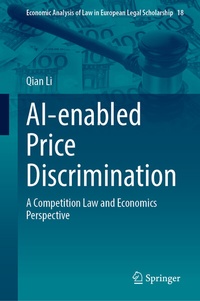
AI-enabled Price Discrimination
Description

This book addresses the question of how to tackle AI-enabled price discrimination (AIPD), which is commonly used in digital markets and can negatively impact competition and consumers. It explores the economic rationale behind AIPD, compares its assessment under EU and Chinese competition law and beyond, evaluates current legal regimes on AIPD from a comparative law and economics perspective, and provides policy recommendations to those jurisdictions for approaching AIPD as an infringement of competition law and beyond.
Since the protection of free competition and consumer welfare are objectives of competition law in both the EU and China, two major jurisdictions, there seems to be a legal basis for competition law intervention. This book offers competition authorities guidance on how to tackle anticompetitive AIPD. Given that AIPD takes place in competitive and monopolistic markets, competition law alone is inadequate to fully address the potential concerns. This book, therefore, also examines other possibilities. Legislation on data protection, consumer protection and business regulation can contribute to tackling AIPD in different phases: (1) collection and processing of consumer data, (2) prediction of the consumer's willingness to pay, and (3) application of discriminatory pricing in digital markets. As such, this work also offers insights to help the relevant authorities (i.e., those responsible for data protection, consumer protection and business regulation) tackle welfare-reducing AIPD in digital markets.
This book will be of interest to academics, practitioners, policymakers, enforcers and consumers. It offers theoretical guidance for the relevant authorities (such as competition agencies, courts and regulators), practitioners and consumers, helping them understand the economic rationale behind AIPD, and provides suggestions to tackle anticompetitive and welfare-reducing AIPD in digital markets from a comparative law and economics perspective.
More details
Other editions
Additional editions
Person
Dr. Qian Li is a postdoctoral researcher at the Faculty of Law of Maastricht University, where she is a member of the Law & Tech Lab and an affiliated researcher at the research institute METRO. Her primary research fields are competition law, AI regulation and digital governance.
Content
The Economics of AI-enabled Price Discrimination.- Regulation of Price Discrimination in Chinese Competition Law.- Regulation of Price Discrimination in the EU Competition Law.- Assessment of AI-enabled Price Discrimination under Competition-Related Rules in China.- Assessment of AI-enabled Price Discrimination under Competition-Related Rules in the EU.- A Comparative Analysis of Legal Regimes to Tackle Anti-competitive AIPD in the EU and China.- Policy Suggestions to Tackle Anticompetitive AIPD in the EU and China.
