

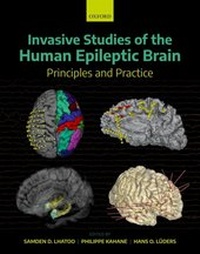
Invasive Studies of the Human Epileptic Brain
Principles and Practice
1st Edition
Published on 8. November 2018
592 pages
978-0-19-102408-5 (ISBN)
Description

No other neurological condition allows the same opportunities for an intracranial electrophysiological study of the human brain as epilepsy does. Epileptic surgery is designed to remove the epileptic focus from the human brain, thereby effecting either cure or substantial reduction of seizures in an individual with an otherwise intractable condition. Its use as a treatment modality dates from the late 19th century, and it has become a widely used treatment option throughout the world in the last 20-30 years. The complexity of epilepsy cases in surgical centres, and the need for invasive electrode studies for pre-surgical evaluation, are both greatly increasing.
Invasive Studies of the Human Epileptic Brain is the definitive reference text on the use of invasive electroencephalographic (EEG) diagnostic studies in human epilepsy. Written by some of the most renowned epilepsy experts of the 20th and 21st centuries, the authors provide their expertise and insights into the identification and mapping of intracranial epileptiform and non-epileptiform activity, mapping of the human brain function, and approaches in the use of invasive electroencephalography in a variety of clinical situations.
The book is organized into an easily readable series of chapters and is brilliantly illustrated with case studies; each providing an intuitively comprehensive approach to invasive brain studies.
More details
Other editions
Additional editions
Samden D. Lhatoo | Philippe Kahane | Hans O. Lueders
Invasive Studies of the Human Epileptic Brain
Principles and Practice
Book
11/2018
Oxford University Press
€324.98
Article exhausted; check different version
Persons
Samden D. Lhatoo is Professor of Neurology, and Dorothy Blair and Robert Daroff Chair in Neurology, in the Department of Neurology, UH Case Medical Center, Cleveland, OH, USA.
Philippe Kahane is Director of the Unit for Epilepsy and Neurological Diseases at the Neurology and Psychiatry Department, Grenoble University Hospital, Grenoble, France.
Hans O. Lüders is a Professor of Neurology in the Department of Neurology, UH Case Medical Center, Cleveland, OH, USA.
Content
- Section 1: General overview
- 1: Hans O. Lüders: History of invasive EEG
- 2: Samden D. Lhatoo, Nuria Lacuey, and Philippe Ryvlin: Principles of invasive EEG
- 3: Gholam K. Motamedi, Jean Gotman, and Ronald P. Lesser: Technical and practical aspects of invasive recordings and brain stimulation
- 4: Robert A. McGovern and Guy M. McKhann II: Subdural grid electrode placement: Approaches and complications
- 5: Thomas Ostergard and Jonathan P. Miller: Depth electrodes: Approaches and complications
- Section 2: Identifying and mapping epileptiform and non-epileptiform activity
- 6: Birgit Frauscher and François Dubeau: Physiological activity and artifacts in the human epileptic brain studied with intracerebral depth electrodes EEG
- 7: Beate Diehl and Catherine A. Scott: Physiological activity and artefacts in epileptic brain in subdural EEG
- 8: Sebastian Bauer and Felix Rosenow: The irritative zone and seizure onset zone in subdural EEG
- 9: Fabrice Bartolomei: The irritative, epileptogenic and ictal onset zones in depth EEG
- 10: André Palmini and Eliseu Paglioli: The irritative zone and seizure onset zone in acute ECoG: The quest for relevant epileptogenic tissue
- 11: Julia Jacobs: High frequency oscillations (HFO)
- 12: Shasha Wu, Vernon L. Towle, Jonathan P. Miller, and Hans O. Lüders: Direct current shift recordings
- 13: Patrick Landazuri and Lorella Minotti: Electrical stimulation for the mapping of the epileptogenic zone
- 14: Jerome Engel, Jr., Richard Staba, and Itzhak Fried: Invasive EEG and hippocampal sclerosis
- 15: Laura Tassi and Roberto Mai: Invasive EEG in cortical dysplasia
- 16: Francine Chassoux, Elisabeth Landré, and Bertrand Devaux: Invasive EEG in tumoral epilepsy
- 17: A. Simon Harvey: Invasive EEG in tuberous sclerosis
- 18: Roberto Mai and Laura Tassi: Invasive EEG in gray matter heterotopia
- 19: Louis Maillard and Georgia Ramantani: SEEG in polymicrogyria: When and how?
- 20: Julia Scholly, Fabrice Bartolomei, and Edouard Hirsch: Invasive EEG in hypothalamic hamartoma
- Section 3: Invasive EEG approaches in specific clinical situations
- 21: Anne-Sophie Job-Chapron, Lorella Minotti, Dominique Hoffmann, and Philippe Kahane: SEEG in temporal lobe epilepsy
- 22: Stephan U. Schuele: Subdural EEG in temporal lobe epilepsy
- 23: Aileen McGonigal and Patrick Chauvel: SEEG in frontal lobe epilepsy
- 24: Akio Ikeda: Subdural EEG in frontal lobe epilepsy
- 25: Stefano Francione, Alexandra Liava, and Francesco Cardinale: SEEG in the posterior cortex epilepsies
- 26: Americo C. Sakamoto, Tonicarlo R. Velasco, and Jorge Gonzalez-Martinez: Subdural EEG in posterior cortex epilepsy
- 27: Philippe Ryvlin and Fabienne Picard: Invasive EEG investigation of the insula
- 28: Bertrand Devaux, Francine Chassoux, Elisabeth Landré, and Baris Turak: Depth EEG in sensorimotor cortex epilepsy
- 29: Jonathan Edwards, Ekrem Kutluay, and William A. Vandergrift: Invasive studies of sensory motor cortex epilepsy
- Section 4: Human brain mapping
- 30: Stephanie Gollwitzer and Hajo M. Hamer: Human brain mapping using subdural electrodes
- 31: Milan Brázdil, Pavel Jurák, and Ivan Rektor: Intracranial event-related potentials
- 32: Riki Matsumoto and Takeharu Kunieda: Cortico-cortical evoked potential mapping
- 33: Jean-Philippe Lachaux: Dynamic spectral imaging: Online and offline functional brain mapping using high-frequency activity [50 Hz - 150 Hz] in SEEG
- Section 5: Therapy using invasive EEG
- 34: Marc Guénot and Pierre Bourdillon: Thermocoagulation of the ictal onset zone using SEEG (thermo-SEEG)
- 35: Mathieu Sprengers, Sofie Carrette, Kristl Vonck, and Paul Boon: Therapeutic stimulation of the ictal onset zone
- Section 6: Special techniques and future prospects
- 36: Michal T. Kucewicz, B. Michael Berry, and Gregory A. Worrell: Simultaneous macro- and micro-recordings
- 37: Michelle L. Humeiden, Jorge E. Quintero, John T. Slevin, and Greg A. Gerhardt: Fast analytical sensing technology: Microelectrode-based recordings of tonic and phasic neurotransmitter signaling in the mamalian brain
- 38: Olivier David: Mapping of seizure networks
- 39: Fabrice Wendling, Pascal Benquet, and Fabrice Bartolomei: SEEG recordings: From signal processing to models of epileptogenic networks
