

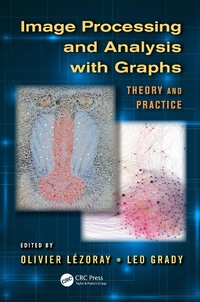
Image Processing and Analysis with Graphs
Theory and Practice
Published on 12. July 2017
570 pages
978-1-4398-5508-9 (ISBN)
Description

Covering the theoretical aspects of image processing and analysis through the use of graphs in the representation and analysis of objects, Image Processing and Analysis with Graphs: Theory and Practice also demonstrates how these concepts are indispensible for the design of cutting-edge solutions for real-world applications.
Explores new applications in computational photography, image and video processing, computer graphics, recognition, medical and biomedical imaging
With the explosive growth in image production, in everything from digital photographs to medical scans, there has been a drastic increase in the number of applications based on digital images. This book explores how graphs-which are suitable to represent any discrete data by modeling neighborhood relationships-have emerged as the perfect unified tool to represent, process, and analyze images. It also explains why graphs are ideal for defining graph-theoretical algorithms that enable the processing of functions, making it possible to draw on the rich literature of combinatorial optimization to produce highly efficient solutions.
Some key subjects covered in the book include:
Definition of graph-theoretical algorithms that enable denoising and image enhancement
Energy minimization and modeling of pixel-labeling problems with graph cuts and Markov Random Fields
Image processing with graphs: targeted segmentation, partial differential equations, mathematical morphology, and wavelets
Analysis of the similarity between objects with graph matching
Adaptation and use of graph-theoretical algorithms for specific imaging applications in computational photography, computer vision, and medical and biomedical imaging
Use of graphs has become very influential in computer science and has led to many applications in denoising, enhancement, restoration, and object extraction. Accounting for the wide variety of problems being solved with graphs in image processing and computer vision, this book is a contributed volume of chapters written by renowned experts who address specific techniques or applications. This state-of-the-art overview provides application examples that illustrate practical application of theoretical algorithms. Useful as a support for graduate courses in image processing and computer vision, it is also perfect as a reference for practicing engineers working on development and implementation of image processing and analysis algorithms.
Explores new applications in computational photography, image and video processing, computer graphics, recognition, medical and biomedical imaging
With the explosive growth in image production, in everything from digital photographs to medical scans, there has been a drastic increase in the number of applications based on digital images. This book explores how graphs-which are suitable to represent any discrete data by modeling neighborhood relationships-have emerged as the perfect unified tool to represent, process, and analyze images. It also explains why graphs are ideal for defining graph-theoretical algorithms that enable the processing of functions, making it possible to draw on the rich literature of combinatorial optimization to produce highly efficient solutions.
Some key subjects covered in the book include:
Definition of graph-theoretical algorithms that enable denoising and image enhancement
Energy minimization and modeling of pixel-labeling problems with graph cuts and Markov Random Fields
Image processing with graphs: targeted segmentation, partial differential equations, mathematical morphology, and wavelets
Analysis of the similarity between objects with graph matching
Adaptation and use of graph-theoretical algorithms for specific imaging applications in computational photography, computer vision, and medical and biomedical imaging
Use of graphs has become very influential in computer science and has led to many applications in denoising, enhancement, restoration, and object extraction. Accounting for the wide variety of problems being solved with graphs in image processing and computer vision, this book is a contributed volume of chapters written by renowned experts who address specific techniques or applications. This state-of-the-art overview provides application examples that illustrate practical application of theoretical algorithms. Useful as a support for graduate courses in image processing and computer vision, it is also perfect as a reference for practicing engineers working on development and implementation of image processing and analysis algorithms.
More details
Series
Language
English
Place of publication
Baton Rouge
United States
Publishing group
Taylor & Francis Inc
Target group
College/higher education
Academia, industrial engineers, managers, researchers, and designers.
Illustrations
169 s/w Abbildungen, 16 farbige Abbildungen, 12 s/w Tabellen
12 Tables, black and white; 16 Illustrations, color; 169 Illustrations, black and white
File size
45,87 MB
ISBN-13
978-1-4398-5508-9 (9781439855089)
Copyright in bibliographic data and cover images is held by Nielsen Book Services Limited or by the publishers or by their respective licensors: all rights reserved.
Schweitzer Classification
Other editions
Additional editions
Book
03/2017
1st Edition
CRC Press
€172.20
Shipment within 10-20 days
Book
07/2012
1st Edition
CRC Press
€272.36
Shipment within 15-20 days
Persons
Olivier Lezoray received his B.Sc. in mathematics and computer science, as well as his M.Sc. and Ph.D. degrees from the Department of Computer Science, University of Caen, France, in 1992, 1996, and 2000, respectively. From September 1999 to August 2000, he was an assistant professor with the Department of Computer Science at the University of Caen. From September 2000 to August 2009, he was an associate professor at the Cherbourg Institute of Technology of the University of Caen, in the Communication Networks and Services Department. In July 2008, he was a visiting research fellow at the University of Sydney, Australia. Since September 2009, he has been a full professor at the Cherbourg Institute of Technology of the University of Caen, in the Communication Networks and Services Department. He also serves as Chair of the Institute Research Committee. In 2011 he cofounded Datexim and is a member of the scientific board of the company, which brought state-of-art image and data processing to market with applications in digital pathology. His research focuses on discrete models on graphs for image processing and analysis, image data classification by machine learning, and computer-aided diagnosis.
Leo Grady received his B.Sc. degree in electrical engineering from the University of Vermont in 1999 and a Ph.D. degree from the Cognitive and Neural Systems Department at Boston University in 2003. Dr. Grady was with Siemens Corporate Research in Princeton, where he worked as a Principal Research Scientist in the Image Analytics and Informatics division. He recently left Siemens to become Vice President of R&D at HeartFlow. The focus of his research has been on the modeling of images and other data with graphs. These graph models have generated the development and application of tools from discrete calculus, combinatorial/continuous optimization, and network analytics to perform analysis and synthesis of the images/data. The primary applications of his work have been in computer vision and biomedical applications. Dr. Grady currently holds 30 granted patents with more than 40 additional patents currently under review. He has also contributed to more than 20 Siemens products that target biomedical applications and are used in medical centers worldwide.
Leo Grady received his B.Sc. degree in electrical engineering from the University of Vermont in 1999 and a Ph.D. degree from the Cognitive and Neural Systems Department at Boston University in 2003. Dr. Grady was with Siemens Corporate Research in Princeton, where he worked as a Principal Research Scientist in the Image Analytics and Informatics division. He recently left Siemens to become Vice President of R&D at HeartFlow. The focus of his research has been on the modeling of images and other data with graphs. These graph models have generated the development and application of tools from discrete calculus, combinatorial/continuous optimization, and network analytics to perform analysis and synthesis of the images/data. The primary applications of his work have been in computer vision and biomedical applications. Dr. Grady currently holds 30 granted patents with more than 40 additional patents currently under review. He has also contributed to more than 20 Siemens products that target biomedical applications and are used in medical centers worldwide.
Content
Graph Theory Concepts and Definitions Used in Image Processing and Analysis. Graph Cuts-Combinatorial Optimization in Vision. Higher-Order Models in Computer Vision. A Parametric Maximum Flow Approach for Discrete Total Variation Regularization. Targeted Image Segmentation Using Graph Methods. A Short Tour of Mathematical Morphology on Edge and Vertex Weighted Graphs. Partial Difference Equations on Graphs for Local and Nonlocal Image Processing. Image Denoising with Nonlocal Spectral Graph Wavelets. Image and Video Matting. Optimal Simultaneous Multisurface and Multiobject Image Segmentation. Hierarchical Graph Encodings. Graph-Based Dimensionality Reduction. Graph Edit Distance-Theory, Algorithms, and Applications. The Role of Graphs in Matching Shapes and in Categorization. 3D Shape Registration Using Spectral Graph Embedding and Probabilistic Matching. Modeling Images with Undirected Graphical Models. Tree-Walk Kernels for Computer Vision.
