

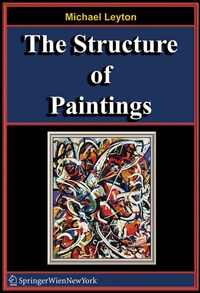
The Structure of Paintings
Description

Michael Leyton has developed new foundations for geometry in which shape is equivalent to memory storage. A principal argument of these foundations is that artworks are maximal memory stores. The theory of geometry is developed from Leyton's fundamental laws of memory storage, and this book shows that these laws determine the structure of paintings. Furthermore, the book demonstrates that the emotion expressed by a painting is actually the memory extracted by the laws. Therefore, the laws of memory storage allow the systematic and rigorous mapping not only of the compositional structure of a painting, but also of its emotional expression. The argument is supported by detailed analyses of paintings by Picasso, Raphael, Cezanne, Gauguin, Modigliani, Ingres, De Kooning, Memling, Balthus and Holbein.
More details
Other editions
Additional editions
Person
Michael Leyton's mathematical work on shape has been used by scientists in over 40 disciplines from chemical engineering to meteorology. His scientific contributions have received major prizes, such as a presidential award and a medal for scientific achievement. His new foundations to geometry are elaborated in his books in Springer-Verlag and MIT Press. Besides his scientific and mathematical work, he is also a highly exhibited painter and sculptor, and his architecture designs have been published by Birkhauser-Architectural. Also he is the composer of published string quartets. He is president of the International Society for Mathematical and Computational Aesthetics, and is on the faculty of the Psychology Department and the DIMACS Center for Discrete Mathematics and Theoretical Computer Science at Rutgers.
