

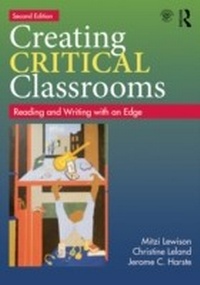
Creating Critical Classrooms
Reading and Writing with an Edge
2nd Edition
Published on 7. August 2014
322 pages
978-1-317-81491-7 (ISBN)
Description

This popular text articulates a powerful theory of critical literacy-in all its complexity. Critical literacy practices encourage students to use language to question the everyday world, interrogate the relationship between language and power, analyze popular culture and media, understand how power relationships are socially constructed, and consider actions that can be taken to promote social justice. By providing both a model for critical literacy instruction and many examples of how critical practices can be enacted in daily school life in elementary and middle school classrooms, Creating Critical Classrooms meets a huge need for a practical, theoretically based text on this topic.
Pedagogical features in each chapter
* Teacher-researcher Vignette
* Theories that Inform Practice
* Critical Literacy Chart
* Thought Piece
* Invitations for Disruption
* Lingering Questions
New in the Second Edition
* End-of-chapter "Voices from the Field"
* More upper elementary-grade examples
* New text sets drawn from "Classroom Resources"
* Streamlined, restructured, revised, and updated throughout
* Expanded Companion Website now includes annotated Classroom Resources; Text Sets; Resources by Chapter; Invitations for Students; Literacy Strategies; Additional Resources
Pedagogical features in each chapter
* Teacher-researcher Vignette
* Theories that Inform Practice
* Critical Literacy Chart
* Thought Piece
* Invitations for Disruption
* Lingering Questions
New in the Second Edition
* End-of-chapter "Voices from the Field"
* More upper elementary-grade examples
* New text sets drawn from "Classroom Resources"
* Streamlined, restructured, revised, and updated throughout
* Expanded Companion Website now includes annotated Classroom Resources; Text Sets; Resources by Chapter; Invitations for Students; Literacy Strategies; Additional Resources
Reviews / Votes
"Creating Critical Classrooms is one of those rare finds. It has the perfect balance of theory-in ways that preservice teachers can understand-along with real ways to "do" theory in classrooms with children."Lisa Scherff, Florida State University, USA
"As immorality and insanity continue to permeate the world of education, and the world in general, Creating Critical Classrooms will become an increasingly vital and crucial text in helping learners, teachers, and citizens understand and analyze the material forces at work in society while also connecting that intellectual work to the much needed interventions required to carry out positive structural transformations on pathways toward creating more humanized and humanizing systems and institutions...before it is too late."
Doug Morris, Eastern New Mexico University, USA
More details
Edition
2nd edition
Language
English
Place of publication
London
United Kingdom
Publishing group
Taylor & Francis Ltd
Target group
College/higher education
Edition type
Revised edition
Illustrations
35 s/w Tabellen
35 Tables, black and white
File size
6,02 MB
ISBN-13
978-1-317-81491-7 (9781317814917)
Copyright in bibliographic data and cover images is held by Nielsen Book Services Limited or by the publishers or by their respective licensors: all rights reserved.
Schweitzer Classification
Other editions
Additional editions
Mitzi Lewison | Christine Leland | Jerome C. Harste
Creating Critical Classrooms
Reading and Writing with an Edge
Book
08/2014
2nd Edition
Routledge
€250.70
Shipment within 15-20 days
Mitzi Lewison | Christine Leland | Jerome C. Harste
Creating Critical Classrooms
Reading and Writing with an Edge
Book
08/2014
2nd Edition
Routledge
€104.00
Shipment within 15-20 days
Persons
Mitzi Lewison is Professor of Literacy, Culture, and Language Education in the School of Education at Indiana University-Bloomington, USA.
Christine Leland is Professor of Literacy, Culture, and Language Education in the School of Education at Indiana University-Purdue University, USA.
Jerome C. Harste is Professor Emeritus of the Department of Literacy, Language, and Culture, Indiana University-Bloomington, USA, where he held the distinction of being the first Armstrong Professor in Teacher Education.
Christine Leland is Professor of Literacy, Culture, and Language Education in the School of Education at Indiana University-Purdue University, USA.
Jerome C. Harste is Professor Emeritus of the Department of Literacy, Language, and Culture, Indiana University-Bloomington, USA, where he held the distinction of being the first Armstrong Professor in Teacher Education.
Content
Brief ContentsForeword / Linda Christensen
Introduction
Chapter One / Overview: Why Do We Need an Instructional Theory of Critical Literacy?
Chapter Two / Personal and Cultural Resources: Using Life Experiences as an Entree into Critical Literacy
Chapter Three / Cultural Resources: Using Popular Culture to Promote Critical Practice
Chapter Four / Cultural Resources: Using Children's and Young Adult Literature to Get Started with Critical Literacy
Chapter Five / Critical Social Practices: Disrupting the Commonplace through Critical Language Study
Chapter Six / Critical Social Practices: Interrogating Multiple Perspectives
Chapter Seven / Critical Social Practices: Focusing on the Sociopolitical
Chapter Eight / Critical Social Practices: Taking Action to Promote Social Justice
Chapter Nine / Taking a Critical Stance: Outgrowing Ourselves
Chapter Ten / Invitations for Students
Classroom Resources: Children's Books, Videos, Songs, and Websites
Appendix: Creating Critical Classrooms Companion Website Contents
About the Authors
References
Index
Introduction
Chapter One / Overview: Why Do We Need an Instructional Theory of Critical Literacy?
Chapter Two / Personal and Cultural Resources: Using Life Experiences as an Entree into Critical Literacy
Chapter Three / Cultural Resources: Using Popular Culture to Promote Critical Practice
Chapter Four / Cultural Resources: Using Children's and Young Adult Literature to Get Started with Critical Literacy
Chapter Five / Critical Social Practices: Disrupting the Commonplace through Critical Language Study
Chapter Six / Critical Social Practices: Interrogating Multiple Perspectives
Chapter Seven / Critical Social Practices: Focusing on the Sociopolitical
Chapter Eight / Critical Social Practices: Taking Action to Promote Social Justice
Chapter Nine / Taking a Critical Stance: Outgrowing Ourselves
Chapter Ten / Invitations for Students
Classroom Resources: Children's Books, Videos, Songs, and Websites
Appendix: Creating Critical Classrooms Companion Website Contents
About the Authors
References
Index
