

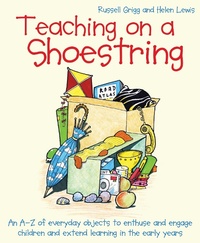
Teaching on a Shoestring
An A-Z of everyday objects to enthuse and engage children and extend learning in the early years
Published on 14. September 2018
208 pages
978-1-78583-360-1 (ISBN)
Description

In Teaching on a Shoestring: An A-Z of everyday objects to enthuse and engage children and extend learning in the early years, Russell Grigg and Helen Lewis explore the educational value of familiar objects and suggest practical activities to help develop young learners' cross-curricular skills.
We take many everyday objects for granted. But in a time of ever-tightening school budgets these objects can be invaluable in affording low-cost, high-impact opportunities for learning. With these value-for-money principles in mind, Russell and Helen have packed this practical A-Z handbook to the brim with fun facts, inspiring ideas and exciting activities to help teachers make the best use of familiar objects as launch pads for effective learning.
Underpinned by solid theory, Teaching on a Shoestring investigates the learning potential of twenty-six inexpensive, readily available resources - from apples to ice cubes to zebra-patterned fabric - and shows how they can be exploited to develop in young learners the four skills widely regarded as essential in the twenty-first century: communication, collaboration, critical thinking and creativity.
The book is organised into two parts: covering theory, then practice. In Part 1 the authors examine the nature of an object-rich learning environment and discuss the benefits of enquiry-based learning, in which the emphasis is upon promoting collaboration, dialogue and higher-order thinking in real-world contexts. In Part 2 the learning opportunities around the twenty-six objects are laid out in detail to illustrate how they can be put into practice. While the book focuses on object-based pedagogy employed with the under-sevens age category, many of the principles can also be applied with older children.
There is a common format for the enquiry into each object, arranged into the following sections:
In a nutshell - key background information about the object in its broader
Did you know? - interesting facts about the object.
Ready - key vocabulary, resources and health and safety factors to consider.
Steady - learning goals and intentions.
Go - activities which show how teachers can develop the four skills of communication, collaboration, critical thinking and creativity around
Other ideas - follow-up cross-curricular ideas.
Find out more - websites and other references for further information.
Suitable for early years educators and anyone who works with young children.
We take many everyday objects for granted. But in a time of ever-tightening school budgets these objects can be invaluable in affording low-cost, high-impact opportunities for learning. With these value-for-money principles in mind, Russell and Helen have packed this practical A-Z handbook to the brim with fun facts, inspiring ideas and exciting activities to help teachers make the best use of familiar objects as launch pads for effective learning.
Underpinned by solid theory, Teaching on a Shoestring investigates the learning potential of twenty-six inexpensive, readily available resources - from apples to ice cubes to zebra-patterned fabric - and shows how they can be exploited to develop in young learners the four skills widely regarded as essential in the twenty-first century: communication, collaboration, critical thinking and creativity.
The book is organised into two parts: covering theory, then practice. In Part 1 the authors examine the nature of an object-rich learning environment and discuss the benefits of enquiry-based learning, in which the emphasis is upon promoting collaboration, dialogue and higher-order thinking in real-world contexts. In Part 2 the learning opportunities around the twenty-six objects are laid out in detail to illustrate how they can be put into practice. While the book focuses on object-based pedagogy employed with the under-sevens age category, many of the principles can also be applied with older children.
There is a common format for the enquiry into each object, arranged into the following sections:
In a nutshell - key background information about the object in its broader
Did you know? - interesting facts about the object.
Ready - key vocabulary, resources and health and safety factors to consider.
Steady - learning goals and intentions.
Go - activities which show how teachers can develop the four skills of communication, collaboration, critical thinking and creativity around
Other ideas - follow-up cross-curricular ideas.
Find out more - websites and other references for further information.
Suitable for early years educators and anyone who works with young children.
More details
Language
English
Place of publication
Carmarthen
United Kingdom
Target group
College/higher education
Professional and scholarly
File size
5,96 MB
ISBN-13
978-1-78583-360-1 (9781785833601)
Copyright in bibliographic data and cover images is held by Nielsen Book Services Limited or by the publishers or by their respective licensors: all rights reserved.
Schweitzer Classification
Other editions
Additional editions
Russell Grigg | Helen Lewis
Teaching on a Shoestring
An A-Z of everyday objects to enthuse and engage children and extend learning in the early years
Book
09/2018
Crown House Publishing
€24.00
Shipment within 3-4 weeks
Persons
Dr Helen Lewis is Director of Initial Teacher Education at Swansea University School of Education. A former primary school teacher and local authority adviser, she has been involved in teacher education for the past 12 years. Her research interests include the development of young children's thinking, teacher enquiry and research and the use of animals in educational settings. Dr Russell Grigg was previously an associate professor at the Wales Centre for Equity in Education. He has extensive experience in teacher training and has written five books and more than 40 articles on the subject of primary education. He has recently taken up a new post as school inspector and consultant for the Ministry of Education in the United Arab Emirates.Dr Helen Lewis leads the Primary PGCE programme at the University of Wales Trinity Saint David. She is a former local authority mathematics adviser with expertise in developing young children's thinking skills.
Content
- Cover
- Title page
- Copyright
- Contents
- Introduction
- Part 1 - Important questions
- 1. Why use objects when teaching in the early years?
- 2. How does the use of everyday objects fit with the requirements for the early years curriculum?
- 3. Why focus on developing communication, collaboration, critical thinking and creativity?
- 4. What is the theory behind using objects?
- 5. What is the role of the teacher?
- 6. How do I create an object-rich environment?
- 7. Where can I find the objects?
- Part 2 - A-Z of everyday objects
- A is for Apples
- B is for Bubbles
- C is for Cardboard Boxes
- D is for Digital Cameras and Digital Photographs
- E is for Eggs, Egg Timers and Egg Boxes
- F is for Feathers
- G is for Glasses (and Goblets)
- H is for Hoops
- I is for Ice Cubes
- J is for Jam Jars
- K is for Kites
- L is for Logs (and Leaves)
- M is for Maps
- N is for Notebooks
- O is for Oatmeal
- P is for Pegs
- Q is for Queen's Head
- R is for Rocks (and Pebbles)
- S is for Socks and Shoes
- T is for Telephones
- U is for Umbrellas
- V is for Velcro (and Buttons and Zips)
- W is for Wellington Boots
- X is for X-rays
- Y is for Yoghurt Pots
- Z is for Zebra-Patterned Fabric
- Conclusion
- Appendix: Mapping activities against the 4 C's
- Endnotes
- References
- Acknowledgements
