

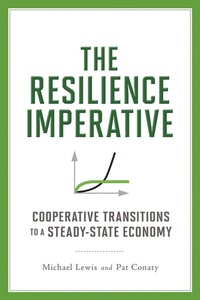
The Resilience Imperative
Cooperative Transitions to a Steady-State Economy
Published on 17. September 2021
400 pages
978-1-55092-505-0 (ISBN)
Description

"[The authors] argue that with more integration and cooperation between businesses, governments and communities, a more sustainable economy is possible." -
The Environmental Magazine
We find ourselves between a rock and a hot place-compelled by the intertwined forces of peak oil and climate change to reinvent our economic life at a much more local and regional scale.
The Resilience Imperative argues for a major SEE (social, ecological, economic) change as a prerequisite for replacing the paradigm of limitless economic growth with a more decentralized, cooperative, steady-state economy.
The authors present a comprehensive series of strategic questions within the broad areas of:
- Energy sufficiency
- Local food systems
- Interest-free financing
- Affordable housing and land reform
- Sustainable community development
More details
Other editions
Additional editions
Michael Lewis | Pat Conaty
The Resilience Imperative
Cooperative Transitions to a Steady-state Economy
Book
05/2012
New Society Publishers
€44.75
Article exhausted; check different version
Persons
Michael Lewis is Executive Director of the Canadian Centre for Community Renewal He is well-known internationally as a practitioner, author, educator, and leader in the field of Community Economic Development. Michael has worked with a wide range of businesses, organizations, communities and governments on initiatives related to transition, community resource management, development finance and the social economy. Until recently he also led the B.C. - Alberta Social Economy Research Alliance, a university/ practitioner platform for applied research.Patrick Conaty is a Californian working in England and Wales. He is a Fellow of new economics foundation and a research associate of Community Finance Solutions at the University of Salford. Pat specializes in developmental research on cooperative and mutual enterprise and is a national expert in the fields of community development finance and community land trusts.
Content
The Resilience Imperative - Table of Contents
Chapter 1
Getting off the Economic Growth Treadmill: The Resilience Imperative
Do we SEE Change as Possible? (SEE refers to social, ecological, economic)
Seeing, Seeking, Securing - A Pedagogy for Redefining What Counts
Climate Change and Fossil Fuel Descent: GLOCAL Drivers of Transition
The Problem with Viewing Life through the Rear View Mirror and the Persistence of Dysfunctional Myths
Revealing what is Hidden : SEEing the World Afresh
Resilience: Strengthening our Capacity to Adapt where we Live
Concepts and Practices that Can Help Maintain and Restore Resilience
Reclaiming the Commons
Reinventing Democracy where we Live
Beyond Self-Centered Economics: Constructing a Social Solidarity
Economy
Pricing as if People and Planet Mattered
Guide to the SEE Change: Discerning Pathways Forward
Chapter 2
Back to the Future: Seers from our Past - Guides for the 21st Century?
Beyond the Market: Probing the Roots of Economic Life
Private Wealth vrs Commonwealth: The Struggle for Land Reform and Economic Democracy
Ecological Economics: From Economic Growth to Balance within Ecological Limits
Seeing the Bars of our Cage: The Manufacturing of Money and Debt by Banks
Breaking the Back of Debt-based Money and Compound Interest: Is it Possible?
Wisdom for the 21st Century?
Chapter 3
Seeking Strategic Pathways from the Grip of Compound Interest: Sweden's JAK Bank - Financing Transition
Challenges of Transition
The Challenge:
The Destructive Power of Compound Interest
A Strategic Question
How do we create interest-free financing mechanisms that foster self-reliance at the household and community level and increase local capacity to finance transition strategies?
A Signpost
Solidarity Finance - Interest Free Lending at Work
Key Points in the JAK Philosophy and Analysis (JAK is a co-operative
bank in Sweden)
How the System Works
Financing Social and Ecological Enterprises: The Local Enterprise Bank
Innovation
The Household and Community Economy: Impacts of JAK Model
Transition Factors
Resilience Reflections
Chapter 4
Seeking Strategic Pathways to Affordable Housing: The Case for Land Reform
Challenges of Transition
The Challenge
Removing Land Costs from the Market and Capturing Public Subsides in Perpetuity
Strategic Questions
How do we remove land in perpetuity from the market in order to increase the stock of affordable housing?
How do we capture the value of public subsidies for low income housing to ensure long term affordability, maintaining it as a public good rather than a vehicle for unearned private equity gains?
Signposts
The Evolution of the Community Land Trust Model in the U.S.
Key Features of the CLT Model
The Champlain Housing Trust Vermont: Demonstrating Household, Community and Taxpayer Benefits from Restoring the Commons
Bridging 250 Years of Land Reform Effort into the 21st Century: Land Trusts in Britain
The Mutual Home Ownership Model : Scaling Up Impact
The Household and Community Economy: Impacts of Land Trusts
Transition Factors
Resilience Reflections
Chapter 5
Seeking Strategic Pathways to Energy Sufficiency
Challenges of Transition
The Challenge
Warming Households, Reducing Carbon and Relieving the Fuel Poor
The Strategic Question What is needed to empower communities to mobilize public and local resources to radically reduce household energy consumption and carbon while reducing fuel poverty?
Signpost
Mobilizing and Focusing Local Energy : Reducing Carbon, Decreasing Fuel Bills and Generation Economic Benefits - Dramatic Results in Kirklees, U.K.
The Challenge
Building Low Carbon Community Energy Self-Reliance
The Strategic Question
How do we build community based and owned renewable energy systems?
Signpost
Municipal Leadership to Become Fossil Free in 26 Communities - Kristianstad, Sweden
The Household and Community Economy: Impact of Kirklees Energy Savings
Transition Factors
Reflections on Resilience
Chapter 6
Seeking Strategic Pathways to Sustainable Food Systems
Challenges of Transition
Pathways and Signposts
Challenge
Navigating the Succession of Next Generation Farmers
Strategic Questions
How can we transfer increasingly valuable land in a manner that is affordable for a new generation of farmers while ensuring aging farmers are assured of a fair and respectful retirement?
How do we ensure that the economic, social and ecological value of the land is transferred into tenures that carry with it the responsibility of contributing to the public good of a food security for local and regional populations?
Signpost 1
Intervale Centre, Burlington Vermont
Signpost 2
The Indian Line Farm Community Land Trust
Transition Factors related to Succession
Resilience Reflections
Challenge
Reconstructing the Missing Links
Strategic Question
How do we rebuild a local-regional food value chain to facilitate the expansion of local and regional markets, ecologically sound food production and improved incomes for farmers?
Signpost 3
Federating Grass Roots Innovation: Building a Transformative Path - The Seikatsu Club Consumers Co-operative
The Household and Community Economy: Adding in the Cost of Sustainable Food
Transition Factors
Resilience Reflections
Chapter 7
Organizing for Transition: Reweaving Local Economies
Strategic Question: How do we organize ourselves for transition where we live?
Basic Economic and Social Functions
RESO: Urban Revitalization in Montreal
Coastal Enterprises Inc. Rural Revitalization in Maine
Transition Factors
Resilience Reflections
Chapter 8
Capital SEE Change Required! : Transforming the Ecology of Finance
Challenges of Transition
The Challenge
Investors focused on maximizing financial return are part of the problem. Transition finance requires multiple bottom lines to be integrated into longer term, limited financial return investments capable of financing SEE change. However, even among co-operative and social finance institutions there are signs of cultural captivity. Progress is being made but connecting the dots of limited innovation to create an ecology of finance capable of meeting the social, ecological and economic challenges we face is a goal far from being realized.
Strategic Question
How can we organise and weave together the key forms of investment capital - seed capital, equity and different forms of low-cost debt financing - to scale up the financing of the innovation and transition required to meet the basic needs of households and communities from production re-situated in the localities and regions where people live?
Towards a New Ecology of Finance
Signpost 1 Illustrative Tools and Techniques
Organizing Angels: The Cigales Network in France
Making it Happen on the Rock: Mobilizing Community Capital in Nova Scotia
Withdrawable Share Capital - Participation Financing
Do it Yourself Banking and Relational Microfinance - Zopa and Kiva
Community Land Trust Facilitation Fund - Seed funds and Risk Pooling
Summary of Key Features and Limits
Signpost 2 Community Innovations that Connect the Dots
Resuscitating Relationship Banking: Empowering the Marginalised through Community Banking Partnerships
Federating Mutuality to Scale up Innovation
Re-conceptualising Micro-finance - Mutual Aid to meet the needs of the Self-employed
Reviving 'relationship banking' and homeopathic financing for transition in localities
Summary of Key Features and Limits
Social and Community Banking - Why is this Sector not an Alternative yet?
Fair Trade Banking - A Strategic Opportunity for Social and Community Finance?
Chapter 9
Securing the SEE Change : Federating for Influence and Power
Challenges of Transition
Strategic Question
How do we build on and join together promising innovations in a way that secures our capacity to foster transformative change, to build the road as we travel it?
Signpost 1
Quebecs 'Chantier': Francophone Construction Site for Building the Social Solidarity Economy
Federating a Development System to Build the Social (Solidarity) Economy
Planning, Research, Promotion & Advocacy
Credit
Equity
Human Resource Development
Transition Factors
Resilience Reflections
Signpost 2
La Via Compensina: Building a Global Movement for Food Sovereity
Transition Factors
Resilience Reflections
Chapter 10
Finance, Democracy and Ownership:
Challenges of Transition
Strategic Question
What are some of the key elements that would make up robust strategies able to expand economic democracy and local ownership?
Signpost 1 The Case of Mondragon
Signpost 1 Ownership Transfer Corporations
Transition Factors
Resilience Reflections
Chapter 11
Wiring and Weaving Scaled Up Approaches to Transition
Challenges of Transition
Strategic Question
Given the current challenges we face, can we imagine ways of organizing that synergistically contribute to solving current problems and advance transition to a low carbon, more resilient society.
Scenario 1 Rolling Back the Home Foreclosure Crisis
Scenario 2 Retrofitting for Energy and Jobs while Seeding Innovation in Finance
Chapter 1
Getting off the Economic Growth Treadmill: The Resilience Imperative
Do we SEE Change as Possible? (SEE refers to social, ecological, economic)
Seeing, Seeking, Securing - A Pedagogy for Redefining What Counts
Climate Change and Fossil Fuel Descent: GLOCAL Drivers of Transition
The Problem with Viewing Life through the Rear View Mirror and the Persistence of Dysfunctional Myths
Revealing what is Hidden : SEEing the World Afresh
Resilience: Strengthening our Capacity to Adapt where we Live
Concepts and Practices that Can Help Maintain and Restore Resilience
Reclaiming the Commons
Reinventing Democracy where we Live
Beyond Self-Centered Economics: Constructing a Social Solidarity
Economy
Pricing as if People and Planet Mattered
Guide to the SEE Change: Discerning Pathways Forward
Chapter 2
Back to the Future: Seers from our Past - Guides for the 21st Century?
Beyond the Market: Probing the Roots of Economic Life
Private Wealth vrs Commonwealth: The Struggle for Land Reform and Economic Democracy
Ecological Economics: From Economic Growth to Balance within Ecological Limits
Seeing the Bars of our Cage: The Manufacturing of Money and Debt by Banks
Breaking the Back of Debt-based Money and Compound Interest: Is it Possible?
Wisdom for the 21st Century?
Chapter 3
Seeking Strategic Pathways from the Grip of Compound Interest: Sweden's JAK Bank - Financing Transition
Challenges of Transition
The Challenge:
The Destructive Power of Compound Interest
A Strategic Question
How do we create interest-free financing mechanisms that foster self-reliance at the household and community level and increase local capacity to finance transition strategies?
A Signpost
Solidarity Finance - Interest Free Lending at Work
Key Points in the JAK Philosophy and Analysis (JAK is a co-operative
bank in Sweden)
How the System Works
Financing Social and Ecological Enterprises: The Local Enterprise Bank
Innovation
The Household and Community Economy: Impacts of JAK Model
Transition Factors
Resilience Reflections
Chapter 4
Seeking Strategic Pathways to Affordable Housing: The Case for Land Reform
Challenges of Transition
The Challenge
Removing Land Costs from the Market and Capturing Public Subsides in Perpetuity
Strategic Questions
How do we remove land in perpetuity from the market in order to increase the stock of affordable housing?
How do we capture the value of public subsidies for low income housing to ensure long term affordability, maintaining it as a public good rather than a vehicle for unearned private equity gains?
Signposts
The Evolution of the Community Land Trust Model in the U.S.
Key Features of the CLT Model
The Champlain Housing Trust Vermont: Demonstrating Household, Community and Taxpayer Benefits from Restoring the Commons
Bridging 250 Years of Land Reform Effort into the 21st Century: Land Trusts in Britain
The Mutual Home Ownership Model : Scaling Up Impact
The Household and Community Economy: Impacts of Land Trusts
Transition Factors
Resilience Reflections
Chapter 5
Seeking Strategic Pathways to Energy Sufficiency
Challenges of Transition
The Challenge
Warming Households, Reducing Carbon and Relieving the Fuel Poor
The Strategic Question What is needed to empower communities to mobilize public and local resources to radically reduce household energy consumption and carbon while reducing fuel poverty?
Signpost
Mobilizing and Focusing Local Energy : Reducing Carbon, Decreasing Fuel Bills and Generation Economic Benefits - Dramatic Results in Kirklees, U.K.
The Challenge
Building Low Carbon Community Energy Self-Reliance
The Strategic Question
How do we build community based and owned renewable energy systems?
Signpost
Municipal Leadership to Become Fossil Free in 26 Communities - Kristianstad, Sweden
The Household and Community Economy: Impact of Kirklees Energy Savings
Transition Factors
Reflections on Resilience
Chapter 6
Seeking Strategic Pathways to Sustainable Food Systems
Challenges of Transition
Pathways and Signposts
Challenge
Navigating the Succession of Next Generation Farmers
Strategic Questions
How can we transfer increasingly valuable land in a manner that is affordable for a new generation of farmers while ensuring aging farmers are assured of a fair and respectful retirement?
How do we ensure that the economic, social and ecological value of the land is transferred into tenures that carry with it the responsibility of contributing to the public good of a food security for local and regional populations?
Signpost 1
Intervale Centre, Burlington Vermont
Signpost 2
The Indian Line Farm Community Land Trust
Transition Factors related to Succession
Resilience Reflections
Challenge
Reconstructing the Missing Links
Strategic Question
How do we rebuild a local-regional food value chain to facilitate the expansion of local and regional markets, ecologically sound food production and improved incomes for farmers?
Signpost 3
Federating Grass Roots Innovation: Building a Transformative Path - The Seikatsu Club Consumers Co-operative
The Household and Community Economy: Adding in the Cost of Sustainable Food
Transition Factors
Resilience Reflections
Chapter 7
Organizing for Transition: Reweaving Local Economies
Strategic Question: How do we organize ourselves for transition where we live?
Basic Economic and Social Functions
RESO: Urban Revitalization in Montreal
Coastal Enterprises Inc. Rural Revitalization in Maine
Transition Factors
Resilience Reflections
Chapter 8
Capital SEE Change Required! : Transforming the Ecology of Finance
Challenges of Transition
The Challenge
Investors focused on maximizing financial return are part of the problem. Transition finance requires multiple bottom lines to be integrated into longer term, limited financial return investments capable of financing SEE change. However, even among co-operative and social finance institutions there are signs of cultural captivity. Progress is being made but connecting the dots of limited innovation to create an ecology of finance capable of meeting the social, ecological and economic challenges we face is a goal far from being realized.
Strategic Question
How can we organise and weave together the key forms of investment capital - seed capital, equity and different forms of low-cost debt financing - to scale up the financing of the innovation and transition required to meet the basic needs of households and communities from production re-situated in the localities and regions where people live?
Towards a New Ecology of Finance
Signpost 1 Illustrative Tools and Techniques
Organizing Angels: The Cigales Network in France
Making it Happen on the Rock: Mobilizing Community Capital in Nova Scotia
Withdrawable Share Capital - Participation Financing
Do it Yourself Banking and Relational Microfinance - Zopa and Kiva
Community Land Trust Facilitation Fund - Seed funds and Risk Pooling
Summary of Key Features and Limits
Signpost 2 Community Innovations that Connect the Dots
Resuscitating Relationship Banking: Empowering the Marginalised through Community Banking Partnerships
Federating Mutuality to Scale up Innovation
Re-conceptualising Micro-finance - Mutual Aid to meet the needs of the Self-employed
Reviving 'relationship banking' and homeopathic financing for transition in localities
Summary of Key Features and Limits
Social and Community Banking - Why is this Sector not an Alternative yet?
Fair Trade Banking - A Strategic Opportunity for Social and Community Finance?
Chapter 9
Securing the SEE Change : Federating for Influence and Power
Challenges of Transition
Strategic Question
How do we build on and join together promising innovations in a way that secures our capacity to foster transformative change, to build the road as we travel it?
Signpost 1
Quebecs 'Chantier': Francophone Construction Site for Building the Social Solidarity Economy
Federating a Development System to Build the Social (Solidarity) Economy
Planning, Research, Promotion & Advocacy
Credit
Equity
Human Resource Development
Transition Factors
Resilience Reflections
Signpost 2
La Via Compensina: Building a Global Movement for Food Sovereity
Transition Factors
Resilience Reflections
Chapter 10
Finance, Democracy and Ownership:
Challenges of Transition
Strategic Question
What are some of the key elements that would make up robust strategies able to expand economic democracy and local ownership?
Signpost 1 The Case of Mondragon
Signpost 1 Ownership Transfer Corporations
Transition Factors
Resilience Reflections
Chapter 11
Wiring and Weaving Scaled Up Approaches to Transition
Challenges of Transition
Strategic Question
Given the current challenges we face, can we imagine ways of organizing that synergistically contribute to solving current problems and advance transition to a low carbon, more resilient society.
Scenario 1 Rolling Back the Home Foreclosure Crisis
Scenario 2 Retrofitting for Energy and Jobs while Seeding Innovation in Finance
