

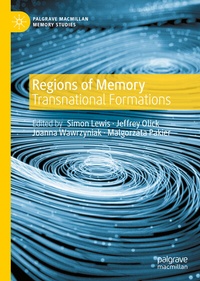
Regions of Memory
Description

"Regions of memory" are a scale of social and cultural memory that reaches above the national, yet remains narrower than the global or universal. The chapters of this volume analyze transnational constellations of memory across and between several geographical areas, exploring historical, political and cultural interactions between societies. Such a perspective enables a more diverse field of possible comparisons in memory studies, studying a variety of global memory regions in parallel. Moreover, it reveals lesser-known vectors and mechanisms of memory travel, such as across Cold War battle lines, across the Indian Ocean, or between Southeast Asia and western Europe.
Chapters 1 and 6 are available open access under a Creative Commons Attribution 4.0 International License via link.springer.com.
Reviews / Votes
"Here is an academically rigorous, well-written, and thoroughly global study of regions of memory. Europe is there as a set of regions among many others, each with its own inflections and obsessions. The discussions of African and Asian regions are new and challenging. This book sets a standard for transnational scholarship in this rapidly expanding field." - Jay Winter , Charles J. Stille Professor of History Emeritus, Yale University, USAMore details
Other editions
Additional editions
Persons
Simon Lewis is Associate Professor in East and Central European Cultural History at the University of Bremen, Germany.
Jeffrey K. Olick is William R. Kenan, Jr. Professor of Sociology and History at the University of Virginia, USA. He is Co-President of the Memory Studies Association.
Joanna Wawrzyniak is a historian and sociologist, Associate Professor and director of the Center for Research on Social Memory at the University of Warsaw, Poland.
Malgorzata Pakier is Head of the Academic Section at European Network Remembrance and Solidarity.
Content
Introduction: Regions of Memory in Theory.- Chapter 2: The Cold War and Regions of Memory.- Chapter 3: Human Rights and Regions of Memory: The Case of the International People's Tribunal on Crimes Against Humanity in Indonesia 1965.- Chapter 4: The Legacy of Empire in East-Central Europe: Fractured Nations and Divided Loyalties.- Chapter 5: Partisan History and the Eastern European Region of Memory.- Chapter 6: China, the Maritime Silk Road, and the Memory of Colonialism in the Asia region.- Chapter 7: Articulations of Memory: Mediation and the Making of Mnemo-Regions.- Chapter 8: Remembering the Violence of (De)colonization in Southern Africa: From Witnessing to Activist Genealogies in Literature and Film. Chapter 9: Transoceanic Entanglements: Remembering Forced Labor Migration in M. G. Vassanji's The In-Between World of Vikram Lall and Yvonne Adhiambo Owuor's Dust .- Afterword: The Discourse of Regions.
