

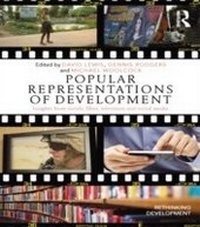
Popular Representations of Development
Insights from Novels, Films, Television and Social Media
1st Edition
Published on 23. January 2014
280 pages
978-1-135-90256-8 (ISBN)
Description

Although the academic study of development is well established, as is also its policy implementation, less considered are the broader, more popular understandings of development that often shape agendas and priorities, particularly in representative democracies.
Through its accessible and provocative chapters, Popular Representations of Development introduces the idea that while the issue of 'development' - defined broadly as problems of poverty and social deprivation, and the various agencies and processes seeking to address these - is normally one that is discussed by social scientists and policy makers, it also has a wider 'popular' dimension. Development is something that can be understood through studying literature, films, and other non-conventional forms of representation. It is also a public issue, one that has historically been associated with musical movements such as Live Aid and increasingly features in newer media such as blogs and social networking. The book connects the effort to build a more holistic understanding of development issues with an exploration of the diverse public sphere in which popular engagement with development takes place.
This book gives students of development studies, media studies and geography as well as students in the humanities engaging with global development issues a variety of perspectives from different disciplines to open up this new field for discussion.
Through its accessible and provocative chapters, Popular Representations of Development introduces the idea that while the issue of 'development' - defined broadly as problems of poverty and social deprivation, and the various agencies and processes seeking to address these - is normally one that is discussed by social scientists and policy makers, it also has a wider 'popular' dimension. Development is something that can be understood through studying literature, films, and other non-conventional forms of representation. It is also a public issue, one that has historically been associated with musical movements such as Live Aid and increasingly features in newer media such as blogs and social networking. The book connects the effort to build a more holistic understanding of development issues with an exploration of the diverse public sphere in which popular engagement with development takes place.
This book gives students of development studies, media studies and geography as well as students in the humanities engaging with global development issues a variety of perspectives from different disciplines to open up this new field for discussion.
Reviews / Votes
Popular representations of development and poverty have always been all around us, and scholars need to understand these alternative conceptualizations of reality to enrich their own discipline-based analysis and policy recommendations. This excellent volume suggests some ways in which this can happen, setting out the gains and the pitfalls of engagement. It is a thought provoking contribution to an important issue in development studies.-Ravi Kanbur, Cornell University, USA.
This book is for a worthy cause, that of going beyond the currently popular quantitative and experimental approach to economic development, to look into wider, often more insightful, humanistic forms of representation of the development process. It shows how representations in literature, films, television, and internet may capture the complexity and nuances of the social processes involved in development in ways not considered in the standard approach.
-Pranab Bardhan, University of California, Berkeley, USA.
This wonderfully engaging and thought-provoking collection provides many lessons about representation and power for researchers and students alike. It will prove to be an invaluable teaching resource and will become a benchmark for much future research.
-Cathy McIlwaine, University of London, UK.
An important milestone in development studies which shows how literature, film and other discourses need to be part of the mix when we try to understand how other people live.
-Giles Foden, author of The Last King of Scotland and Turbulence.
An essential analysis of the world of international development... and essential reading for rock stars everywhere.
-Richard Bean, author of The God Botherers and One Man, Two Guvnors.
...this book provides a timely and significant parameter in the study of development through the exploration of its popular representations in representative Western democracies. Through the illustration and analysis of diverse case studies with respect to the power of the image in shaping and sharing meaning about the concept of development, it illuminates the prevalence of popular culture and calls for a more grounded understanding of public perceptions of progress. It is certain to be a great read for scholars of development studies, media and communications, sociology, anthropology and geography at all levels.
-Eleftheria Lekakis, Lecturer in Media and Communications, University of Sussex
More details
Series
Language
English
Place of publication
London
United Kingdom
Publishing group
Taylor & Francis Ltd
Target group
College/higher education
Illustrations
25 s/w Abbildungen, 10 s/w Tabellen, 14 s/w Photographien bzw. Rasterbilder, 1 s/w Zeichnung
10 Tables, black and white; 1 Line drawings, black and white; 14 Halftones, black and white; 25 Illustrations, black and white
File size
6,42 MB
ISBN-13
978-1-135-90256-8 (9781135902568)
Copyright in bibliographic data and cover images is held by Nielsen Book Services Limited or by the publishers or by their respective licensors: all rights reserved.
Schweitzer Classification
Other editions
Additional editions
David Lewis | Dennis Rodgers | Michael Woolcock
Popular Representations of Development
Insights from Novels, Films, Television and Social Media
Book
08/2013
1st Edition
Routledge
€215.41
Shipment within 15-20 days
David Lewis | Dennis Rodgers | Michael Woolcock
Popular Representations of Development
Insights from Novels, Films, Television and Social Media
Book
08/2013
1st Edition
Routledge
€81.89
Shipment within 15-20 days
Persons
David Lewis is Professor of Social Policy and Development at the London School of Economics & Political Science (LSE), United Kingdom.
Dennis Rodgers is Professor of Urban Social and Political Research at the University of Glasgow, United Kingdom
Michael Woolcock is Lead Social Development Specialist with the World Bank's Development Research Group in Washington, DC, and Lecturer in Public Policy at the Harvard Kennedy School, Harvard University.
Dennis Rodgers is Professor of Urban Social and Political Research at the University of Glasgow, United Kingdom
Michael Woolcock is Lead Social Development Specialist with the World Bank's Development Research Group in Washington, DC, and Lecturer in Public Policy at the Harvard Kennedy School, Harvard University.
Content
Part 1: Introduction 1. Popular Representations of Development David Lewis, Dennis Rodgers, and Michael WoolcockPart 2: Literature and Fiction 2. The Fiction of Development: Literary Representation as a Source of Authoritative Knowledge David Lewis, Dennis Rodgers, and Michael Woolcock3. Notes on Teaching International Studies With Novels: 'Hard Times', 'Half of a Yellow Sun' and 'The Quiet American' John Harriss 4. Considering 'Pedagogical' Fictions and Metanarratives of Development: 1 World Manga Veronica Davidov Part 3: Media and Television 5. More News is Bad News: Why Studies of 'the Public Faces of Development' and 'Media and Morality' should be concerned with reality TV programmes Martin Scott 6. 'Hidden in Plan Sight': Baltimore, The Wire and the politics of under-development in urban America Simon Parker Part 4: Film 7. The Projection of Development: Cinematic Representation as An(other) Source of Authoritative of Knowledge? Simon Parker 8. Affective Histories: Imagining Poverty in Popular Indian Cinema Esha ShahPart 5: Public Campaigns 9. Visual Representations of Development: The Empire Marketing Board Poster Campaign 1926-1933 Uma Kothari 10. Band Aid Reconsidered: Sentimental Cultures and Populist Humanitarianism Cheryl LousleyPart 6: New Media 11. Blogs + Twitter = Change? Discursive Reproduction of Global Governance and the Limits of Social Media Tobias Denskus and Daniel E. Esser 12. Followme.intdev.com: International Development in the Blogosphere Ryann ManningPart 7: Conclusion 13. Conclusion: Popular Representations of Development - Taking Stock, Moving Forward David Lewis, Dennis Rodgers, and Michael Woolcock
