

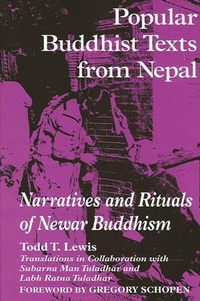
Popular Buddhist Texts from Nepal
Description

This book demonstrates how popular ritual texts and story narratives have shaped the religious life and culture of the only surviving South Asian Mahayana Buddhist society, the Newars of Kathmandu. It begins with an account of the Newar Buddhist community's history and its place within the religious environment of Nepal and proceeds to build around five popular translations, several of which were known across Asia: the Srngabheri Avadana, the Simhalasarthabahu Avadana, the Tara, the Mahakala Vratas, and the Pancaraksa. Lewis documents how the respective texts have been domesticated in Nepal's art and architecture, healing traditions, and rituals. He shows how they provide paradigmatic case studies that transcend the Nepalese context, illustrating universal practices or issues in all Buddhist communities, such as gender relations and stupa veneration, the role of merchants, ethnicity, violence, devotions to celestial bodhisattvas by kings and women, and the role of mantra recitations and healing rituals in the lives of Buddhists.
This book demonstrates how popular ritual texts and story narratives have shaped the religious life and culture of the only surviving South Asian Mahayana Buddhist society, the Newars of Kathmandu. It begins with an account of the Newar Buddhist community's history and its place within the religious environment of Nepal and proceeds to build around five popular translations, several of which were known across Asia: the Srngabheri Avadana, the Simhalasarthabahu Avadana, the Tara, the Mahakala Vratas, and the Pancaraksa. Lewis documents how the respective texts have been domesticated in Nepal's art and architecture, healing traditions, and rituals. He shows how they provide paradigmatic case studies that transcend the Nepalese context, illustrating universal practices or issues in all Buddhist communities, such as gender relations and stupa veneration, the role of merchants, ethnicity, violence, devotions to celestial bodhisattvas by kings and women, and the role of mantra recitations and healing rituals in the lives of Buddhists.
More details
Other editions
Additional editions
Person
This book demonstrates how popular ritual texts and story narratives have shaped the religious life and culture of the only surviving South Asian Mahayana Buddhist society, the Newars of Kathmandu. It begins with an account of the Newar Buddhist community's history and its place within the religious environment of Nepal and proceeds to build around five popular translations, several of which were known across Asia: the Srngabheri Avadana, the Simhalasarthabahu Avadana, the Tara, the Mahakala Vratas, and the Pancaraksa. Lewis documents how the respective texts have been domesticated in Nepal's art and architecture, healing traditions, and rituals. He shows how they provide paradigmatic case studies that transcend the Nepalese context, illustrating universal practices or issues in all Buddhist communities, such as gender relations and stupa veneration, the role of merchants, ethnicity, violence, devotions to celestial bodhisattvas by kings and women, and the role of mantra recitations and healing rituals in the lives of Buddhists.
Content
Foreword by Gregory Schopen
Preface
1. Introduction: Buddhism as a Pragmatic Religious Tradition
Popular Narratives and their "Domestication" in Buddhist Communities
The Development of Buddhist Ritualism
The Ritual Innovations of Mahayana Buddhism
Nepal and Newar Buddhism
The Context and Paradoxes of Modernity
2. Stupas and Spouses: The Shrngabheri Avadana
Background
Translation
The Domestication of the Text
Observations on the History of Practical Buddhism
3. Merchants, Demonesses, and Missionary Faith: The Simhalasarthabahu Avadana
Background
Translation
The Domestication of the Text
Observations on the History of Practical Buddhism
4. Devotions to a Celestial Bodhisattva: The Tara Vrata
Background
Translation
The Domestication of the Text
5. Invoking the Powers of the Buddhist "Dark Lord": The Caturdashi Vrata of Mahakala
Background
Translation
The Domestication of the Text
Vratas and the History of Practical Buddhism
6. The Refuge of Recitation: The Pañcaraksa
Buddhism amid Disease in the Premodern World
Background
Translation
The Domestication of the Pañcaraksa Texts
Observations on the History of Practical Buddhism
7. Summary and Conclusions
Notes
Bibliography
Index
