
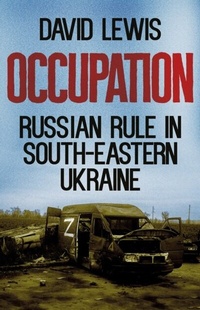
Occupation
Description
Alles über E-Books | Antworten auf Fragen rund um E-Books, Kopierschutz und Dateiformate finden Sie in unserem Info- & Hilfebereich.
In September 2022, at a grandiose ceremony in the Kremlin, President Putin announced the incorporation into the Russian Federation of four provinces in southern and eastern Ukraine?the most significant attempted land seizure in Europe since World War II. Although Russia was not in control of large parts of these provinces, its military occupied more than 40,000 square miles, roughly the size of Denmark.
Occupation explains how Russia sought to subjugate these territories through a toxic mix of violence, political influence and economic coercion. Its security forces kidnapped, tortured and killed civilians and officials, seized businesses and properties from Ukrainian owners, erased physical evidence of Ukrainian culture, and subjected the population to a barrage of constant propaganda.
More than half of the pre-war population fled, to Europe, Russia or the rest of Ukraine, and most who remained were hostile to the occupiers. Yet Russia found local politicians to front its regime. A few people openly collaborated; most faced uncomfortable choices to survive under Russian rule.
In occupied Ukraine, Moscow attempted to create an ersatz 'new Russia', based on fantasy, ideology and violence. This regime was a microcosm of the contemporary Russian Federation, reflecting its deepening militarisation and authoritarianism.
All prices
More details
Other editions
Additional editions
Person
David Lewis is Professor of Global Politics at the University of Exeter, specialising in Russia, Central Asia and the Caucasus. His most recent book is Russia's New Authoritarianism: Putin and the Politics of Order. In 2019?22, he was seconded to the UK Foreign, Commonwealth and Development Office.

System requirements
File format: ePUB
Copy protection: Adobe-DRM (Digital Rights Management)
System requirements:
- Computer (Windows; MacOS X; Linux): Install the free reader Adobe Digital Editions prior to download (see eBook Help).
- Tablet/smartphone (Android; iOS): Install the free app Adobe Digital Editions or the app PocketBook before downloading (see eBook Help).
- E-reader: Bookeen, Kobo, Pocketbook, Sony, Tolino and many more (not Kindle).
The file format ePub works well for novels and non-fiction books – i.e., „flowing” text without complex layout. On an e-reader or smartphone, line and page breaks automatically adjust to fit the small displays.
This eBook uses Adobe-DRM, a „hard” copy protection. If the necessary requirements are not met, unfortunately you will not be able to open the eBook. You will therefore need to prepare your reading hardware before downloading.
Please note: We strongly recommend that you authorise using your personal Adobe ID after installation of any reading software.
For more information, see our ebook Help page.
File format: ePUB
Copy protection: Watermark-DRM (Digital Rights Management)
System requirements:
- Computer (Windows; MacOS X; Linux): Use a reading software that can process the file format ePUB: e.g., Adobe Digital Editions or FBReader – both free (see eBook Help).
- Tablet/Smartphone (Android; iOS): Before downloading, install the free app Adobe Digital Editions (see eBook Help).
- E-reader: Bookeen, Kobo, Pocketbook, Sony, Tolino and many more (not Kindle).
The file format ePUB works well for novels and non-fiction books – i.e., „flowing” text without complex layout. On an e-reader or smartphone, line and page breaks automatically adjust to fit the small displays.
This eBook uses Watermark-DRM, a „soft” copy protection. This means that there are no technical restrictions to prevent illegal distribution. However, there is a personalised watermark embedded in the eBook that can be used to identify the purchaser of the eBook in the event of misuse and to provide evidence for legal purposes.
For more information, see our eBook Help page.