

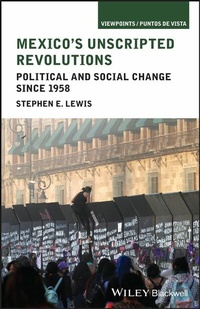
Mexico's Unscripted Revolutions
Description

In Mexico's Unscripted Revolutions: Political and Social Change Since 1958, distinguished historian Stephen Lewis offers a well-argued--and provocative--presentation of Mexico's recent "unofficial" grassroots revolutions. The book explores generational change and youthful rebellion in the 1960s and the emergence of second-wave feminism in the 1970s. It also discusses Mexico's uniquely protracted democratic transition, initiated by the hegemonic Institutional Revolutionary Party (PRI) but pushed forward at critical moments by ordinary citizens, opposition parties, and even armed insurgencies.
In clear, accessible prose, the author argues that persistent inequality and authoritarian practices have hobbled Mexico's democratic consolidation since 2000. He also provides coverage of the presidency of Andrés Manuel López Obrador (2018-2024), who promised peaceful revolution but seemed nostalgic for a return to Mexico's populist, authoritarian past.
Readers will also find:
* A revealing examination of racism and classism in Mexico, which persist despite the state's celebration of the country's Indigenous heritage and its promotion of biological and cultural mixing, known as mestizaje.
* The provocative suggestion that democratization may have unwittingly contributed to the surge in cartel-related violence.
* A timely chronicle of how women took advantage of the democratic opening to push for gender quotas in politics, which has produced gender parity today in the national congress and in state legislatures.
* An overview of Mexico's surprising and growing religious diversity, both within the Catholic Church and without.
Perfect for undergraduate students studying Mexican and Latin American history and politics, Mexico's Unscripted Revolutions: Political and Social Change Since 1958 will also benefit students in Latin American Studies, political science, anthropology, religious studies, and women's studies and laypersons with an interest in contemporary Mexico.
More details
Other editions
Additional editions
Person
Stephen E. Lewis is Professor of History at California State University, Chico, where he coordinates the Latin American Studies program. He is the author of Rethinking Mexican Indigenismo: The INI's Coordinating Center in Highland Chiapas and the Fate of a Utopian Project.
Content
Series Editor's Preface vii
Acknowledgments xi
List of Abbreviations xiii
Introduction 1
1 Revolution or Bust? The Long Sixties in Mexico 11
2 Twilight of the "Perfect Dictatorship": The Democratic Transition, 1977-2000 35
3 Mexico's Partial Embrace of Its Dark- Skinned Majority 59
4 Church(es) and State in Contemporary Mexico 83
5 The Women's Revolution 115
6 Finally, a Democracy Without Adjectives? 144
7 Mexico's Unscripted Revolutions and the "Fourth Transformation" 170
Bibliography 198
Index 212
