

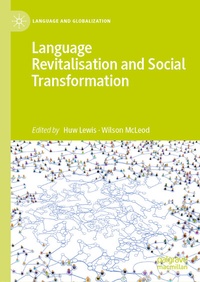
Language Revitalisation and Social Transformation
Description

This book brings together an interdisciplinary group of academic researchers in order to examine how and to what extent the challenge of language revitalisation should be reassessed and reconceptualised to take account of our fast-changing social context. The period of four decades between 1980 and 2020 that straddled the end of the twentieth century and the beginning of the twenty-first is widely regarded as one that witnessed a series of fundamental social, economic and political transformations. Many societies have become increasingly individualistic, mobile and diverse in terms of ethnicity and identity; their economies have become increasingly interconnected; and their governance structures have become increasingly complex, incorporating a growing number of different levels and actors. In addition, rapid advancements with regard to automated, digital and communication technology have had a far-reaching impact on how people interact with each other and participate in society. The chapters in this book aim to advance an agenda of key questions that should concern those working in the field of language revitalisation over the coming years, and the volume will be of interest to students, scholars and policy-makers in related areas including sociolinguistics, education, sociology, geography, political science, law, economics, Celtic studies, and communication technology.
More details
Other editions
Additional editions
Persons
Huw Lewis is Senior Lecturer in Politics at Aberystwyth University, UK.
Wilson McLeod is Professor of Gaelic at the University of Edinburgh, UK.
