

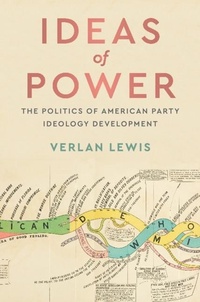
Ideas of Power
The Politics of American Party Ideology Development
Published on 24. April 2019
978-1-108-75723-2 (ISBN)
Description

This groundbreaking book challenges the dominant view of ideology held by both political scientists and political commentators. Rather than viewing ideological constructs like liberalism and conservatism as static concepts with fixed and enduring content, Professor Verlan Lewis explains how the very meanings of liberalism and conservatism frequently change along with the ideologies of the two major parties in American politics. Testing a new theory to help explain why party ideologies evolve the way that they do, this book traces the history of American political parties from the Hamiltonian Federalists and Jeffersonian Republicans of the 1790s to the liberal Democrats and conservative Republicans of today. Ideas of Power shows us how changing party control of government institutions, such as Congress, the presidency, and the Supreme Court, influences how party ideologies develop.
Reviews / Votes
'The dominant paradigm of American politics scholarship builds in an assumption that 'liberal' and 'conservative' are fixed in meaning - and that one major political party is always on the 'left' while the other is on the 'right'. But what if that's not so? In this outstanding book, Verlan Lewis not only shows us how party ideologies have changed over time, but he also uncovers predictable patterns in those changes and links them to the fundamental political calculations of party actors in and out of power. Ideas of Power is a must-read - it's a book that will reshape the way we understand ideology in the United States and beyond.' Sarah Anzia, Michelle J. Schwartz Associate Professor of Public Policy, University of California, Berkeley 'In documenting how party ideologies have changed throughout American history - and with them the very meanings of liberalism and conservatism - Lewis challenges mainstream views about the origins and role of ideology, the value of DW-NOMINATE scores, and how the dynamics of American politics can best be understood. He is calling for a transformation in the analytics at the heart of the field. This is what contributions are made of.' Terry M. Moe, William Bennett Munro Professor of Political Science, Stanford University 'In this ambitious study, Verlan Lewis contends that American political parties, and American politics more broadly, can only be understood by paying serious attention to partisan ideas; by recognizing that they, and the meanings of 'liberal' and 'conservative', 'right' and 'left', change over time; and by understanding how wielding governing power can contribute to ideological change. Literatures in several fields will need to come to grip with these important arguments.' Rogers M. Smith, Christopher H. Browne Distinguished Professor of Political Science, University of Pennsylvania 'American party ideology, as taught in political science, philosophy, and history courses, needs to be reconceptualized given Verlan Lewis's study of how it evolves based on the interpretations of the two dominant parties and which one controls the executive, legislative, and judicial branches of government. Students of public opinion and political behavior will have an answer to their question of why it so often seems that average citizens, or non-elites, have difficulty correlating ideologies, specifically conservatism and liberalism, with policy positions.' M. J. Blumberg, Choice 'The vital lessons of and the many follow-up questions that arise from Ideas of Power attest to the enormous contribution Lewis has made to several fields-APD, political thought/ideas, parties, the Presidency, Congress, and the courts. Individually and collectively, these fields will be substantially improved by engaging with Lewis's crucial arguments that (1) party ideologies are not static over time and (2) party control over institutions drives party ideology development.' John A. Dearborn, The ForumMore details
Language
English
Place of publication
Cambridge
United Kingdom
Target group
Professional and scholarly
Illustrations
Worked examples or Exercises; 12 Tables, black and white; 4 Line drawings, black and white
File size
3,15 MB
ISBN-13
978-1-108-75723-2 (9781108757232)
Copyright in bibliographic data and cover images is held by Nielsen Book Services Limited or by the publishers or by their respective licensors: all rights reserved.
Schweitzer Classification
Other editions
Additional editions
Book
05/2019
Cambridge University Press
€126.00
Shipment within 15-20 days
Person
Content
1. The liberal conservative myth and political science; 2. A political theory of American party ideology development; 3. The presidency and party theories of foreign intervention; 4. Unified government and party theories of economic intervention; 5. The Supreme Court and party theories of judicial intervention; 6. Politics, history, and American party ideology development.
