

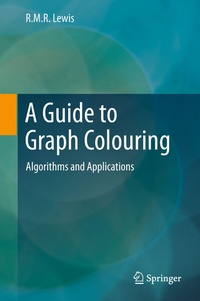
A Guide to Graph Colouring
Description

This book treats graph colouring as an algorithmic problem, with a strong emphasis on practical applications. The author describes and analyses some of the best-known algorithms for colouring arbitrary graphs, focusing on whether these heuristics can provide optimal solutions in some cases; how they perform on graphs where the chromatic number is unknown; and whether they can produce better solutions than other algorithms for certain types of graphs, and why.
The introductory chapters explain graph colouring, and bounds and constructive algorithms. The author then shows how advanced, modern techniques can be applied to classic real-world operational research problems such as seating plans, sports scheduling, and university timetabling. He includes many examples, suggestions for further reading, and historical notes, and the book is supplemented by a website with an online suite of downloadable code.
The book will be of value to researchers, graduate students, and practitioners in the areas of operations research, theoretical computer science, optimization, and computational intelligence. The reader should have elementary knowledge of sets, matrices, and enumerative combinatorics.
Reviews / Votes
"The book gives a comprehensive description and handling on arguably one of the most important notions of combinatorics-graph coloring. . The book is nicely written, and carries a big pile of information valuable for both users and researchers in the field." (András Sándor Pluhár, Mathematical Reviews, February, 2017)
"This well-written book will serve as a utilitarian guide to graph coloring and its practical applications. It includes many definitions, theorems, proofs, algorithms, and pointers for further reading. The book will be helpful for teaching courses on graph coloring to students of mathematics and computer science. I strongly recommend it for the intended audience." (S. V. Nagaraj, Computing Reviews, computingreviews.com, June, 2016)
"The book is a comprehensive guide to graph colouring algorithms. . The book is a nicetextbook for both undergraduate and graduate students in the areas of operations research and theoretical computer science. . Finally, it is a good source of knowledge for practitioners." (Marcin Anholcer, zbMATH 1330.05002, 2016)
More details
Other editions
Additional editions
Person
Content
Introduction to Graph Colouring.- Bounds and Constructive Algorithms.- Advanced Techniques for Graph Colouring.- Algorithm Case Studies.- Applications and Extensions.- Designing Seating Plans.- Designing Sports Leagues.- Designing University Timetables.- App. A, Computing Resources.- References.- Index.
