

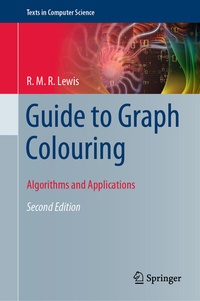
Guide to Graph Colouring
Description

This textbook treats graph colouring as an algorithmic problem, with a strong emphasis on practical applications. The author describes and analyses some of the best-known algorithms for colouring graphs, focusing on whether these heuristics can provide optimal solutions in some cases; how they perform on graphs where the chromatic number is unknown; and whether they can produce better solutions than other algorithms for certain types of graphs, and why.
The introductory chapters explain graph colouring, complexity theory, bounds and constructive algorithms. The author then shows how advanced, graph colouring techniques can be applied to classic real-world operational research problems such as designing seating plans, sports scheduling, and university timetabling. He includes many examples, suggestions for further reading, and historical notes, and the book is supplemented by an online suite of downloadable code.
The book is of value to researchers, graduate students, and practitioners in the areas of operations research, theoretical computer science, optimization, and computational intelligence. The reader should have elementary knowledge of sets, matrices, and enumerative combinatorics.
More details
Other editions
Additional editions
Person
Dr. Rhyd Lewis is a reader in operational research at Cardiff School of Mathematics, Cardiff University. Previously, he was a lecturer in quantitative methods at Cardiff Business School. He holds a Ph.D. in Computer Science and Operational Research from Edinburgh Napier University. His research interests cover algorithmic graph theory and the analysis and application of metaheuristic algorithms. He is a cofounder and associate editor of the Intl. J. of Metaheuristics.
Content
1. Introduction to Graph Colouring.- 2. Bounds and Constructive Algorithms.- 3. Advanced Techniques for Graph Colouring.- 4. Algorithm Case Studies.- 5. Applications and Extensions.- 6. Designing Seating Plans.- 7. Designing Sports Leagues.- 8. Designing University Timetables.
