

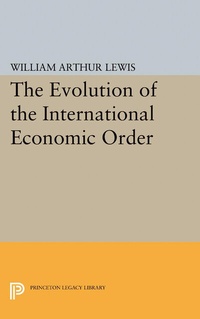
The Evolution of the International Economic Order
Evolution of the International Economic Order
1st Edition
Published on 19. May 2015
92 pages
978-1-4008-6851-3 (ISBN)
Description

Do rich industrial nations underestimate the threat to their economic stability posed by demands for a new international economic order? Are the developing countries wrong to assume that their economic advancement depends on a transfer of wealth from the richer nations? Sir W. Arthur Lewis's provocative analysis of the present economic order and its origins suggests that the answer to both questions is yes.
Professor Lewis perceptively illuminates aspects of recent economic history that have often been overlooked by observers of international affairs. He asks first how the world came to be divided into countries exporting manufactures and countries exporting primary commodities. High agricultural productivity and a good investment climate allowed countries in Northwest Europe to industrialize rapidly, while the favorable terms of trade they enjoyed assured them and the temperate lands to which Europeans migrated of continuing dominance over the tropical countries.
At the core of the author's argument lies the contention that as the structure of international trade changes, the tropical countries move rapidly toward becoming net importers of agricultural commodities and net exporters of manufactures. Even so, they continue to depend on the markets of the richer countries for their growth, and they continue to trade on unfavorable terms. Both of these disadvantages, he concludes, stem from large agricultural sectors with low productivity and will disappear only as the technology of tropical food production is revolutionized.
Originally published in 1978.
The Princeton Legacy Library uses the latest print-on-demand technology to again make available previously out-of-print books from the distinguished backlist of Princeton University Press. These editions preserve the original texts of these important books while presenting them in durable paperback and hardcover editions. The goal of the Princeton Legacy Library is to vastly increase access to the rich scholarly heritage found in the thousands of books published by Princeton University Press since its founding in 1905.
Professor Lewis perceptively illuminates aspects of recent economic history that have often been overlooked by observers of international affairs. He asks first how the world came to be divided into countries exporting manufactures and countries exporting primary commodities. High agricultural productivity and a good investment climate allowed countries in Northwest Europe to industrialize rapidly, while the favorable terms of trade they enjoyed assured them and the temperate lands to which Europeans migrated of continuing dominance over the tropical countries.
At the core of the author's argument lies the contention that as the structure of international trade changes, the tropical countries move rapidly toward becoming net importers of agricultural commodities and net exporters of manufactures. Even so, they continue to depend on the markets of the richer countries for their growth, and they continue to trade on unfavorable terms. Both of these disadvantages, he concludes, stem from large agricultural sectors with low productivity and will disappear only as the technology of tropical food production is revolutionized.
Originally published in 1978.
The Princeton Legacy Library uses the latest print-on-demand technology to again make available previously out-of-print books from the distinguished backlist of Princeton University Press. These editions preserve the original texts of these important books while presenting them in durable paperback and hardcover editions. The goal of the Princeton Legacy Library is to vastly increase access to the rich scholarly heritage found in the thousands of books published by Princeton University Press since its founding in 1905.
More details
Other editions
Additional editions
William Arthur Lewis
The Evolution of the International Economic Order
Book
04/2016
Princeton University Press
€68.70
Article not available at the moment
William Arthur Lewis
The Evolution of the International Economic Order
Book
03/2015
Princeton University Press
€29.20
Shipment within 10-20 days

William Arthur Lewis
The Evolution of the International Economic Order
Book
03/1978
Princeton University Press
€11.13
Article exhausted; check different version
William Arthur Lewis
The Evolution of the International Economic Order
Book
03/1978
Princeton University Press
€30.95
Article exhausted; check different version
Person
William Arthur Lewis
Content
Frontmatter, pg. i
CONTENTS, pg. v
PREFACE, pg. vii
1. INTRODUCTION, pg. 1
2. THE DIVISION OF THE WORLD, pg. 4
3. THE FACTORAL TERMS OF TRADE, pg. 14
4. CUMULATIVE FORCES, pg. 21
5. COMMODITY POLICY, pg. 26
6. THE RISE OF MANUFACTURING, pg. 31
7. FINANCIAL DEPENDENCE, pg. 38
8. INTERNATIONAL FLUCTUATIONS, pg. 47
9. THE VOLUME OF DEBT, pg. 58
10. THE ENGINE OF GROWTH, pg. 67
11. POSTSCRIPT, pg. 76
INDEX, pg. 79
CONTENTS, pg. v
PREFACE, pg. vii
1. INTRODUCTION, pg. 1
2. THE DIVISION OF THE WORLD, pg. 4
3. THE FACTORAL TERMS OF TRADE, pg. 14
4. CUMULATIVE FORCES, pg. 21
5. COMMODITY POLICY, pg. 26
6. THE RISE OF MANUFACTURING, pg. 31
7. FINANCIAL DEPENDENCE, pg. 38
8. INTERNATIONAL FLUCTUATIONS, pg. 47
9. THE VOLUME OF DEBT, pg. 58
10. THE ENGINE OF GROWTH, pg. 67
11. POSTSCRIPT, pg. 76
INDEX, pg. 79
