

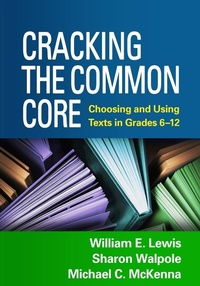
Cracking the Common Core
Choosing and Using Texts in Grades 6-12
Published on 25. November 2013
234 pages
978-1-4625-1320-8 (ISBN)
Description

Teachers, academic coaches, and staff developers in grades 6-12; teacher educators and graduate students. May serve as a text in such courses as Adolescent Literacy, Content Area Literacy, and Teaching English Language Arts.
More details
Other editions
Additional editions
William E. Lewis | Sharon Walpole | Michael C. McKenna
Cracking the Common Core
Choosing and Using Texts in Grades 6-12
Book
01/2014
1st Edition
Guilford Press
€37.00
Shipment within 15-20 days
Persons
William E. Lewis, PhD, is Associate Professor of Literacy Education in the School of Education at the University of Delaware, where he teaches undergraduate and graduate courses in content-area literacy, English language arts (ELA) methods, and young adult literature. Dr. Lewis presents a range of professional development seminars on secondary content-area literacy and text-based writing. Before teaching at the University of Delaware, he taught high school ELA for 20 years in Pennsylvania public schools. His research has been published in leading journals. Dr. Lewis is a recipient of the Excellence in Teaching Award from the University of Delaware.
Sharon Walpole, PhD, is Professor in the School of Education at the University of Delaware. She has extensive school-based experience designing and implementing tiered instructional programs. Dr. Walpole has also been involved in federally funded and other schoolwide reform projects. Her current work involves the design and effects of schoolwide reforms. She has coauthored or coedited several books, including How to Plan Differentiated Reading Instruction, Second Edition: Resources for Grades K-3; The Literacy Coach's Handbook, Second Edition; and Organizing the Early Literacy Classroom. Dr. Walpole is also Series Editor, with Michael C. McKenna, of The Essential Library of PreK-2 Literacy. She is a recipient of the Early Career Award for Significant Contributions to Literacy Research and Education from the Literacy Research Association and the Excellence in Teaching Award from the University of Delaware.
Michael C. McKenna, PhD, was Thomas G. Jewell Professor of Reading in the School of Education and Human Development at the University of Virginia until his death in 2016. He authored, coauthored, or edited more than 20 books and over 100 articles, chapters, and technical reports on a range of literacy topics. Dr. McKenna also served as Series Editor, with Sharon Walpole, of The Essential Library of PreK-2 Literacy. His research was sponsored by the National Reading Research Center and the Center for the Improvement of Early Reading Achievement. He was a corecipient of the Edward B. Fry Book Award from the Literacy Research Association and the Award for Outstanding Academic Books from the American Library Association, and a member of the Reading Hall of Fame.
Content
Foreword, Jeffrey Menzer and Jacob Nagy
1. Embracing the Common Core
2. Understanding Adolescent Readers
3. Understanding Challenging Texts
4. Designing Challenging Text Sets
5. Building Background Knowledge
6. Supporting Students during Reading
7. Implementing High-Quality Discussions after Reading
8. Text-Based Writing to Support Understanding
9. Research in the Content Areas
10. Leading for Change
Appendix 1. Text Set Examples from English Language Arts
Appendix 2. Text Set Examples from History/Social Studies
Appendix 3. Text Set Examples from Science
1. Embracing the Common Core
2. Understanding Adolescent Readers
3. Understanding Challenging Texts
4. Designing Challenging Text Sets
5. Building Background Knowledge
6. Supporting Students during Reading
7. Implementing High-Quality Discussions after Reading
8. Text-Based Writing to Support Understanding
9. Research in the Content Areas
10. Leading for Change
Appendix 1. Text Set Examples from English Language Arts
Appendix 2. Text Set Examples from History/Social Studies
Appendix 3. Text Set Examples from Science
