

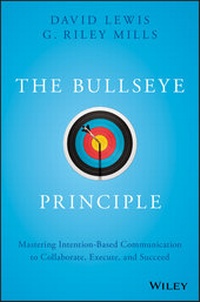
The Bullseye Principle
Description

The Bullseye Principle is the definitive how-to guide for communicating, collaborating, and executing as a leader in the corporate arena. With these "soft skills" trending above technical knowledge in executive wish lists, this book provides invaluable guidance for new and experienced leaders alike; from the planning stages to the outcome and beyond, the discussion features critical insight and actionable tips based on award-winning methods. Polish your presence, utilize intention, influence emotion, engage workers, build relationships, make connections, and leverage the power of storytelling--it all comes down to technique. This book shows you everything you need to know to start communicating more effectively, starting today.
The success of any communication rests more on how the information is conveyed than what that information actually is; at every level, in every sphere, effective leaders strive to master key skills that inspire, empower, motivate, and more. This book gives you a solid blueprint for effective communication in nearly any situation, merging the practical and theoretical to help you:
* Master the most challenging business interactions
* Become more influential as a leader and communicator
* Adopt a 3-step methodology to collaborate more effectively
* Build your personal brand and executive presence toward sustained success
Most people believe that their communications skills are satisfactory for their jobs--most managers would disagree. That gap in perception presents a problem that ripples beyond your chances of promotion--where your communication fails, it has the capacity to affect the organization as a whole. The Bullseye Principle helps you build a robust repertoire of communication skills that put you ahead of the pack.
More details
Other editions
Additional editions
Persons
DAVID LEWIS and G. RILEY MILLS are cofounders of Pinnacle Performance Company, a global communication skills training firm that teaches The Pinnacle Method(TM) to thousands of professionals each year. Lewis is a former Fortune 500 executive, film producer and screen actor. Mills is a regular speaker and award-winning writer with twenty years of professional acting experience.
For more information, please visit www.pinper.com.
Content
Introduction 1
Hit Your Mark 11
Utilizing Intention to Maximize Message Impact
2 Define Your Personal Brand 35
Establishing and Projecting Executive Presence
3 Land the Job 59
Strategic Interviewing Techniques to Get You Hired
4 Communicate Like a Leader 83
Influencing Emotion through Style, and Delivery
5 Inspire and Motivate Others 105
Engaging Workers and Leading a Team through Change
6 Build Relationships 129
Making Connections, Establishing Trust and Earning Respect
7 Create a Memorable Narrative 155
Leveraging the Power of Storytelling in Business
8 Handle Difficult Conversations 179
Providing Feedback, Managing Emotions, and Speaking in the Moment
9 Run Killer Meetings 203
Facilitating Like a Pro to Get Results
10 Make the Sale 225
Being Assertive, Influencing Others, and Preparing to Engage
Notes 245
Glossary of Terms 269
Acknowledgments 275
About the Authors 279
Index 283
Chapter 1
Hit Your Mark
Utilizing Intention to Maximize Message Impact
Every objective must carry in itself the germs of action.
-CONSTANTIN STANISLAVSKI
If you are a leader in the corporate arena, your role will not only require you to influence the thoughts and feelings of stakeholders inside and outside of your organization, but also to motivate their actions through your vision and ideas. This is no small feat, and it will likely happen on a daily basis, sometimes with high stakes in the balance. Great leadership is practiced one conversation at a time, and someone communicating a message must understand how they want their audience to react before being able to deliver it with impact. Actors are masters of verbal and nonverbal communication; experts at driving their messages home with intent. In this chapter, we will detail our three-step process for influential communication as well as the concepts of intention and objective (the effective communicator's secret weapon), to allow you to engage others by influencing emotions and motivating action.
The Legend of Phil Davison
As of this writing, if you enter the words "worst speech of all time" into Google's search engine it will bring up over 18 million results. But the very first entry on the very first page of results is a video of a man named Phil Davison. Additionally, if you do a Google search for "worst speaker of all time" it is Phil Davison who once again comes up on the first page of results. (We will pause here for you to go watch the video on YouTube. Trust us, it's worth it.) The speech that Davison delivered brought him international infamy and was named "top political rant" of all time by the Washington Post. The story of Phil Davison is an interesting tale and one that offers important lessons for all of us who are tasked with influencing others with our communication.1
In 2010, Phil Davison was an aspiring politician in Ohio, a tall and soft-spoken man who still lived with his father in the same house where he had grown up. Davison's political career began when he walked into the Board of Elections for Stark County one day and filled out an application to run for the office of County Treasurer. Davison had been working as a local councilman at the time and decided he wanted to make a difference in his community and help people.
Davison had first become interested in the idea of public service when, as a child, a local politician had knocked on his front door, introducing himself and asking Davison's parents for their vote. Davison was intrigued by this man who had come into his house-connecting with Phil and his family on a personal level, right there at their kitchen table. Davison had listened intently to the man and decided way back then that he would pursue a similar calling himself one day. He loved the idea of meeting people, of understanding their concerns and then helping them make their lives better. During the years before the speech, Davison had been involved as a volunteer with local politics, often donating money to the local Republican party and helping out at various events and fundraisers. But mounting a campaign of his own was something that would need to wait until further down the road. For now, he was happy building relationships, making connections, and paying his dues, biding his time until the moment was right for him to run for office himself.
Then, in 2010, that moment arrived.
Davison had been working as a councilman when he was notified by a local Republican leader that there was an open position. "I thought, ' This might be my one shot,' " said Davison. Urged on by party leaders, he decided the time for him to run for office had finally arrived. The Republican party of Ohio was looking for a candidate to run for the position of Stark County Treasurer and they thought Phil would be a perfect fit. Davison learned that there were five other candidates on the ballot and all six of them had been invited to speak to a group of Republican insiders in Canton, Ohio-the very people who would decide which of the six candidates would get their endorsement and support.
Excited by the opportunity to introduce himself to local leadership, Davison went to work on his speech. He sat down at his kitchen table on a Sunday afternoon and began writing, composing a well-crafted speech that established his credibility, detailed the problems facing Ohio, and proposed a handful of clear, practical solutions that he planned to implement if elected. He threw in a relevant quote from Albert Einstein to drive the theme of his speech home and made sure the powerful phrasing and repetition in the speech would make his points more memorable. He wrote the speech in longhand and then typed it up the following day. Davison called a friend and asked him to watch while he rehearsed his speech. When he had finished the practice run, Davison was energized. The speech suddenly "came to life," he recalled, "it breathed, it moved."
The night of the speech was soon upon him and Davison felt confident and ready. He put on his best suit and headed to Canton where the influential Republican Party insiders were gathering to pick their candidate. He arrived early and did his best to mingle with the other people in attendance. The party chairman approached him and they shook hands. The chairman had placed six numbered slips of paper in a hat and invited the candidates to draw a slip to determine the order in which they would speak. Davison drew the number 6, which meant he would be speaking last, the grand finale of the night's proceedings.
The other speakers took the stage and, one by one, gave their speeches. Finally, it was Davison's turn. He set aside the microphone, judging that he would not need it. You see, something had happened prior to delivering the speech that changed the circumstances for Davison and would soon change the temperature of the room. Before taking his place amongst the other candidates, Davison had been approached by one of the local party leaders who wished him luck with his speech but informed him that party insiders had already decided which of the six candidates they would be backing in the election. "I was told, 'The vote's in and you're not getting it,' " he recalled. Davison was shocked. For years, he had given money and volunteered his time to help these people. He felt humiliated and betrayed. How could this have happened?
As Davison took the stage, he looked out into the audience and took a breath. Many of the party leaders kept their heads down, avoiding eye contact, while others sported buttons endorsing other candidates. As he unrolled his notes, Davison was overcome by emotion and he launched into the speech that would make him famous. Pacing like a caged animal, he locked in on the audience, pointing, glaring, gesticulating: "My name is Phil Davison . . . and I will not apologize for my tone tonight!" He delivered every word of the speech he had so carefully prepped and rehearsed. And in less than six minutes, he was done. Davison folded his notes and placed them back in his breast pocket. He took his seat and waited patiently as the votes were counted. A few minutes later, the winner was declared. Davison, alone, headed to the parking lot, got into his car and drove the 40 minutes back to his small hometown of Minerva.
The next morning Davison got up and grabbed the local newspaper to see the coverage of the election. As he read the paper at his kitchen table, the phone rang. It was a college friend, now living in New York. The friend informed Davison that the video of him giving the speech had gone viral and was burning up the Internet. Phil was dumbfounded. Why would anyone be interested in a speech by a losing politician in a local race in Ohio? He would soon find out as the telephone began to ring with one call after another: first the BBC, then Good Morning America, Comedy Central, CBS, ABC, NBC, and Fox. Local television reporters swarmed his front door requesting interviews. One reporter even told him: "Mr. Davison, I've been a reporter for 30 years now and I've never been as afraid to go to someone's door as I was today."
As momentum from the video continued to build, the speech popped up in the most random places: a professor in Sweden screened it for her students, college kids would watch it on repeat and then recite it word for word. A beverage company approached Davison to be the spokesman for a new Red Bull-type drink they were about to launch. And it didn't stop there-soon Hollywood came calling. Davison starred in a television commercial for Volkswagen alongside reggae legend Jimmy Cliff. That commercial, which featured a clip of Davison's famous speech, played during the Super Bowl-the most-watched television program of the year. It became a whirlwind journey toward celebrity for the aspiring politician from Minerva. Davison admitted that the sudden fame was not easy to handle. "It was embarrassing, it was exciting, it was new to me. I was scared."
And it was just about at this point in the Phil Davison saga where we enter the story.
When our first book, The Pin Drop Principle, was released we were frequently asked to speak at events and conferences, and as part of our presentation, we would often show the Phil Davison video because it was a perfect example of intention and objective going haywire for a...
