

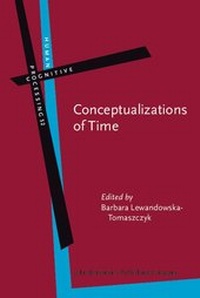
Conceptualizations of Time
Institutions, Evolution, Future
1st Edition
Published on 15. March 2016
XXI, 315 pages
978-90-272-6759-7 (ISBN)
Description

As time cannot be observed directly, it must be analyzed in terms of mental categories, which manifest themselves on various linguistic levels. In this interdisciplinary volume, novel approaches to time are proposed that consider temporality without time, on the one hand, and the coding of time in language, including sign language, and gestures, on the other. The contributions of the volume demonstrate that time is conceptualized not only in terms of space but in terms of other domains of human experience as well.
Renowned specialists in the study of time, the authors of this volume investigate this fascinating topic from a variety of perspectives - philosophical, linguistic, anthropological, (neuro)psychological, and computational - demonstrating a familiarity with both classical and recent approaches to the study of time and including up-to-date corpus-based methods of study.
The volume will be of interest to philosophers, linguists (including specialists in cognitive linguistics, corpus linguistics, and computational linguistics), anthropologists, (neuro)psychologists, translators, language teachers, and graduate students.
Renowned specialists in the study of time, the authors of this volume investigate this fascinating topic from a variety of perspectives - philosophical, linguistic, anthropological, (neuro)psychological, and computational - demonstrating a familiarity with both classical and recent approaches to the study of time and including up-to-date corpus-based methods of study.
The volume will be of interest to philosophers, linguists (including specialists in cognitive linguistics, corpus linguistics, and computational linguistics), anthropologists, (neuro)psychologists, translators, language teachers, and graduate students.
More details
Other editions
Additional editions
Barbara Lewandowska-Tomaszczyk
Conceptualizations of Time
Book
06/2016
John Benjamins Publishing Co
€100.70
Shipment within 10-15 days
Person
Content
- Intro
- Conceptualizations of Time
- Editorial page
- Title page
- LCC data
- Table of contents
- Preface
- Introducing conceptualizations of time
- 1. Structure of the volume
- 2. Survey of the chapters
- References
- Part I. Timeless concept of temporality
- Chapter 1. Temporal reference without the concept of time?
- 1. The thesis
- 2. Modal supervenience
- 3. Indispensability of temporal reference?
- 4. Banishing A-theory from metaphysics and from semantics?
- 5. Direct-Quantitative semantics?
- 6. Concluding remarks
- References
- Part II. Spatial construal of time extended
- Chapter 2. Situating events in language
- 1. Introduction
- 2. Previous work on locating events
- 3. Events in space
- 4. A procedure for event localization
- 5. Non-movement event localization
- 6. Conclusion
- References
- Chapter 3. Speaking, gesturing, reasoning: Methods and issues in the study of spatial constru
- 1. Introduction
- 2. Spatial construals of time in linguistics
- 2.1 Findings in linguistics
- 3. Spatial construals of time in gesture
- 3.1 Methods in gesture research
- 3.2 Findings from gesture research
- 3.3 Summary
- 4. Spatial construals of time in psychological experiments
- 4.1 Spatial arrangement tasks
- 4.2 Priming studies
- 4.3 Response compatibility studies
- 4.4 Findings from psychological experiments
- 5. The peculiar case of sequence judgments along the sagittal axis
- 6. Conclusion
- References
- Chapter 4. Temporal language and temporal thinking may not go hand in hand
- 1. Introduction
- 2. The sagittal timeline in English
- 2.1 Directionality in deictic space-time metaphors
- 2.2 Directionality in sequence space-time metaphors
- 2.3 Are there any other timelines in English?
- 3. Evidence for a laterally-oriented mental timeline
- 4. An experiment: What is the dominant timeline in English speakers' minds?
- 5. When are gestures more informative than words?
- 6. Why do English speakers use a lateral mental timeline?
- 6.1 Do speakers ever use a sagittal timeline in gesture or thought?
- 7. Mental timelines in Darija speakers: Another dissociation between temporal language and thought
- 8. Conclusions
- Notes
- References
- Chapter 5. The western conception of time in signed languages: A cognitive linguistic perspe
- 1. Introduction
- 2. Cognitive linguistics and signed languages
- 3. Time and culture
- 4. The Western conception of time
- 5. The Western conception of time in signed languages
- 5.1 Time as linear
- 5.2 Time as related to observable phenomena
- 5.3 Time as cyclic
- 5.4 Time as an economic resource
- 6. Summary
- References
- Chapter 6. The mental timeline during the processing of linguistic information
- 1. Mental representation of time
- 2. Mental timeline
- 3. Linguistic relevance of the mental timeline
- 4. Conclusion
- References
- Part III. Time conceptualizations beyond space
- Chapter 7. The cultural cognition of time: Some anthropological perspectives
- 1. Introduction
- 2. Geophysical and environmental models
- 3. Social models
- 4. The body model
- 5. Time and lexicalisation
- 6. Some problems in the cultural cognition of time
- 6.1 Is time (what some have called "Time as such") a cultural domain and conceptual universal?
- 6.2 Can we conceptualise time without the concept of space?
- 6.3 Why is it necessary to describe one cultural domain in terms of another?
- 6.4 Can the conventional opposition made between linear and cyclic conceptions of time be sustained?
- 6.5 To what extent are notions of time based on shared processes of cognition?
- 6.6 To what extent does consciousness, achieved through culture and augmented by language, mean tha
- 6.7 If all humans operate with some notions of time that exist independent of language, what aspects
- 7. Conclusion
- References
- Chapter 8. When time is not space: The social and linguistic construction of time intervals and tem
- 1. Introduction
- 2. Space-time mappings and temporal relations
- 3. Time-based time intervals and symbolic cognitive artefacts
- 4. Calendars and time reckoning: Anthropological perspectives
- 5. Amondawa culture and society: An overview
- 6. Time intervals in Amondawa language and culture
- 6.1 Method
- 6.2 Task 1. Calendar questionnaire
- 6.3 Task 2. Calendar installation: Seasons
- 6.4 Task 3. Calendar installation: Days
- 7. Time and the human lifespan in Amondawa
- 8. Do Amondawa speakers use space-time constructional mapping?
- 8.1 Task 4. Time landscape game
- 9. Discussion
- 10. Conclusion
- 11. Postscript for this volume
- Acknowledgements
- References
- Chapter 9. Metaphor and thought: Conceptualization of time in Chinese
- 1. Introduction
- 2. Literature review
- 2.1 Space-to-time mappings
- 2.2 time is space
- 3. The meaning of time in Chinese
- 3.1 time is nature
- 3.2 time is change
- 3.3 Time and space
- 3.4 Representation of time in modern Chinese
- 4. Time as water
- 5. Concluding remarks
- References
- Appendix
- Part IV. Conceptualizations of temporal categories
- Chapter 10. Temporal scenery: Experiential bases for deictic concepts of time in East Asi
- 1. Introduction
- 2. Major linguistic conceptions of time
- 2.1 Time adverbials and tense
- 2.2 The Time Orientation metaphor
- 2.3 The Moving Time and Moving Observer metaphors
- 3. Deictic time conception in Ainu, Chinese, Japanese, Korean, and Ryukyuan
- 3.1 Deictic adverbials of temporal orientation
- 3.2 Tense markers
- 3.3 Dominant metaphors for time conception
- 4. Motion and orientation in deictic time conception
- 4.1 'Front/back' orientation based on a moving entity
- 4.2 'First,' 'next,' 'earlier,' and 'later'
- 5. Temporal scenery as structured experience of time
- 5.1 Temporal scenery in East Asian languages
- 5.2 Theoretical implications and a further cross-linguistic perspective
- 6. Conclusion
- References
- Appendix
- Chapter 11. Marking anteriority, perfect and perfectivity in languages of mainland Southeast Asia: C
- 1. Introduction
- 2. Language data and labels in publications
- 2.1 Burmese markers referring to the past and their labels
- 2.2 Lao markers referring to the past and their labels
- 2.3 Thai markers referring to the past and their labels
- 2.4 Vietnamese markers referring to the past and their labels
- Abbreviations
- References
- Appendix: Transliteration conventions
- Part V. Distributional sources of time conceptualization
- Chapter 12. Reflection of temporal horizon in linguistic performance
- 1. Introduction
- 2. The concept of temporal horizon
- 3. Time and the socializing process
- 4. Measurement of time perspective in psychology
- 5. Reflection of temporal horizon in spontaneous conversations
- 5.1 Research methodology
- 6. Density of temporal horizon
- 7. Extension of temporal horizon
- 8. Alterations of temporal horizon across age groups
- 9. Cognitive schema of temporal horizon
- 10. Conclusions
- References
- Appendix: Explanations for query listings
- Chapter 13. Time-discretising adverbials Distributional evidence of conceptualisation patterns
- 1. Introduction
- 2. Methodology
- 3. Temporal discretisation patterns as construals
- 4. The data
- 5. Exploratory analysis
- 6. Observations
- 7. Formulaicity analysis
- 8. Seconds and minutes in English and Polish data: n = 5
- 9. Hours in English and Polish data: n = 8
- 10. Summary
- References
- Author index
- Subject index
