

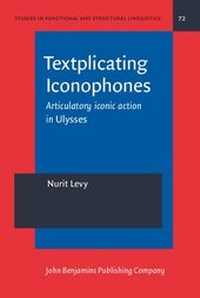
Textplicating Iconophones
Articulatory iconic action in <i>Ulysses</i>
1st Edition
Published on 15. March 2016
XVII, 337 pages
978-90-272-6739-9 (ISBN)
Description

This volume applies a sign-oriented approach to the description of articulatory and acoustic iconic phenomena in James Joyce's Ulysses. In its hypothesis, the greater the role of sensory experience in the message of a text, the more likely it is to employ linguistic representation in articulated sounds iconically to affect sensory experience. Ulysses is presented as a work of art whose emphasis on sensual impression and sensory experience is reflected in the composition and distribution of its phonemes.
Four English phonemes are examined, each in several contexts in Ulysses. A systematic association of resemblance is found between the manner and effort involved in the articulation of each phoneme relative to other phonemes and sounds, and the manner in which semantic content is arranged in the scenes and themes of the book. The different emphases of semantic arrangement associated with each of the examined phonemes are maintained across diverse themes, varied scopes of reference and opposed manners of contextualization. The phonological unit is therefore perceived to carry a semantic impact to complement its differentiating role in linguistic signification. It also offers an innovative approach to Ulysses and exposes new semantic nuances in its narration and characterization techniques.
Four English phonemes are examined, each in several contexts in Ulysses. A systematic association of resemblance is found between the manner and effort involved in the articulation of each phoneme relative to other phonemes and sounds, and the manner in which semantic content is arranged in the scenes and themes of the book. The different emphases of semantic arrangement associated with each of the examined phonemes are maintained across diverse themes, varied scopes of reference and opposed manners of contextualization. The phonological unit is therefore perceived to carry a semantic impact to complement its differentiating role in linguistic signification. It also offers an innovative approach to Ulysses and exposes new semantic nuances in its narration and characterization techniques.
More details
Other editions
Additional editions
Book
04/2016
John Benjamins Publishing Co
€111.30
Shipment within 10-15 days
Content
- Intro
- Textplicating Iconophones
- Editorial page
- Title page
- LCC data
- Table of Contents
- Acknowledgement
- Symbols and Terms
- Lists of Tables
- From phoneme and juncture to an hypothesis of articulatory iconic action in James Joyce's Ulysses
- Introduction
- Reintroducing linguistic substance
- An overview of sound symbolism
- Articulatory iconicity
- Phonology as human behaviour (PHB)
- Phonotactic phenomena from the PHB perspective
- Emphasizing process in language: An example in a theory of juncture
- Three basic theoretical premises
- An hypothesis of articulatory iconic relation between phoneme and text
- The phoneme as the fundamental iconic unit
- Illustrating Ulysses from the perspective articulatory iconic action
- Mirco and macro structure
- Editorial selection
- The phonological system of English in Ulysses
- Articulatory iconic action
- From articulatory iconic action to sound symbolic phenomena
- A text-based illustration of articulatory iconicity
- Articulatory favourings and disfavourings: An example in ch
- Allophones, "free phonetic variation" and phonemes
- Phonemes versus "conditioned" allophones: Opposing phonetic complements
- "Free phonetic variation": Using neologisms to detect articulatory iconicity in a written text
- From "free phonetic variation" to phonemes
- Iconic features of juncture as the method of illustration
- Descriptive emphases in the arrangement of the illustrations
- ILLUSTRATIONS
- PART I. ?
- Suggesting an invariable bias for +boundary in ?
- Articulatory distinctive features
- Inventory
- Introduction: From a synergetic bias to a semantic distinctive feature boundary
- A communicative opposition ? | n+g: The signal-final distribution of ?
- dressinggown
- dressinggown versus morning air
- ungirdled
- drINGdring versus drINGAdring: From a contextual contrast to an oppsotion -ing+ | -ing+a-
- Context
- Iconicity in the contextualization and articulatory action of ?
- Three possible segmentations of -inga-
- Conclusion
- n repetition + [-i]ng, identifying the scope of a larger-than-word segment
- Literary context
- Rhythm
- Stress contour, Lexemes and morphemes
- Articulatoy action and acoustic context
- Iconicity in ?: An articulatory iconic reflection of boundary
- snotgreen | scrotumtightening
- Thematic progression and the articulatory composition of n(x2)+?
- A clustering of articulatory distinctive features: nasality, continuity and aperture 0 in the collocation of n and ?
- n | ?
- Conclusion
- [-i]ng repetition in lexeme+-ing
- Aims
- Context
- Thematic delineation
- shaking and gurgling: Repetition and switch
- Distribution of shak(e+)-ing and gurgl(e+)-ing in Ulysses
- Overview
- Iconic implications of -iNG+G- in shak[ing g]urgling
- Distribution of lexemes and morphemes in the segment
- Textual distribution of gurgle(e+)-ing
- Thematically sensitive distribution of lexeme+-ing
- Repetitions
- A special case of thematically sensitive repetition and switch: she | -ish
- Scene-internal and textual implications of repetition
- Context: Repetition tactics
- Contextual implications of the opposition when | where - an iconic reflection of the spatial-temporal-existential cline in the combination of aperture and mobility: N versus r
- Scene-internal repetition
- Conclusion: Iconic aspects of the arrangement of ? in lexeme+-ing
- A note on the encoder's phonotactic direction-awareness: The case of Stephen Dedalus
- PART II. d
- -ed repetition for theme delimitation
- Articulatory distinctive features
- Inventory
- Introduction: A synergetic bias for transition-delimitation
- Context
- Lexical and articulatory repetition
- Articulatory action: Establishing the possibility of a synergetic bias from the communication-effort perspective
- Repetition-perceptibility
- Stress
- Articulatory action and contextualization in d
- Conclusion: Iconic representation of theme boundary
- A note on the contextualization of n in the scene
- A note on frequency and combination in d: -ed+-ly
- A note on the distribution of -ave+w- in Ulysses
- (+/-a)d- in diaphane | adiaphane - the transparent and the opaque
- Context
- diaphane | adiaphane: Contextualization from the phonotactic perspective
- Contextualization of d
- d articulatory features: Iconicity
- Theme boundaries: Prosodic and morphological features of ineluctable | ineluctably
- Context appropriateness in stress and aperture
- Context appropriateness and iconicity: The encoder's awareness
- Repetition in obstruent phonemes
- Expanding on I am: Signature | sign
- Conclusion
- Conclusion
- An iconic representation of delimitation+transition in d
- Expanding on repetition+switch in lrd
- l-related articulatory iconicity
- Articulatory arrangement: Repetition and switch
- Context
- Iconic integration in r relative to articulatory and acoustic time
- PART III. ?
- Conclusion
- The d connection
- Iconic aspects in the distribution of ?
- Iconicity in the orthographic and articulatory composition of ghost+
- Phonetic and phonemic indexing in -o-
- whores' gets | bastards ghosts
- Context
- Introduction: A synergetic bias for segmenting-sequencing
- Morphology
- Articulatory iconicity and abstraction
- Inventory
- Articulatory-acoustic features
- g, h, versus gh-
- ? and the structuring of topic and comment
- Context that is | that's
- Context-appropriate similarities and associations
- that is | that's
- From that is | that's to -at is | -at's
- A note on iconic phenomena in what is this that is
- -at is | -at's + focusser: That | Ø
- Iconic aspects in the distribution of ?: From that's to phoneme of aperture+?
- phoneme of aperture+?+h(x2)
- ?+h(x2)
- The Bloom connection
- PART IV. s
- From hospice to -ce to s
- Iconicity in the distribution of -ce: Hospice | hospit+
- Message-specific emphases and -ce
- Iconicity in the contextulization of -ce: Once versus twice and thrice
- Iconic aspects in the distribution of -ce
- A contextualization of n for integration
- An articulators-to-signals association of n with semantic integrality in a lexical inventory: One and once
- From the qualitative to the quantitative: A note on n frequency
- Context-appropriate distribution of signals and phonemes: From n to one
- n | ?
- Introduction: A synergetic bias for integration
- Inventory
- Articulatory-acoustic features
- "Contraction" of a copular construct
- A "top-down" selection of 's+: 's+{life[+I'll be round..]}
- A "bottom-up" combinatory anchor of the association of s and integration: 'slife+
- An Irish connection?
- A syntagmatic-paradigmatic iconicity in the distribution of s: That's
- it's | 's-
- Language-specific articulatory iconicity: 'slife versus Irish-Gaelic foth Dia
- Conclusion: A comment-topic arrangement for 'slife, I'll be round with you
- From book end to book beginning as an instance of the association of s and integration: From yeS to Stately
- Signal (re-)arrangement
- Iconicity in the composition of yes: S and integration
- Thematic transitions surrounding yes
- Inter-episode comparison
- Book-scope distribution of yes
- From addition to conclusion in the +result yes
- Contextual support for an association of s with integration in the distribution of yes: A book-scope fluctuation of conclusionaddition
- Book-boundaries: Absolute skewing for +/?dialogue in the distribution of yes
- Conclusion
- Rationale
- A few observations
- Some findings in short
- Iconic anchors in phonemes
- Iconic combinatory processes
- Implications of the iconic processes
- Literary connections
- A final remark
- References
- Appendix
- The Gilbert and Linati Schemata
- Subject Index
- Theme Index
