

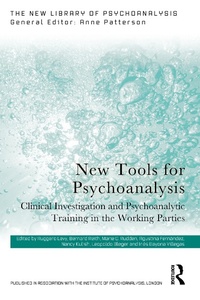
New Tools for Psychoanalysis
Clinical Investigation and Psychoanalytic Training in the Working Parties
1st Edition
Published on 6. February 2024
302 pages
978-1-003-82814-3 (ISBN)
Description

Bringing together the findings from psychoanalysts across the globe, this book introduces and describes the research practices utilised by the Working Parties that were created by the European Psychoanalytical Federation and later supported by the International Psychoanalytical Association.
The book opens with a discussion of the epistemology of research in psychoanalysis, then the various Working Parties describe their methodology and findings, and finally, in the last chapter, an assessment is made of what contributions this oxygenating movement has made to psychoanalysis. It examines topics including individual and group work, supervision, clinical interpretation, erotic transference and psychosomatics, and contains contributions from many distinguished analysts.
Providing a wealth of information on the place of research in evaluating new clinical methods and tools, this book is key reading for psychoanalysts both in practice and in training.
The book opens with a discussion of the epistemology of research in psychoanalysis, then the various Working Parties describe their methodology and findings, and finally, in the last chapter, an assessment is made of what contributions this oxygenating movement has made to psychoanalysis. It examines topics including individual and group work, supervision, clinical interpretation, erotic transference and psychosomatics, and contains contributions from many distinguished analysts.
Providing a wealth of information on the place of research in evaluating new clinical methods and tools, this book is key reading for psychoanalysts both in practice and in training.
Reviews / Votes
'New Tools for Psychoanalysis is a remarkable book that describes the history, development and the different forms of one of the most creative achievements of psychoanalysis supported and stimulated by IPA: the working parties. The editors and contributors are the analysts who developed and currently chair the working parties; each chapter is a true masterclass richly illustrated with clinical material. I strongly recommend the reading of this comprehensive and scholarly-written new book, which shows the vitality of contemporary psychoanalysis. As someone who took part in the collective effort to develop this fascinating new psychoanalytic tool, I am sure that the readers will enjoy the symbiosis of scientific method and aesthetic experience that the book provides.'Claudio Laks Eizirik, former president of the IPA
'The Working Parties were and are the most courageous, innovative and creative experiment of mutual knowledge and theoretical-clinical fertilisation in the psychoanalytic community. By periodically confronting live clinical material provided by analysts from all over the world, groups of geographically and culturally heterogenous colleagues have been able to evolve individually and at the same time have contributed to substantial collective progress in our scientific field. This book, written by yesterday's and today's protagonists of this wonderful adventure, is absolutely recommendable as a fundamental text for understanding contemporary psychoanalysis.'
Stefano Bolognini, former president of the IPA, founder of the Inter-Regional Encyclopedic Dictionary of Psychoanalysis
'Twenty years ago, the European Psychoanalytic Federation initiated a series of working parties to study psychoanalysis psychoanalytically. They were to focus on psychoanalytic data such as case presentations and employ psychoanalytic methods such as free associative listening. The project has since been taken over by the International Psychoanalytic Association, has expanded around the world, and has become a dominant theme in the intellectual life of the profession. This volume, the creation of 31 leading psychoanalysts, presents a valuable summary of ten of these working parties and provides the foundation for the next stage of inquiry in psychoanalysis.'
Robert Michels, MD, Walsh McDermott University professor of Medicine and Psychiatry, Weill Cornell Medicine; president, Board of Directors, The Psychoanalytic Quarterly; former joint editor-in-chief, The International Journal of Psychoanalysis
More details
Series
Edition
1. Auflage
Language
English
Place of publication
London
United Kingdom
Publishing group
Taylor & Francis Ebooks
Target group
College/higher education
Professional and scholarly
Product notice
Reflowable
ISBN-13
978-1-003-82814-3 (9781003828143)
Copyright in bibliographic data and cover images is held by Nielsen Book Services Limited or by the publishers or by their respective licensors: all rights reserved.
Schweitzer Classification
Other editions
Additional editions
Ruggero Levy | Bernard Reith | Agustina Fernandez
New Tools for Psychoanalysis
Clinical Investigation and Psychoanalytic Training in the Working Parties
Book
02/2024
1st Edition
Routledge
€55.60
Shipment within 10-20 days
Ruggero Levy | Bernard Reith | Agustina Fernandez
New Tools for Psychoanalysis
Clinical Investigation and Psychoanalytic Training in the Working Parties
Book
02/2024
1st Edition
Routledge
€186.60
Shipment within 10-20 days
Persons
Ruggero Levy is a psychoanalyst, full member and training analyst of the Porto Alegre Psychoanalytical Society (SPPA); former chair of the IPA Working Parties Committee (2017-2021); former IPA board member (2011-2013 and 2013-2021); gave the keynote paper at the IPA Congress in 2017; and is former president of the SPPA
Bernard Leith is training and supervising analyst and former president of the Swiss Society of Psychoanalysis; regional editor for Europe of the International Journal of Psychoanalysis; former co-chair for Europe of the IPA Working Parties Committee (2017-2021) and chair (2021-2023); and former chair of the EPF Working Party on Initiating Psychoanalysis (2005-2016)
Agustina Fernandez is a psychoanalyst, full member and training analyst of the Argentine Psychoanalytic Association (APA); co-chair for Latin America of the IPA Working Parties Committee (2017-2021 and 2021-2023); and former co-chair of FEPAL Working Parties Commission (2012-2014) and former chair (2014-2016)
Leopoldo Bleger left Argentina in 1976, where he trained as a medical doctor and psychiatrist, and has lived in Paris since. He is a "supervisor analyst" of the French Association. He is member of the EPF WP on Specificity of the Psychoanalytic Treatment Today and was general secretary of the European Federation (2012-2016) and president of his society (2017-2019)
Nancy Kulish is a faculty member and training and supervising analyst of the Michigan Psychoanalytic Institute and adjunct professor, Department of Psychiatry, Wayne State Medical School. She is a member of the IPA Working Parties Committee and gave the Plenary Panel address on Sexuality at the International Psychoanalytic Congress in Mexico City, 2011
Marie G. Rudden is training and supervising analyst of the American Psychoanalytic Association; co-chair of the North American Comparative Clinical Methods Working Party; associate editor, International Journal of Applied Psychoanalytic Studies; on the North American Editorial Board, International Journal of Psychoanalysis; and co-author, Psychodynamic Treatment of Depression (first and second editions), APA
Ines Bayona Villegas is a psychoanalyst and full member of the Colombian Psychoanalytic Society; former IPA chair for Latin America of the Interregional Encyclopedia and Dictionary of Psychoanalysis (2019-2022) and author of Dear Candidate (2021)
Bernard Leith is training and supervising analyst and former president of the Swiss Society of Psychoanalysis; regional editor for Europe of the International Journal of Psychoanalysis; former co-chair for Europe of the IPA Working Parties Committee (2017-2021) and chair (2021-2023); and former chair of the EPF Working Party on Initiating Psychoanalysis (2005-2016)
Agustina Fernandez is a psychoanalyst, full member and training analyst of the Argentine Psychoanalytic Association (APA); co-chair for Latin America of the IPA Working Parties Committee (2017-2021 and 2021-2023); and former co-chair of FEPAL Working Parties Commission (2012-2014) and former chair (2014-2016)
Leopoldo Bleger left Argentina in 1976, where he trained as a medical doctor and psychiatrist, and has lived in Paris since. He is a "supervisor analyst" of the French Association. He is member of the EPF WP on Specificity of the Psychoanalytic Treatment Today and was general secretary of the European Federation (2012-2016) and president of his society (2017-2019)
Nancy Kulish is a faculty member and training and supervising analyst of the Michigan Psychoanalytic Institute and adjunct professor, Department of Psychiatry, Wayne State Medical School. She is a member of the IPA Working Parties Committee and gave the Plenary Panel address on Sexuality at the International Psychoanalytic Congress in Mexico City, 2011
Marie G. Rudden is training and supervising analyst of the American Psychoanalytic Association; co-chair of the North American Comparative Clinical Methods Working Party; associate editor, International Journal of Applied Psychoanalytic Studies; on the North American Editorial Board, International Journal of Psychoanalysis; and co-author, Psychodynamic Treatment of Depression (first and second editions), APA
Ines Bayona Villegas is a psychoanalyst and full member of the Colombian Psychoanalytic Society; former IPA chair for Latin America of the Interregional Encyclopedia and Dictionary of Psychoanalysis (2019-2022) and author of Dear Candidate (2021)
Content
1. Introduction: New Tools of Psychoanalysis 2. End of Training Project/Mind of the Supervisor: Situations with Institutional Impingement 3. The Specificity of Psychoanalytic Treatment Today: Research by the Paris Group 4. The Comparative Clinical Methods Working Party - Passion in the Consulting Room: Analysts' Approaches to Erotic Transferences 5. Working Party on Initiating Psychoanalysis: Understanding the Research Method as Providing a Container for Developing Thinking 6. Working Party on Faimberg's Method for the Group Discussion of Clinical Material: Listening to Listening 7. The Working Party "Microscopy of the Analytic Session: Developing the Capacity for Clinical Investigation (Dreaming, Interpreting, Validating and Theorising) 8. Free Clinical Groups - A Peer Group-Centred Method for Evaluating: Options of Interpretation 9. Working Party on Psychosomatics - EPF: "A Journey of Exploration" (2012-2020) 10. The Three-Level Model: History, Mandate, Rationale and an Extended Case Study Exploring Change in a Patient in Psychoanalysis with the Three-Level Model (3-LM) 11. In its More Than 10 Years of Existence, What Contributions have Working Parties Brought to Psychoanalsis and Psychoanalytic Research?
