

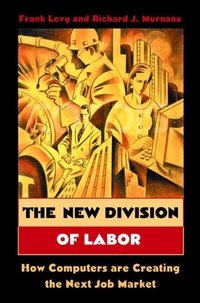
The New Division of Labor
How Computers Are Creating the Next Job Market
1st Edition
Published on 16. June 2015
192 pages
978-1-4008-4592-7 (ISBN)
Description

As the current recession ends, many workers will not be returning to the jobs they once held--those jobs are gone. In The New Division of Labor, Frank Levy and Richard Murnane show how computers are changing the employment landscape and how the right kinds of education can ease the transition to the new job market.
The book tells stories of people at work--a high-end financial advisor, a customer service representative, a pair of successful chefs, a cardiologist, an automotive mechanic, the author Victor Hugo, floor traders in a London financial exchange. The authors merge these stories with insights from cognitive science, computer science, and economics to show how computers are enhancing productivity in many jobs even as they eliminate other jobs--both directly and by sending work offshore. At greatest risk are jobs that can be expressed in programmable rules--blue collar, clerical, and similar work that requires moderate skills and used to pay middle-class wages. The loss of these jobs leaves a growing division between those who can and cannot earn a good living in the computerized economy. Left unchecked, the division threatens the nation's democratic institutions.
The nation's challenge is to recognize this division and to prepare the population for the high-wage/high-skilled jobs that are rapidly growing in number--jobs involving extensive problem solving and interpersonal communication. Using detailed examples--a second grade classroom, an IBM managerial training program, Cisco Networking Academies--the authors describe how these skills can be taught and how our adjustment to the computerized workplace can begin in earnest.
The book tells stories of people at work--a high-end financial advisor, a customer service representative, a pair of successful chefs, a cardiologist, an automotive mechanic, the author Victor Hugo, floor traders in a London financial exchange. The authors merge these stories with insights from cognitive science, computer science, and economics to show how computers are enhancing productivity in many jobs even as they eliminate other jobs--both directly and by sending work offshore. At greatest risk are jobs that can be expressed in programmable rules--blue collar, clerical, and similar work that requires moderate skills and used to pay middle-class wages. The loss of these jobs leaves a growing division between those who can and cannot earn a good living in the computerized economy. Left unchecked, the division threatens the nation's democratic institutions.
The nation's challenge is to recognize this division and to prepare the population for the high-wage/high-skilled jobs that are rapidly growing in number--jobs involving extensive problem solving and interpersonal communication. Using detailed examples--a second grade classroom, an IBM managerial training program, Cisco Networking Academies--the authors describe how these skills can be taught and how our adjustment to the computerized workplace can begin in earnest.
All prices
More details
Edition
Course Book
Language
English
Place of publication
Princeton, NJ
United States
Publishing group
De Gruyter
Target group
Professional and scholarly
Edition type
Digital original
Product notice
Reflowable
Illustrations
2 halftones. 10 line illus.
File size
0,53 MB
ISBN-13
978-1-4008-4592-7 (9781400845927)
Schweitzer Classification
Other editions
Additional editions
Frank Levy | Richard J. Murnane
The New Division of Labor
How Computers Are Creating the Next Job Market
Book
09/2005
Princeton University Press
€32.20
Shipment within 10-20 days
Frank Levy | Richard J. Murnane
The New Division of Labor
How Computers Are Creating the Next Job Market
Book
05/2004
Princeton University Press
€52.08
Article exhausted; check different version
Persons
Frank Levy and Richard J. Murnane coauthored the bestselling Teaching the New Basic Skills (Free Press). Levy is the Daniel Rose Professor of Urban Economics at the Massachusetts Institute of Technology. His books include The New Dollars and Dreams: American Incomes and Economic Change. Murnane, an economist, is Juliana W. and William Foss Thompson Professor of Education and Society at Harvard University. His books include Who Will Teach?: Policies that Matter.
Content
Acknowledgments vii
CHAPTER 1 New Divisions of Labor 1
PART I
Computers and the Economy
CHAPTER 2 Why People Still Matter 13
CHAPTER 3 How Computers Change Work and Pay 31
PART II The Skills Employers Value
CHAPTER 4 Expert Thinking 57
CHAPTER 5 Complex Communication 76
PART III How Skills Are Taught
CHAPTER 6 Enabling Skills 99
CHAPTER 7 Computers and the Teaching of Skills 109
CHAPTER 8 Standards-Based Education Reform in the Computer Age 131
CHAPTER 9 The Next Ten Years 149
Notes 159
Index 169
CHAPTER 1 New Divisions of Labor 1
PART I
Computers and the Economy
CHAPTER 2 Why People Still Matter 13
CHAPTER 3 How Computers Change Work and Pay 31
PART II The Skills Employers Value
CHAPTER 4 Expert Thinking 57
CHAPTER 5 Complex Communication 76
PART III How Skills Are Taught
CHAPTER 6 Enabling Skills 99
CHAPTER 7 Computers and the Teaching of Skills 109
CHAPTER 8 Standards-Based Education Reform in the Computer Age 131
CHAPTER 9 The Next Ten Years 149
Notes 159
Index 169

