

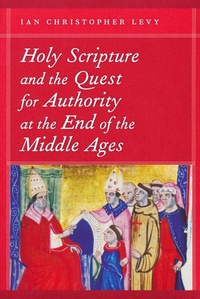
Holy Scripture and the Quest for Authority at the End of the Middle Ages
1st Edition
Published on 15. April 2012
277 pages
978-0-268-08581-0 (ISBN)
Description

All participants in late medieval debates recognized Holy Scripture as the principal authority in matters of Catholic doctrine. Popes, theologians, lawyers-all were bound by the divine truth it conveyed. Yet the church possessed no absolute means of determining the final authoritative meaning of the biblical text-hence the range of appeals to antiquity, to the papacy, and to councils, none of which were ultimately conclusive. Authority in the late medieval church was a vexing issue precisely because it was not resolved. Ian Christopher Levy's book focuses on the quest for such authority between 1370 and 1430, from John Wyclif to Thomas Netter, thereby encompassing the struggle over Holy Scripture waged between Wycliffites and Hussites on the one hand, and their British and Continental opponents on the other. Levy demonstrates that the Wycliffite/Hussite "heretics" and their opponents-the theologians William Woodford, Thomas Netter, and Jean Gerson-in fact shared a large and undisputed common ground. They held recognized licenses of expertise, venerated tradition, esteemed the church fathers, and embraced Holy Scripture as the ultimate authority in Christendom. What is more, they utilized similar hermeneutical strategies with regard to authorial intention, the literal sense, and the appeal to the fathers and holy doctors in order to open up the text. Yet it is precisely this commonality, according to Levy, that rendered the situation virtually intractable; he argues that the erroneous assumption persists today that Netter and Gerson spoke for "the church," whereas Wyclif and Hus sought to destroy it. Levy's sophisticated study in historical theology, which reconsiders the paradigm of heresy and orthodoxy, offers a necessary adjustment in our view of church authority at the turn of the fifteenth century.
Reviews / Votes
"The rivalry which has been traced by many scholars seeking to understand why the controversies of the late Middle Ages led to the Reformation has commonly been seen in terms of 'Church' versus 'Scripture.' But as this refreshing study reminds us, there was [a] third protagonist. This was the exegetical tradition which had developed down the ages in the West. . . . In the text itself there is no oversimplification but a subtle and intelligent tracing of the discussion with close reference to the texts, with welcome Latin source quotations provided in the footnotes. This is an important book." -Journal of Theological Studies"This well-written study tackles an important and essentially unanswerable question about the determination of authority in the late Middle Ages. The simplest answer to the question is that the scriptures are the foundation to which theology, canon law, and indeed the papacy are all subject, but establishing an authoritative reading of the scriptures within the context of tradition is anything but simple." -Renaissance Quarterly
"Levy has written an interesting book about the debate concerning the interpretation of Christian Scripture . . . . Levy's work offers readers a lucid, careful look at a crucial issue for the Christian Church-not only for the late Middle Ages, but also for the church in the 21st century." -Choice
"Levy focuses on the quest for an authoritative determination of the biblical text between the years 1370 and 1430, from John Wycliff to Thomas Netter, thereby encompassing the struggle over Holy Scripture waged between the Hycliffites and Hussites, on the one side, and their British and Continental opponents, on the other side." -New Testament Abstracts
"In recent years John Frymire's The Primacy of the Postils and Christopher Ocker's Biblical Poetics before Humanism and Reformation have fundamentally changed the notion that the Reformation marked a radical departure in attitudes towards scripture. Now Ian Christopher Levy joins the debate and points out that the Reformation was characterized more by questions of authority than scriptural hermeneutics." -The Marginalia Review of Books
"This is a volume the implications of which reach into many disciplines in the study of the late Middle Ages; its impact will be felt for many years to come.... And in a world where Churches of many stripes remain troubled by debates about authority, it offers a clear-eyed look at a period where such debates, left unchecked and fuelled by fear and personal antagonism, had deadly consequences." -Ecclesiastical History
"For the potential reader, this brilliant book is beautifully written in clear prose. . . . From start to finish, Ian Levy is a model teacher, telling us what he intends to do, then doing it, and in the final chapter, 'The Enduring Dilemma,' allowing himself to go beyond the Council of Constance and into the fifteenth century, which thus forms a bridge to sixteenth-century reformations." -The American Benedictine Review
"[This book] focuses on the fundamental problems of finding authority to resolve religious controversies and deciding which sources or traditions had primacy over the others. . . . Levy negotiates the details of the controversies and the complexities of the various actors in this debate masterfully." -Comitatus
"Levy's book is a valuable resource for both scholars and students of late medieval theology, and anyone who wishes to unpack the questions of authority that have undergirded so much theological debate. In addition to the book's utility for historians, the content of this study also bears careful consideration by those who interpret Holy Scripture in contemporary theological discourse." -Religious Studies Review
"Ian Christopher Levy . . . presents a radical rereading of late-medieval theology, with a particular focus on Wyclif and Hus and their opponents, and a surprising presentation of the 'orthodox' foundations of these two famous teachers, masters understood by many of their contemporaries as archetypes of heretics. . . . The theologies of Wyclif and Hus were not a radical departure from the medieval Catholic exegetical tradition, and Levy does a masterful job not only in demonstrating this, but also in providing the context to understand this more fully." -The Thomist
More details
Other editions
Additional editions
Ian Christopher Levy
Holy Scripture and the Quest for Authority at the End of the Middle Ages
Book
08/2022
University of Notre Dame Press
€146.80
Shipment within 10-20 days
Ian Christopher Levy
Holy Scripture and the Quest for Authority at the End of the Middle Ages
Book
04/2012
University of Notre Dame Press
€47.40
Shipment within 10-20 days
Person
Ian Christopher Levy is associate professor of theology at Providence College, Providence, Rhode Island.
Content
- Cover
- Half title
- Series page
- Title page
- Copyright
- Dedication
- Contents
- Abbreviations
- Preface
- Acknowledgments
- Chapter 1: Facets of Authority in the Late Medieval Church
- Chapter 2: The Indignant Master
- Chapter 3: The Ambivalent Friar
- Chapter 4: Ad Fontes (?)
- Chapter 5: A Falling Out
- Chapter 6: Approaching Final Authority
- Chapter 7: The Enduring Dilemma
- Notes
- Bibliography
- Index
