

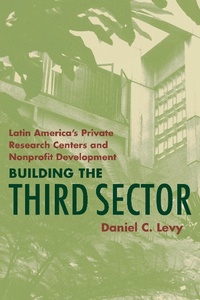
Building the Third Sector
Latin America's Private Research Centers and Nonprofit Development
Published on 23. November 2010
369 pages
978-0-8229-7486-4 (ISBN)
Description

. Winner of the 1997 ARNOVA Award for Distinguished Book in Nonprofit and Voluntary Action Research
The private third sector has largely displaced public universities and bureaucracies as Latin America's leaders in social science and related policy activities. In many nations, these private research centers have become the main workplace for intellectuals. Mostly think tanks, they are influential political institutions, often making strong contribution to democratization.
The success of these research centers marks an unsurpassed triumph for international philanthropy, but it also raises questions about the proper role and structural home for research and advanced study. Levy shows how the centers' success often undermine a region's struggling universities while failing themselves to fulfill higher education's fundamental mission.
Levy deals broadly with regional developments, yet systematically identifies and analyzes the crucial subpatterns. He integrates impressive empirical data with conceptual perspectives on nonprofit organizations, comparative politics, and comparative education as well as Latin American studies.
The private third sector has largely displaced public universities and bureaucracies as Latin America's leaders in social science and related policy activities. In many nations, these private research centers have become the main workplace for intellectuals. Mostly think tanks, they are influential political institutions, often making strong contribution to democratization.
The success of these research centers marks an unsurpassed triumph for international philanthropy, but it also raises questions about the proper role and structural home for research and advanced study. Levy shows how the centers' success often undermine a region's struggling universities while failing themselves to fulfill higher education's fundamental mission.
Levy deals broadly with regional developments, yet systematically identifies and analyzes the crucial subpatterns. He integrates impressive empirical data with conceptual perspectives on nonprofit organizations, comparative politics, and comparative education as well as Latin American studies.
More details
Other editions
Additional editions
Daniel Levy
Building the Third Sector
Latin America's Private Research Centers and Nonprofit Development
Book
08/1996
University of Pittsburgh Press
€58.32
Article exhausted; check different version
Daniel Levy
Building the Third Sector
Latin America's Private Research Centers and Nonprofit Development
Book
08/1996
University of Pittsburgh Press
€60.80
Article exhausted; check different version
Person
Daniel Levy is professor in the departments of Educational Administration and Political Studies, Latin American Studies, and Political Science at the State University of New York, albany.
Content
- Intro
- Contents
- List of Acronyms
- Preface
- 1. Breakthroughs
- 2. Mapping the Center and Periphery
- 3. Growth: Public Failure and Beyond
- 4. Finances: Philanthropy, Diversification, and Control
- 5. Politics: The Two Faces of Pluralism
- 6. Combining Quality and Relevance
- 7. The Subordination of Scholarship
- 8. Conclusion
- Appendixes
- Appendix A: Interviews
- Appendix B: Personal Correspondence
- Notes
- References
- Index
