

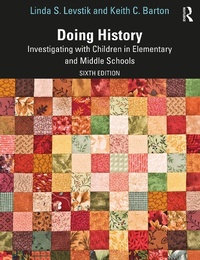
Doing History
Investigating with Children in Elementary and Middle Schools
6th Edition
Published on 6. September 2022
244 pages
978-1-000-63486-0 (ISBN)
Description

Now in its sixth edition, Doing History offers a unique perspective on teaching and learning history in the elementary and middle grades. Through case studies of teachers and students in diverse classrooms and from diverse backgrounds, it shows children engaging in authentic historical investigations, often in the context of an integrated social studies curriculum.
The book is grounded in the view that children can engage in valid forms of historical inquiry-asking questions, collecting and analyzing evidence, examining the varied perspectives and experiences of people in the past, and creating evidence-based historical accounts and interpretations. Grounded in contemporary sociocultural theory and research, the text features vignettes in each chapter showing communities of teachers and students doing history in environments rich in literature, art, writing, and discussion. The authors explain how these classrooms reflect contemporary principles of teaching and learning, and thus, the descriptions not only provide specific examples of successful activities but also place them in a context that allows teachers to adapt and apply them in a wide range of settings.
Doing History emphasizes diversity in two ways: Readers encounter students from a variety of backgrounds and see how their diverse experiences can form the foundation for learning, and they also see examples of how teachers can engage students with diverse experiences and perspectives in the past, including those that led to conflict and oppression. The book also discusses principles for working with English learners and newcomers, and it provides guidance in using multiple forms of assessment to evaluate the specifically historical aspects of children's learning.
Updates to this edition include updated historical and instructional examples to ensure currency, new suggestions for children's literature to support good teaching, expanded attention to teaching about oppressed groups in history, and greater attention to when historical perspective taking is and is not appropriate.
The book is grounded in the view that children can engage in valid forms of historical inquiry-asking questions, collecting and analyzing evidence, examining the varied perspectives and experiences of people in the past, and creating evidence-based historical accounts and interpretations. Grounded in contemporary sociocultural theory and research, the text features vignettes in each chapter showing communities of teachers and students doing history in environments rich in literature, art, writing, and discussion. The authors explain how these classrooms reflect contemporary principles of teaching and learning, and thus, the descriptions not only provide specific examples of successful activities but also place them in a context that allows teachers to adapt and apply them in a wide range of settings.
Doing History emphasizes diversity in two ways: Readers encounter students from a variety of backgrounds and see how their diverse experiences can form the foundation for learning, and they also see examples of how teachers can engage students with diverse experiences and perspectives in the past, including those that led to conflict and oppression. The book also discusses principles for working with English learners and newcomers, and it provides guidance in using multiple forms of assessment to evaluate the specifically historical aspects of children's learning.
Updates to this edition include updated historical and instructional examples to ensure currency, new suggestions for children's literature to support good teaching, expanded attention to teaching about oppressed groups in history, and greater attention to when historical perspective taking is and is not appropriate.
Reviews / Votes
As a path-breaking, field-defining text, Doing History is a timeless, essential and mindful resource for social studies educators. In this revised edition, Levstik and Barton inspire teachers to confront the diverse realities of a complex and conflicted history by guiding students in the study of history as a multifarious array of choices complicated by social, political, and economic factors deeply rooted in cultural variation, controversy, perplexing dilemmas, and persistent historic issues. Grounded in authentic and research-informed classroom applications, each chapter presents tools to constructively empower students as transformative, agentic beings capable of engaging in historical inquiry which teaches them how to seek justice, learn from diverse people, exercise reasoned deliberation, intelligently participate in community-facing civil action, and live harmoniously in a complex, diverse world.Tina L. Heafner, Professor of Social Studies Education, University of North Carolina-Charlotte, USA, and former President, National Council for the Social Studies
A foundational text for teaching history to elementary and middle school students! Through vivid teaching examples, Levstik and Barton show how young students can grapple with the complexities of history. The authors present theory-informed pedagogical practices for inquiry-based instruction, historical research, deliberation, and arts integration while also providing varied ways to assess students' historical thinking and disciplinary skills and methods to support English Language Learners. This new edition includes updated classroom examples and the latest scholarship to guide educators in teaching controversy and inclusive histories. All social studies educators need a copy in their professional library!
Sara B. Demoiny, Assistant Professor of Elementary Education, Auburn University, USA.
More details
Edition
6th edition
Language
English
Place of publication
London
United Kingdom
Publishing group
Taylor & Francis Ltd
Target group
College/higher education
Illustrations
3 Tables, black and white; 28 Line drawings, black and white; 6 Halftones, black and white; 34 Illustrations, black and white
ISBN-13
978-1-000-63486-0 (9781000634860)
Copyright in bibliographic data and cover images is held by Nielsen Book Services Limited or by the publishers or by their respective licensors: all rights reserved.
Schweitzer Classification
Other editions
Additional editions
Linda S. Levstik | Keith C. Barton
Doing History
Investigating with Children in Elementary and Middle Schools
Book
09/2022
6th Edition
Routledge
€104.40
Shipment within 10-20 days
Linda S. Levstik | Keith C. Barton
Doing History
Investigating with Children in Elementary and Middle Schools
Book
09/2022
6th Edition
Routledge
€215.41
Shipment within 10-20 days
Book
09/2022
Taylor & Francis
Unfortunately, price unknown
Available (delivery time upon request)
Previous edition
Mark Donnelly | Claire Norton
Doing History
E-Book
11/2020
2nd Edition
Routledge
€33.99
Available for download
Persons
Linda S. Levstik is Professor Emerita in the Department of Curriculum and Instruction at the University of Kentucky, USA.
Keith C. Barton is Professor in the Department of Curriculum and Instruction and Adjunct Professor of History at Indiana University, USA.
Keith C. Barton is Professor in the Department of Curriculum and Instruction and Adjunct Professor of History at Indiana University, USA.
Content
1 Past, Present, and Future: The Sociocultural Context for Studying History; 2 It's Not Just a Mishap: The Theory Behind Historical Inquiry; 3 There Aren't a lot of "For Sure" Facts: Building Communities of Historical Inquiry; 4 To Find out Things We Didn't Know about Ourselves: Personal Histories; 5 Tell Me about Yourself: Linking Children to the Past through Family Histories; 6 "I Think Columbus Went to Hell!" Connections and Controversies in World History; 7 Camel Dies, Lose Three Turns: Scaffolding Inquiry into World History; 8 Rats in the Hospital: Creating a History Museum; 9 I have no Experience with This! Historical Inquiry in an Integrated Social Studies Setting; 10 Why Isn't That in the Textbook? Fiction, Nonfiction, and Historical Thinking; 11 Oh, Good! We Get to Have...A Reasoned Discussion: Putting Conflict in Context; 12 In My Opinion, it Could Happen Again: How Attitudes and Beliefs have Changed over Time; 13 Nosotros La Gente: Honesty and Diversity in U.S. History; 14 The Arts Make Us All Part of Humankind: Cognitive Pluralism in History Teaching and Learning
