

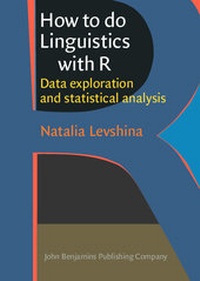
How to do Linguistics with R
Data exploration and statistical analysis
1st Edition
Published on 25. November 2015
XI, 443 pages
978-90-272-6845-7 (ISBN)
Description

This book provides a linguist with a statistical toolkit for exploration and analysis of linguistic data. It employs R, a free software environment for statistical computing, which is increasingly popular among linguists. How to do Linguistics with R: Data exploration and statistical analysis is unique in its scope, as it covers a wide range of classical and cutting-edge statistical methods, including different flavours of regression analysis and ANOVA, random forests and conditional inference trees, as well as specific linguistic approaches, among which are Behavioural Profiles, Vector Space Models and various measures of association between words and constructions. The statistical topics are presented comprehensively, but without too much technical detail, and illustrated with linguistic case studies that answer non-trivial research questions. The book also demonstrates how to visualize linguistic data with the help of attractive informative graphs, including the popular ggplot2 system and Google visualization tools.
This book has a companion website: http://doi.org/10.1075/z.195.website
This book has a companion website: http://doi.org/10.1075/z.195.website
More details
Other editions
Additional editions
Book
11/2015
John Benjamins Publishing Co
€111.30
Shipment within 10-15 days
Book
11/2015
John Benjamins Publishing Co
€38.16
Shipment within 10-15 days
Person
Content
- Intro
- How to do Linguistics with R
- Title page
- LCC data
- Dedication page
- Table of contents
- Acknowledgements
- Introduction
- 1. Who is this book written for?
- 2. The quantitative turn in linguistics
- 3. How to use this textbook
- 1. What is statistics?
- What you will learn from this chapter:
- 1.1 Statistics and statistics
- 1.2 Formulating and testing your hypotheses
- 1.2.1 Null and alternative hypotheses
- 1.2.2 Those mysterious p-values.
- 1.2.3 Type I and Type II errors
- 1.2.4 One-tailed and two-tailed statistical tests
- 1.3 What statistics cannot do for you
- 1.4 Types of variables
- 1.5 Summary
- 2. Introduction to R
- What you will learn from this chapter:
- 2.1 Introduction
- 2.2 Installation of the basic distribution and add-on packages
- 2.3 First steps with R
- 2.3.1 Starting R
- 2.3.2 R syntax
- 2.3.3 Exiting from R or terminating a process
- 2.3.4 Getting help
- 2.4 Main types of R objects
- 2.5 RStudio
- 2.6 Importing and exporting your data and saving your graphs
- 2.6.1 Importing your data to R
- 2.6.2 Exporting your data from R
- 2.6.3 Saving your graphs
- 2.7 Summary
- 3. Descriptive statistics for quantitative variables
- What you will learn from this chapter:
- 3.1 Analysing the distribution of word lengths: Basic descriptive statistics
- 3.1.1 The data
- 3.1.2 Measures of central tendency
- 3.1.3 Measures of dispersion
- 3.2 Bad times, good times: Visualization of a distribution and finding outliers
- 3.3 Zipf's law and word frequency: Transformation of quantitative variables
- 3.4 Summary
- 4. How to explore qualitative variables
- What you will learn from this chapter:
- 4.1 Frequency tables, proportions and percentages
- 4.2 Visualization of categorical data
- 4.3 Basic Colour Terms: Deviations of Proportions in subcorpora
- 4.3.1 The data and hypothesis
- 4.3.2 Deviation of proportions as a measure of dispersion
- 4.4 Summary
- 5. Comparing two groups
- What you will learn from this chapter:
- 5.1 Comparing group means (medians): An overview of the tests
- 5.2 Comparing the number of associations triggered by high- and low-frequency nouns with the help of an independent t-test
- 5.2.1 Data and hypothesis
- 5.2.2 Descriptive statistics and visualizations
- 5.2.3 Choosing an appropriate test to compare the measures of central tendency in two groups
- 5.2.4 Confidence intervals and standard errors
- 5.3 Comparing concreteness scores of high- and low-frequency nouns with the help of a two-tailed Wilcoxon test
- 5.3.1 Data and hypotheses
- 5.3.2 Descriptive statistics and visualizations: Strip charts and rug plots
- 5.3.3 Inferential statistics: The two-tailed Wilcoxon test
- 5.4. Comparing associations produced by native and non-native speakers: A paired one-tailed t-test
- 5.4.1 Creating simulation data
- 5.4.2 Performing the paired t-test
- 5.5 Summary
- 6. Relationships between two numerical variables
- What you will learn from this chapter:
- 6.1 What is correlation?
- 6.2 Word length and word recognition: The Pearson product-moment correlation coefficient
- 6.2.1 The data and hypothesis
- 6.2.2 Descriptive statistics and visualizations
- 6.2.3 Testing the significance of the correlation coefficient
- 6.3 Emergence of grammar from lexicon: Spearman's ? and Kendall's t.
- 6.3.1 The data and hypothesis
- 6.3.2 Exploring the data and computing correlation coefficients
- 6.4 Visualization of correlations between more than two variables with the help of correlograms
- 6.5 Summary
- 7. More on frequencies and reaction times
- What you will learn from this chapter
- 7.1 The basic principles of linear regression analysis
- 7.2 Putting several factors together: Predicting reaction times in a lexical decision task
- 7.2.1 Data and hypotheses
- 7.2.2 The lm() function and interpretation of its output
- 7.2.3 Selecting the explanatory variables
- 7.2.4 Checking for outliers and overly influential observations
- 7.2.5 Checking the regression assumptions
- 7.2.6 Testing and interpreting interactions
- 7.2.7 Checking for overfitting
- 7.2.8 Robust regression: Bootstrap
- 7.3 Summary
- 8. Finding differences between several groups
- What you will learn from this chapter:
- 8.1 What is ANOVA?
- 8.2 Motion events in Nicaraguan Sign Language: Independent one-way ANOVA
- 8.2.1 Theoretical background and data
- 8.2.2 Exploring the data
- 8.2.3 Assumptions of one-way parametric ANOVA
- 8.2.4 Performing parametric one-way ANOVA
- 8.2.5 Alternative tests
- 8.2.6 Post-hoc tests
- 8.3 Development of spatial modulations in Nicaraguan Sign Language: Independent factorial (two-way) ANOVA
- 8.3.1 The data and hypothesis
- 8.3.2 Descriptive statistics for different groups and interaction plot
- 8.3.3 Assumptions of parametric factorial ANOVA
- 8.3.4 ANOVA and orthogonal contrasts
- 8.3.5 Alternative tests
- 8.3.6 Post-hoc tests
- 8.4 Do native English and native Mandarin Chinese speakers conceptualize time differently? Repeated-measured and mixed-design ANOVA (mixed GLM method)
- 8.4.1 The data and hypothesis
- 8.4.2 Fitting a mixed-design ANOVA with the help of mixed GLM
- 8.4.3 Post-hoc tests
- 8.5 Summary
- 9. Measuring associations between two categorical variables
- What you will learn from this chapter:
- 9.1 Testing independence
- 9.2 The story of over is not over: Metaphoric and non-metaphoric uses in two registers (analysis of a 2-by-2 contingency table)
- 9.2.1 The data and hypothesis
- 9.2.2 Visualizations, proportions and measures of effect size: Odds ratios, Cramér's V and the ø coefficient
- 9.2.3 Testing statistical significance: The ?2 -test of independence
- 9.3 Metaphorical and non-metaphorical uses of see in four registers (analysis of a 4-by-2 table)
- 9.3.1 The data and hypothesis
- 9.3.2 Descriptive statistics and visualizations
- 9.3.3 Testing the statistical significance and analysing the residuals: The ?2-test and mosaic and association plots
- 9.4 Summary
- 10. Association measures
- What will you learn from this chapter:
- 10.1 Measures of association: A brief typology
- 10.1.1 Frequencies that you will need in order to compute association measures
- 10.1.2 Unidirectional (asymmetric) vs. bidirectional (symmetric) measures
- 10.1.3 Contingency-based vs. non-contingency-based measures
- 10.2 Case study: The Russian ditransitive construction and its collexemes
- 10.2.1 Theoretical background and data
- 10.2.2 Computation of some popular association measures
- 10.3 Summary
- 11. Geographic variation of quite: Distinctive collexeme analysis
- What you will learn from this chapter:
- 11.1 Introduction to distinctive collexeme analysis
- 11.2 Distinctive collexeme analysis of quite + ADJ in different varieties of English
- 11.2.1 Theoretical background and data
- 11.2.2 Simple distinctive collexeme analysis of quite + ADJ in British and American English
- 11.2.3 Multiple distinctive collexeme analysis: Quite + ADJ in the British, American and Canadian varieties of English
- 11.3 Summary
- 12. Probabilistic multifactorial grammar and lexicology
- What you will learn from this chapter:
- 12.1 Introduction to logistic regression
- 12.2 Logistic regression model of Dutch causative auxiliaries doen and laten
- 12.2.1 Theoretical background and data
- 12.2.2 Fitting a binary logistic regression model: Main functions
- 12.2.3 Selection of variables
- 12.2.4 Testing possible interactions
- 12.2.5 Identifying outliers and overly influential observations
- 12.2.6 Checking the regression assumptions
- 12.2.7 Testing for overfitting
- 12.2.8 Interpretation of the model
- 12.3 Summary
- 13. Multinomial (polytomous) logistic regression models of three and more near synonyms
- What you will learn from this chapter:
- 13.1 What is multinomial regression?
- 13.2 Multinomial models of English permissive constructions
- 13.2.1 Data and hypotheses
- 13.2.2 Contrasting allow and permit with let
- 13.2.3 'One vs. rest' approach
- 13.3 Summary
- 14. Conditional inference trees and random forests
- What you will learn from this chapter:
- 14.1 Conditional inference trees and random forests
- 14.2 Conditional inference trees and random forests of three English causative constructions
- 14.2.1 The data and hypotheses
- 14.2.2 Fitting a conditional inference tree model
- 14.2.3 Random forests
- 14.3 Summary
- 15. Behavioural profiles, distance metrics and cluster analysis
- What you will learn from this chapter:
- 15.1 What are Behavioural Profiles?
- 15.2 Behavioural Profiles of English analytic causatives
- 15.2.1 Data and theoretical background
- 15.2.2 Computation of numeric BP vectors from the categorical data
- 15.2.3 Distance matrix
- 15.2.4 Hierarchical cluster analysis
- 15.2.4.1 Identifying the clusters
- 15.2.4.2 Interpretation of the cluster solution: Snake plots and effect size measures
- 15.2.4.3 Validation of a cluster solution
- 15.2.5 Partitioning methods
- 15.2.5.1 General introduction
- 15.2.5.2 Partitioning around centroids (k-means)
- 15.2.5.3 Partitioning around medoids
- 15.3 Summary
- 16. Introduction to Semantic Vector Spaces
- What you will learn from this chapter:
- 16.1 Distributional models of semantics and Semantic Vector Space models
- 16.2 A Semantic Vector Space model of English verbs of cooking
- 16.2.1 Theoretical background and data
- 16.2.2 Creating vectors of weighted co-occurrence frequencies
- 16.2.3 Cosine similarity
- 16.3 Summary
- 17. Language and space
- What you will learn from this chapter:
- 17.1 Making maps with R
- 17.2 What is multidimensional scaling?
- 17.3 Computation and representation of geographical distances
- 17.4 Computation and representation of linguistic distances: The Kruskal non-metric MDS
- 17.4.1 Recoding the dataset
- 17.4.2 Computation of Gower distances
- 17.5 The Mantel test for distance matrices
- 17.6 Summary
- 18. Multidimensional analysis of register variation
- What you will learn from this chapter:
- 18.1 Multidimensional analysis of register variation
- 18.2 Case study: Register variation in the British National Corpus
- 18.2.1 The data and research question
- 18.2.2 Principal Component Analysis
- 18.2.3 Factor Analysis
- 18.3 Summary
- 19. Exemplars, categories, prototypes
- What you will learn from this chapter:
- 19.1 Register variation of Basic Colour Terms: Simple Correspondence Analysis
- 19.1.1 The data and hypothesis
- 19.1.2 Simple Correspondence Analysis
- 19.2 Visualization of exemplars and prototypes of lexical categories: Multiple Correspondence Analysis of Stuhl and Sessel
- 19.2.1 The data and theoretical background
- 19.2.2 Multiple Correspondence Analysis
- 19.3 Summary
- 20. Constructional change and motion charts
- What you will learn from this chapter:
- 20.1 The past and present of the future: Diachronic motion charts of be going to and will
- 20.1.1 Theoretical background and data
- 20.1.2 Motion charts
- 20.2 Summary
- Epilogue
- Appendix 1. The most important R objects and basic operations with them
- Appendix 2. Main plotting functions and graphical parameters in R
- 24.1 A scatterplot with text labels
- References
- Subject Index
