

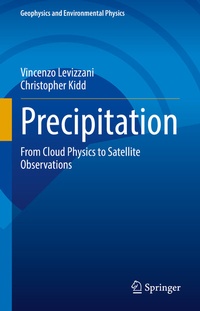
Precipitation
Description

This book provides a comprehensive and in-depth exploration of the physics involved in the formation of precipitation in the Earth's atmosphere. It begins by emphasizing the significance of precipitation in the Earth system and climate. Cloud physics is incorporated to provide readers with the essential physical background necessary to understand the process of hydrometeor formation within clouds. Subsequently, the intricate structure of precipitation systems is elucidated, aiding readers in comprehending the mesoscale and synoptic characteristics of precipitation organization. The book concludes with a section on precipitation observation and measurements, which examines various sensors, such as gauges, radars, satellites, and platforms. These networks enable access to global precipitation data for meteorology and climate analysis.
Designed to meet the needs of graduate and PhD students in fields such as geophysics, meteorology, climate science, hydrology, environmental sciences, water management, and geography, this book is also valuable for researchers and professionals from diverse disciplines who require a solid understanding of precipitation products for their work. Although the book requires a fundamental understanding of classical physics (including dynamics, thermodynamics, electricity, and magnetism), as well as a basic grasp of inorganic chemistry, its content remains accessible and informative for readers with diverse levels of expertise.
More details
Other editions
Additional editions
Persons
Vincenzo Levizzani is retired as Director of Research at the National Research Council of Italy. He has taught cloud physics at the University of Bologna for more than 20 years. His research focuses on the structure of precipitating systems, the physics of intense storms using radar and satellites, satellite precipitation estimation, severe weather analysis, and climatology of precipitation. He has led, as chairman, several expert groups at WMO, EUMETSAT and satellite planning groups for Meteosat Third Generation and EUMETSAT Polar Satellite Second Generation. He was co-founder of the International Precipitation Working Group, an international organisation with more than 500 members. He has also led several research projects of the European Commission. His publications consist of more than 200 papers in peer reviewed literature and several books.
Christopher Kidd is a research scientist at the Earth System Science Interdisciplinary Center at the University of Maryland and at NASA's Goddard Space Flight Center. Before moving to the US, he was a senior lecturer at the University of Birmingham in the UK where he taught applied meteorology and climatology and Earth observation. The focus of his research centres on the observation of precipitation from surface and satellite sensors, the intercomparison and validation of precipitation measurements and the development of new satellite systems for precipitation estimation. He has been a member of a number of advisory groups for EUMETSAT, ESA and NASA, has been a co-chair of the International Precipitation Working Group, is a co-lead for the Precipitation Virtual Constellation of the Committee on Earth Observation Satellites, and is a member of the National Academies Committee on Radio Frequencies. His research has been funded by NASA, NOAA, EUMETSAT, ESA, Natural Environment Research Council, and the European Commission. He has published over 100 papers, book chapters and books in internationally peer reviewed literature.
Content
Clouds and precipitation in the Earth system.- Observing clouds.- Cloud physics.- Precipitation.- Precipitation observations.
