

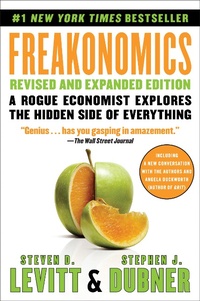
Freakonomics Rev Ed
Description

The legendary bestseller that encouraged millions of readers to look at the hidden side of everything
Which is more dangerous: a gun or a swimming pool? Why do drug dealers still live with their moms? What do real estate agents and the KKK have in common?
These may not sound like typical questions for an economist to ask. But Steven D. Levitt is not a typical economist. He is a much-heralded scholar who uses data analysis to study the riddles of everyday life?from cheating and crime to sports and child-rearing?and whose conclusions turn conventional wisdom on its head. Freakonomics Rev Ed is a groundbreaking collaboration between Levitt and Stephen J. Dubner, an award-winning author and journalist. Some of these questions concern life-and-death issues; others have an admittedly freakish quality. Thus the new field of study contained in this book: freakonomics.
Through forceful storytelling and wry insight, Levitt and Dubner show that pop economics is, at root, the study of incentives?how people get what they want, or need, especially when other people want or need the same thing. In Freakonomics Rev Ed, they explore the hidden side of everything. The inner workings of a crack gang. The myths of campaign finance. The telltale marks of a cheating schoolteacher. What unites all these stories is a belief in counterintuitive thinking: that the modern world, despite a great deal of complexity and downright deceit, is not impenetrable, is not unknowable, and?if the right questions are asked?is even more intriguing than we think. All it takes is a new way of looking. Freakonomics Rev Ed establishes this unconventional premise: If morality represents how we would like the world to work, then behavioral economics represents how it actually does work. It is true that readers of this book will be armed with enough riddles and stories to last a thousand cocktail parties. But Freakonomics can provide more than that. It will literally redefine the way we view the modern world.
This revised and expanded edition of the book contains a smattering of bonus material, including selected Freakonomics columns from The New York Times Magazine; a Q&A with Steven Levitt, Stephen Dubner, and Angela Duckworth; and the New York Times Magazine profile Dubner wrote about Levitt that started it all.
This exploration of the hidden side of everything reveals:
- Incentives Are Everywhere: Why do drug dealers still live with their moms? It all comes down to understanding how people?from criminals to teachers?respond to economic, social, and moral incentives.
- Challenging Conventional Wisdom: Discover what schoolteachers and sumo wrestlers have in common, why real estate agents might not have your best interest at heart, and how common knowledge is often completely wrong.
- Case Studies in Economics: See how sifting through data reveals surprising truths about crime rates, parenting strategies, and more, showing that the modern world is more intriguing than we think.
- Real-World Economics: Learn which is more dangerous, a gun or a swimming pool, and other riddles of everyday life that demonstrate how economics represents the way the world actually works.
More details
Other editions
Additional editions
Persons
Steven D. Levitt, a professor of economics at the University of Chicago, was awarded the John Bates Clark Medal, given to the most influential American economist under forty. He is also a founder of The Greatest Good, which applies Freakonomics-style thinking to business and philanthropy.
Stephen J. Dubner, an award-winning journalist and radio and TV personality, has worked for the New York Times and published three non-Freakonomics books. He is the host of Freakonomics Radio and Tell Me Something I Don't Know.
Content
- Intro
- Title Page
- Contents
- An Explanatory Note
- Introduction: The Hidden Side of Everything
- Chapter 1: What Do Schoolteachers and Sumo Wrestlers Have in Common?
- Chapter 2: How is the Ku Klux Klan Like a Group of Real-Estate Agents?
- Chapter 3: Why Do Drug Dealers Still Live with Their Moms?
- Chapter 4: Where Have All the Criminals Gone?
- Chapter 5: What Makes a Perfect Parent?
- Chapter 6: Perfect Parenting, Part II
- or: Would a Roshanda by Any Other Name Smell as Sweet?
- Epilogue: Two Paths to Harvard
- Bonus Matter
- "The Probability That a Real-Estate Agent Is Cheating You . . ."
- Selected "Freakonomics" Columns From The New York Times Magazine
- A Q&A with the Authors
- Acknowledgments
- An Excerpt From The New York Times Bestseller Superfreakonomics
- Notes
- Index
- About the Authors
- Praise
- Copyright
- About the Publisher
