

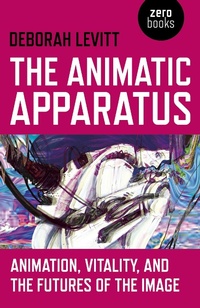
The Animatic Apparatus
Animation, Vitality, and the Futures of the Image
Published on 25. May 2018
160 pages
978-1-78535-703-9 (ISBN)
Description

Unprecedented kinds of experience, and new modes of life, are now produced by simulations, from the CGI of Hollywood blockbusters to animal cloning to increasingly sophisticated military training software, while animation has become an increasingly powerful pop-cultural form. Today, the extraordinary new practices and radical objects of simulation and animation are transforming our neoliberal-biopolitical "culture of life". The Animatic Apparatus offers a genealogy for the animatic regime and imagines its alternative futures, countering the conservative-neoliberal notion of life's sacred inviolability with a new concept and ethics of animatic life.
Reviews / Votes
At once theoretically dazzling and fearless, The Animatic Apparatus shows how the production of life in animation deconstructs ontology as such: "There is no death in animation, because there is no being, no existence, to begin with." But an-ontology is not the end of living. Instead, carefully tracing how the medium of animation has come to operate as a supermedium, Levitt finds animation to be the key not only to modelling the contemporary condition but also to formulating an ethical relation to it. Animation offers nothing less than a toolkit for new assembling of lives upon the active void of contemporary media. -- Thomas Lamarre, University of Chicago With subtlety and elan, Levitt compellingly animates an historical journey with dolls, puppets, automata, replicants and artificial life to secure the case for "an-ontology." Media, in the form of novels, films, images, cartoons, screens, robots, and other automata are recursively part of the "human" condition such that distinctions between life and artificial life or intelligence and AI are ultimately unsustainable. Levitt's inspired pursuit of a mediology of technology and metaphysics demonstrates that whatever we are, our emergence is bound up with the simulacrum, and that animation is at least as real as the real itself. What's more, our ethics and our politics must come from that condition. -- Jonathan Beller, Author of The Cinematic Mode of Production, Professor of Humanities and Media Studies and Critical and Visual Studies, Pratt Institute, Brooklyn, NY What if Mamoru Oshi's 2004 anime Ghost in the Shell 2: Innocence is not just a midnight cult film, but the secret template for nearly all of 21st century technoculture? In The Animatic Apparatus, Deborah Levitt convincingly argues that this is actually the case. "Images possess their own forms of vitality," ones that cannot be easily distinguished from our own. -- Steven Shaviro, DeRoy Professor of English at Wayne State University, author of Connected: Or, What It Means to Live in the Network SocietyMore details
Language
English
Place of publication
New York
United Kingdom
Publishing group
Collective Ink
File size
2,87 MB
ISBN-13
978-1-78535-703-9 (9781785357039)
Copyright in bibliographic data and cover images is held by Nielsen Book Services Limited or by the publishers or by their respective licensors: all rights reserved.
Schweitzer Classification
Other editions
Additional editions
Book
05/2018
Zero Books
€13.00
Article not available at the moment
Person
Deborah Levitt is Assistant Professor of Culture and Media Studies at Eugene Lang College, The New School. She is a media historian and theorist interested in film and digital media including CGI, VR, and AR and has published on Giorgio Agamben, media and biopolitics, and animation theory. She lives in New York.
Content
- Intro
- Title Page
- Copyright
- Contents
- Acknowledgements
- Introduction
- Chapter 1: The Cinematic Regime: Biopolitics, Spectral Life, and the Crisis of Ontology
- Chapter 2: The Animatic Apparatus: Desiring Images
- Chapter 3: Phantasmatic Simulacra and Anti-Pinocchios
- Chapter 4: The Doll Theme: Object Lessons in An-Ontology
- Chapter 5: An-Ontology and Animatic Aesthetics
- Chapter 6: Animatic Aesthetics, Part 2: Affects, Anagrams, Simulacra
- Chapter 7: Animatic Pop: Body-as-Image, Image-as-Body
- Conclusion: How-Ethics
- Notes
- Works Cited
