

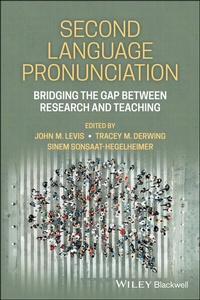
Second Language Pronunciation
Description

In Second Language Pronunciation: Bridging the Gap Between Research and Teaching, a team of distinguished researchers and educators delivers an incisive and practical approach to evidence-based pronunciation instruction in second language classrooms. Developed for language teachers who want to incorporate and implement the most effective pedagogical methods in their language instruction, this edited volume offers 15 essays that connect the latest research with practical applications in the classroom.
In addition to exploring recent but less well-known methods--like High Variability Phonetic Training, discourse-based teaching, communicative classrooms, and technology-based methods--these chapters are unified in bringing theory to bear on practical questions faced by language teachers. The chapters follow a standard format, moving from critical research issues to pedagogical implications, and practical resources to equip language teachers, scholars, administrators, and teachers-in-training with the tools they require to develop their students' pronunciation abilities. Readers will also find:
* A thorough introduction to using empirical evidence to guide pronunciation instruction in second language students
* Comprehensive explorations of the integration of pronunciation instruction into second language education
* Practical discussions of perception training in pronunciation instruction and the importance of L2 segmental and suprasegmental contrasts in pronunciation learning
* In-depth examinations of classroom research for pronunciation and the use of technology to explore L2 pronunciation
Perfect for upper-level undergraduate and graduate students studying TESOL, applied linguistics, and second language acquisition, Second Language Pronunciation: Bridging the Gap Between Research and Teaching will also earn a place in the libraries of researchers, scholars, and teachers of language and education.
More details
Other editions
Additional editions
Persons
John M. Levis is Professor of English and Applied Linguistics at Iowa State University, USA. He is a veteran ESL teacher, and his research is focused on second language acquisition, especially second language pronunciation.
Tracey M. Derwing is Professor Emeritus of TESL in the Department of Educational Psychology at the University of Alberta, Canada and Adjunct Professor at Simon Fraser University. She focuses her research on L2 pronunciation and investigates the elements of successful social integration of immigrants and refugees.
Sinem Sonsaat-Hegelheimer is Assistant Professor of English and Applied Linguistics at Iowa State University, USA. Her research is focused on pronunciation teaching, computer-assisted language learning, and teaching materials evaluation.
Content
1 Bridging the Research-Practice Gap in L2 Pronunciation 1
Tracey M. Derwing, John M. Levis, and Sinem Sonsaat-Hegelheimer
2 Integrating Pronunciation into Language Instruction 19
John M. Levis and Andrea Echelberger
3 Perception in Pronunciation Training 42
Ron I. Thomson
4 Making the Teaching of Segmentals Purposeful 61
Joshua Gordon
5 Making the Teaching of Suprasegmentals Accessible 85
Mary Grantham O'Brien
6 Classroom Research for Pronunciation 107
Veronica G. Sardegna and Alison McGregor
7 Using Technology to Explore L2 Pronunciation 129
Dorothy M. Chun and Yan Jiang
8 Beyond Controlled, Guided, and Free Practice: Teaching Pronunciation Effectively Via a Coaching Model 151
Donna M. Brinton, Michael Burri, and Amanda A. Baker
9 Effective Feedback for Pronunciation Teaching 174
Graeme Couper
10 Pronunciation Assessment in Classroom Contexts 194
Daniel R. Isbell and Mari Sakai
11 Pronunciation in Varied Teaching and Learning Contexts 215
Mark Tanner and Lynn Henrichsen
12 Pronunciation Teaching in EFL K-12 Settings 235
Elina Tergujeff
13 The Laboratory, the Classroom, and Online: What Works in Each Context 254
Ines A. Martin and Solène Inceoglu
14 Teaching Pronunciation in the Context of Multiple Varieties of English 273
Lucy Pickering and Meichan Huang
15 Research-Informed Materials for Pronunciation Teaching 293
Sinem Sonsaat-Hegelheimer and Shannon McCrocklin
Glossary 315
Index 329
2
Integrating Pronunciation into Language Instruction
John M. Levis1 and Andrea Echelberger2
1 Iowa State University
2 Literacy Minnesota
"Teacher [only] you understand me" said a visibly frustrated student in a beginning level adult ESL class. Heads nodded in agreement around the room. The student recounted an experience she'd had over the weekend while shopping in the community. She'd asked a native English-speaking store employee a question, one she had practiced numerous times in class the previous week. The employee couldn't understand her after she had unsuccessfully repeated it several times, and walked away without answering.
This story highlights a frequent occurrence in language classrooms, especially for individuals early in their L2 learning. The teacher knew that the students had pronunciation difficulties, but after several years of working with this population had become accustomed to their pronunciation patterns, making unconscious allowances in listening and largely ignoring pronunciation teaching. This "teacher ear" means that language teachers may have a different interpretation of intelligibility than other people because of exposure to accented speech and comfort with negotiation for meaning (Macdonald, 2002). While it is beneficial for students to have teachers who can understand them, in this case it did not contribute to the improvement of their ability to communicate outside of class. As one teacher in MacDonald's study observed, "Out in society. not everyone is as patient and understanding" (p. 8). The approach of this teacher to pronunciation instruction parallels the practices of many teachers. When they address pronunciation in the classroom, it is often in an unsystematic and reactive manner (Foote et al., 2016), only addressing errors that "are too prominent to be ignored" (Levis & Grant, 2003, p. 13). This chapter suggests one way to address pronunciation consistently, by integrating pronunciation with the teaching of other skills. We take the perspective of teachers working with immigrant/refugee populations in Adult Basic Education (ABE) programs in the United States.
Critical Issues
Integrating pronunciation into language classes requires an understanding of contextual constraints that influence what can be done by teachers (McGregor & Reed, 2018). This is particularly true for teachers working with adult migrants, immigrants, and refugees in ABE or community-based settings. Due to limited class time, multilevel classes, space constraints, and testing requirements, many teachers in these settings teach pronunciation haphazardly, if they address it at all. The challenges they face make for an interesting opportunity for researchers to explore effective pronunciation teaching; if teachers working in less than ideal situations can effectively integrate pronunciation into regular instruction, so can teachers in a wide variety of teaching and learning contexts.
Community-based language classes have students with a broad range of needs, language and educational backgrounds, and ability levels. For example, a beginning-level adult ESL class may have learners aged 22-82. Within the same classroom there may be learners with advanced degrees who are literate in multiple languages (but not the target language), while others may have only attended a few years of elementary school, with limited literacy in their native language. Some learners may attend classes to develop language skills for employment, others attend to help their children with homework, while still others come to class to stay connected to a community and socialize outside their homes. There are additional logistical challenges that community-based teachers contend with. Classes may take place in shared spaces, requiring teachers to set up and break down their classroom space every day. Classes may have open enrollment, meaning that learners can enter a program anytime or leave anytime because of employment changes, family obligations, health, and so on. It is also common for teaching positions in community-based classes to be part-time and low-paying, with teacher experience and educational requirements varying widely from school to school.
These factors may imply that the stakes for these classes are low, but quite the opposite is true. Several countries that commonly receive immigrants and refugees have national language proficiency requirements built into their naturalization (citizenship acquisition) processes, including Australia, Canada, France, Germany, the Netherlands, and the United States (Berger & Lenz, 2014). Given the demands on adult immigrants' and refugees' lives (e.g., working spouses, children, caring for elders), community-based language/citizenship courses, which are generally offered free-of-charge and sometimes include childcare, are frequently the most accessible educational opportunities for this student population. National testing requirements needed for continued funding can add additional pressure on school administrators and teachers. For example, in the United States, adult schools receiving federal education funding must use one of a small handful of tests approved by the National Reporting System (NRS). States are also required to create a state plan for the implementation of content standards aligned with the national Common Core State Standards. A majority of adult education state systems have adopted the College and Career Readiness Standards (CCRS) for Adults (2013), or the English Language Proficiency (ELP) Standards (U.S. Department of Education, 2016), or individual state standards adapted to align to the Common Core, CCRS or ELP Standards. While all sets of national standards for adults specifically address listening and speaking skills, pronunciation features contributing to clear and coherent speech are not specifically referenced. Some states or programs address pronunciation more systematically; adult English language programs in Massachusetts, for example, are required to align their curriculum to the Massachusetts English Language Proficiency Standards for Adult Education (MA ELPS), which directly refers to pronunciation for all levels of speaking and listening standards. However, standards such as the MA ELPS are the exception rather than the norm, and most ABE instruction is literacy-oriented; that is, it emphasizes written language, which is a major, but not the only, challenge faced by learners in ABE, many of whom have been displaced from their countries of origin.
For displaced people, education has long been a limited commodity. In 2019, the United Nations High Commission on Refugees reported that only 63% of refugee children attend primary school, while only 24% attend secondary school. Resettled refugees, asylum seekers, and family reunification immigrants who have experienced no or interrupted schooling face a steep learning curve when they arrive in language classes. Over the years, the literacy researchers who have focused on this understudied population have documented evidence of what ABE teachers have always known instinctively; adults who are not literate in a native language learn a new language differently from literate adults and from children learning to read for the first time (Bigelow & Tarone, 2004; Gardner et al., 1996; Malicky & Derwing, 1993). Traditional methods of teaching pronunciation, which are tied to textbooks and require a basic level of literacy, do not work for these learners. Literacy-level learners need much more than alphabetics and phonics instruction to become successful readers. They also need extensive instruction in speaking and listening to build the necessary foundation for literacy skills. To this end, explicit pronunciation instruction is a crucial component in the development of reading skills (Walter, 2008). Strube (2009, p. 49) writes that literacy-level learners often have a very restricted grasp of second language (L2) oral skills, which results in an "inadequately developed" lexicon and working knowledge of sounds, words, and sentences in the target language. Research with literacy-level learners has shown that oral processing is interconnected with print literacy, making it more challenging to complete target language verbal tasks that require phonemic and phonological awareness; likewise, a lack of alphabetic print literacy makes it harder for learners to focus on the segments of the target language (Bigelow & Vinogradov, 2011; Kurvers et al., 2006; Tarone, 2010; Tarone et al., 2009). Researchers have found that young children (Ehri & Wilce, 1985; Liberman, Shankweiler, Fisher, & Carter, 1974) and adults (Kurvers et al., 2006) who were identified as non-readers were able to segment utterances by syllables but not able to segment utterances by phonemes or words, leading to "fuzzy and imprecise word representations" (Darcy, 2018, p. 25) and difficulty recognizing and producing target words. Developing a working oral vocabulary paves the way for literacy skills: without it, reading is akin to "sounding out nonsense words" (Kurvers, 2007, p. 41).
Research on Pronunciation Integration
Those interested in teaching second language pronunciation have long asserted that pronunciation is usually neglected in favor of other aspects of language. This does not mean that pronunciation is not taught. Instead, it means that language teachers fall into two general categories when it comes to teaching pronunciation. Teachers in the first category view pronunciation as an essential focus of instruction, and they ensure that pronunciation is connected and...
