

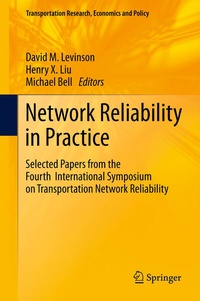
Network Reliability in Practice
Description

This book contains selected peer-reviewed papers that were presented at the Fourth International Symposium on Transportation Network Reliability (INSTR) Conference held at the University of Minnesota July 22-23, 2010. International scholars, from a variety of disciplines--engineering, economics, geography, planning and transportation-offer varying perspectives on modeling and analysis of the reliability of transportation networks in order to illustrate both vulnerability to day-to-day and unpredictability variability and risk in travel, and demonstrates strategies for addressing those issues.
The scope of the chapters includes all aspects of analysis and design to improve network reliability, specifically user perception of unreliability of public transport, public policy and reliability of travel times, the valuation and economics of reliability, network reliability modeling and estimation, travel behavior and vehicle routing under uncertainty, and risk evaluation and management for transportation networks. The book combines new methodologies and state of the art practice to model and address questions of network unreliability, making it of interest to both academics in transportation and engineering as well as policy-makers and practitioners.
More details
Other editions
Additional editions
Content
- Intro
- Transportation Research, Economics and Policy
- Contents
- Contributors
- 1 Introduction to Network Reliability in Practice
- Introduction
- References
- 2 Disruptions to Transportation Networks: A Review
- Introduction
- System Effects
- Transit Strike
- Bridge Closure
- Special Events
- Earthquakes
- Behavioral Effects
- Route Choice and Departure Time
- Mode Shifts
- Travel Experience
- Data Collection
- Conclusion
- References
- 3 Travel Impacts and Adjustment Strategies of the Collapse and the Reopening of the I-35W Bridge
- Introduction
- Surveys
- P-2007
- P-2008
- W-2007
- W-2008
- Demographics
- Information Acquisition
- Travel Impacts
- Adjustment Strategies
- Bridge Fear? Psychological Impact of I-35W Bridge Collapse on Driving Behavior
- Conclusions
- References
- 4 How Severe Are the Problems of Congestion and Unreliability? An Empirical Analysis of Traveler Perceptions
- Introduction
- Data
- Empirical Results
- Perception About Congestion
- Person-Level Variables
- Household-Level Variables
- Perception About Unreliability
- Person-Level Variables
- Household-Level Variables
- Relative Perceptions About Congestion and Unreliability
- Person-Level Variables
- Household-Level Variables
- Summary and Conclusions
- References
- 5 Institutional Architecture to Support Improved Highway Operational Performance
- Context
- Non-recurring Congestion and Performance Management
- Beyond ITS: Effective SO&M Applications
- The SHRP2 Program and Systems Reliability
- The Development of Guidance for Transportation Agency Managers
- Relationships Between Effective SO&M Programs and Institutional Architecture
- Key Elements of Institutional Architecture
- Capability Maturity Levels of Institutional Architecture
- How Institutional Architecture Maturity Relates to Technical and Business Processes
- Capability Improvement Strategies at Each Level
- Using the Framework as Guidance
- Closure
- 6 Travel Time Reliability Indices for Highway Users and Operators
- Introduction
- Definition of Travel Time Reliability
- Travel Time Reliability Measures
- Multi-Hierarchical Stochastic Model for Travel Time Variation
- Overview
- Framework for Determining Travel Time Reliability from Snowfall Weathercast
- Estimation Model of Travel Time Variation
- Study Area
- Results
- Conclusions
- References
- 7 Incorporating Robustness Analysis into Urban Transportation Planning Process
- Introduction
- Problem Statement
- Theory of Robustness Analysis Problem Formulation
- Principle of Robustness Analysis
- Analysis for Robustness
- Illustrative Example
- Formulation of Study Scenarios
- The Use of Robustness Analysis as a Decision Criterion in Transportation Planning
- Discussion of Results
- Robustness Analysis Results
- Robustness Analysis as Related to Network Reliability
- Conclusions and Implications of the Study
- References
- 8 A Model of Bridge Choice Across the Mississippi Riverin Minneapolis
- Introduction
- Data
- Recruitment
- Methodology
- Descriptive Statistics
- Sociodemographics
- Routes: Preferences, and Attributes According to Survey Data
- Route Changing Behavior According to Survey Data
- Statistical Model
- Results
- Time Period
- I-35W: Average Travel Time and Travel Time Variability
- Alternatives: Average Travel Time and Travel Time Variability
- Alternatives: Bridge Diversity
- Sociodemographic Variables
- Discussion and Limitations
- Conclusion
- References
- 9 Network Evaluation Based on Connectivity Reliability and Accessibility
- Introduction
- Connectivity-Potential Accessibility Index
- Concept
- Definition of Connectivity-Potential Accessibility Index
- Link Reliability and Impedance Function
- Solution Algorithm
- Numerical Experiment for Test Networks
- Settings for Numerical Experiment
- Network Topology and Severity of Disaster
- Earthquake-Proof Construction
- Opportunity Distribution
- Impartiality Among Nodes
- Application to Kyoto Prefecture Network
- Kyoto Prefecture Network
- Settings Used in Numerical Experiments
- Calculation Results
- Conclusion
- References
- 10 Goal Programming Approach to Solve the Stochastic Multi-Objective Network Design Problem
- Introduction
- Mathematical Model
- Objective Measures
- Efficiency
- Environment
- Equity
- Chance Constrained Multi-Objective Programming Model
- Goal Programming Formulation
- Solution Procedure
- Numerical Experiment
- Network Description and Parameter Setting
- Convergence Characteristics and Numerical Results
- Sensitivity Analysis
- Effect of Construction Budget
- Effect of Priority Structure
- Effect of Goal Setting
- Conclusions and Future Research
- References
- 11 An Algorithm for the Minimum Robust Cost Path on Networks with Random and Correlated Link Travel Times
- Introduction
- Review of Literature
- Problem Description
- Problem Context and Scope
- Path with Optimal Robust Cost Between a Given Origin and Destination
- Formulation as Quadratic Integer Programming Problem
- Sources of Difficulty
- Absence of Linearity and Link Separability
- Failure of Sub Path Optimality Principle
- Proposed Algorithm
- Link Separable Formulation
- Uncoupling the Robust Cost Objective into Multiple Objectives
- Relationship Between Optimal Solutions of RCP and Multiple-objective Problem
- Permutation Invariant Non-dominance
- Algorithm Description
- Outline
- Link-separable Multiple-objective Formulation
- Computation of Non-dominated Path Set (ND)
- Computation of Approximate Permutation Invariant Non-dominated Path Set (PIND)
- Illustrative Example
- Computational Complexity
- Computational Experiments
- Computational Performance of PIND Heuristic
- Performance of PIND Heuristic with Varying Network Inputs
- Performance of PIND Heuristic with Varying Network Size
- Performance of Robust Cost Measure
- Comparison with Least Expected Time Path
- Importance of Modeling Correlations (Comparison with MRCP Assuming Independence)
- Sensitivity of Optimal Path Robust Cost to Variation in Input Factors
- Conclusions
- Appendix A: Optimality Criteria (Mean2-Variance)
- Appendix B: Test for PI Dominance
- Appendix C: Optimality Criteria (Mean-Standard Deviation Formulation)
- References
- 12 A Link-Based Stochastic Traffic Assignment Model for Travel Time Reliability Estimation
- Introduction
- Methodology
- Original Model
- A Link-Based Model
- Solution Procedure
- Case Study
- Simple Network
- Multiple O-D Network
- Conclusions
- Appendix A: Generate Candidate Link Flows from the Proposal Distribution
- References
- 13 Considering On-Time and Late Arrivals in Multi-Class Risk-Averse Traffic Equilibrium Model with Elastic Demand
- Introduction
- Mathematical Formulation
- Equilibrium Conditions
- Variational Inequality Formulation
- METT Under Lognormal Travel Demand Distribution
- Route-Based Solution Algorithm
- Numerical Results
- Network Description
- Equilibrium Results
- Comparison Between TTB and METE Models
- Sensitivity Analysis
- Conclusions and Future Research
- References
- 14 Heuristic Solution Techniques for No-Notice Emergency Evacuation Traffic Management
- Introduction
- The Dynamic System Optimum Model
- System Objective, Initial Conditions, and Demands
- Flow Conservation
- Flow Restriction
- Heuristic Algorithm for Staged Traffic Evacuation
- Source Sorting
- Exogenous Computation Time Budget: Intermediate Algorithm Results
- Computational Complexity of HASTE
- Application: Officer Deployment
- Mathematical Model
- Heuristic Solution Strategy
- Numerical Experiments
- Experiment 1: Evacuee Routing
- Experiment 2: Officer Deployment
- Concluding Remarks
- References
