

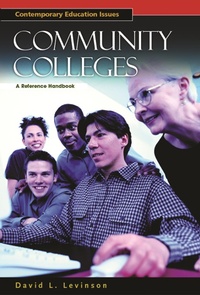
Community Colleges
A Reference Handbook
Published on 25. March 2005
280 pages
978-1-57607-767-2 (ISBN)
Description

The only overview of research on the uniquely American community college system, which is increasingly becoming the site of entry for students seeking a higher education.
This new volume shows why America's community colleges increasingly find themselves at the epicenter of social conflict, surrounded by unresolved questions such as: In a country based on the notion of equal opportunity, shouldn't all high school graduates have access to higher education? Are access and excellence really compatible? What is the real work of community colleges? Is it to provide transfer programs for students going on to baccalaureate colleges or training workers for careers in business and industry?
In this comprehensive guide, readers will find not only a solid grounding in the latest research on these difficult questions but also a thoughtful analysis of the social forces that gave rise to American community colleges and still shape them today.
This new volume shows why America's community colleges increasingly find themselves at the epicenter of social conflict, surrounded by unresolved questions such as: In a country based on the notion of equal opportunity, shouldn't all high school graduates have access to higher education? Are access and excellence really compatible? What is the real work of community colleges? Is it to provide transfer programs for students going on to baccalaureate colleges or training workers for careers in business and industry?
In this comprehensive guide, readers will find not only a solid grounding in the latest research on these difficult questions but also a thoughtful analysis of the social forces that gave rise to American community colleges and still shape them today.
More details
Series
Language
English
Place of publication
New York
United States
Publishing group
Bloomsbury Publishing Plc
Target group
Interest Age: From 7 to 17 years
File size
1,99 MB
ISBN-13
978-1-57607-767-2 (9781576077672)
Copyright in bibliographic data and cover images is held by Nielsen Book Services Limited or by the publishers or by their respective licensors: all rights reserved.
Schweitzer Classification
Other editions
Additional editions
Book
03/2005
ABC-CLIO
€58.90
Shipment within 3-4 weeks
Person
David L. Levinson is president of Norwalk Community College in Norwalk, CT.
Content
- Cover
- Contents
- Series Editor's Preface
- Preface
- EXISTING MONOGRAPHS ON COMMUNITY COLLEGES
- UNIQUE FEATURES OF THIS VOLUME
- References
- Acknowledgments
- 1 Introduction
- DEFINING COMMUNITY COLLEGES
- The Community Aspect of Community Colleges
- Creating Community
- THE KNOWLEDGE ECONOMY
- THE COMPREHENSIVE COMMUNITY COLLEGE
- Governance
- Faculty
- Accreditation
- THE PROMISE OF HIGHER EDUCATION
- Community Colleges and Expanding Access to Higher Education
- Community Colleges and the Growth of Higher Education
- CHALLENGES
- Bifurcated Student Populations
- Community College Students as First-Generation Learners
- International Students
- THE BENEFITS OF THE COMMUNITY COLLEGE
- Community Colleges and Workforce Training
- Community Colleges as Cultural Institutions
- Economic Impact and Economic Return of a Community College Education
- Community Colleges as Bastions of Democracy
- THE "CRISIS IN EDUCATION" AND THE CONTEMPORARY IMPORTANCE OF COMMUNITY COLLEGES
- Boosters and Detractors
- UNDERSTANDING THE STUDENT EXPERIENCE IN COMMUNITY COLLEGES
- EXPANDING THE MISSION OF COMMUNITY COLLEGES
- CONCLUSION
- References
- 2 The Growth of Community Colleges in the Twentieth Century
- CHRONOLOGY
- THE DEVELOPMENT OF COMMUNITY COLLEGES IN THE UNITED STATES: AN INTERPRETIVE ESSAY
- CONCEPTUALIZING HISTORICAL CHANGE
- REVIEW OF MODELS FOR EXPLAINING THE DEVELOPMENT OF COMMUNITY COLLEGES
- FACTORS INFLUENCING COMMUNITY COLLEGE DEVELOPMENT
- Population Change and Immigration
- Schooling for Acculturation and Assimilation
- THE DEVELOPMENT OF COMMUNITY COLLEGES AND THE PROFESSIONALIZATION OF HIGHER EDUCATION DURING THE TWENTIETH CENTURY
- Institutionalism
- Politics versus Markets
- TENSIONS SURROUNDING LOCAL VERSUS FEDERAL CONTROL
- The Ideological "Promise" of Schooling for Upward Mobility
- Immigration, Acculturation, and Citizenship
- Bureaucratization, Professionalization, and Control
- THE EMERGENCE OF THE RESEARCH UNIVERSITY AND HIGHER EDUCATION SEGMENTATION
- CONCLUSION
- References
- 3 Community Colleges and Access versus Excellence
- ACCESS VERSUS EXCELLENCE: THE CONUNDRUM OF DEMOCRATIC LIBERALISM
- The Promise of Equality and Persistence of Inequality
- THE COMPLEXITY OF MEASURING COMMUNITY COLLEGE EFFECTIVENESS
- The Dilemma Facing Community Colleges
- Accountability and High-Stakes Testing
- Measuring Success
- Assessing Outcomes
- Meritocracy
- Market-Based Reforms
- THE AFFORDABILITY OF HIGHER EDUCATION
- CHALLENGES OF ATTAINING AND MAINTAINING EXCELLENCE
- Learning Communities and Peer Mentoring
- The Learning College
- Service Learning
- Supplemental Instruction
- ONLINE LEARNING
- The Digital Divide
- THE CITY UNIVERSITY OF NEW YORK: BALANCING ACCESS AND EQUITY
- DEVELOPMENTAL EDUCATION
- CONCLUSION
- References
- 4 The Curriculum: Transfer versus Career
- THE HISTORIC CURRICULUM DIVIDE
- RESPONDING TO WORKFORCE NEEDS
- Vocational Education
- Determining Career Trajectories
- COMMUNITY COLLEGE CURRICULA
- General Education
- Cross-Functional Skills
- Vocational Clusters
- Absence of Clear Career Pathways
- IS THERE A SHORTAGE OF SKILLED WORKERS?
- Wage Inequality
- Is College for All?
- ANTIPATHY TOWARD VOCATIONAL EDUCATION
- Changing the Context of Undergraduate Education
- Workforce Training
- Separating Technical from Liberal Arts
- CONCLUSION
- References
- 5 Community Colleges and Lifelong Learning
- EDUCATIONAL INEQUALITY THROUGHOUT THE LIFE SPAN
- HUMAN CAPITAL, LIFELONG LEARNING, AND ECONOMIC DEVELOPMENT
- WORKFORCE TRAINING AND WORKFORCE INTERMEDIARIES
- LIFELONG HIGHER EDUCATION ENROLLMENT PATTERNS
- Creating a Foundation for Lifelong Learning
- Factors That Inhibit Lifelong Learning
- INCREASE IN CONTINUING AND PROFESSIONAL EDUCATION ENROLLMENTS
- Perfecting Adult Learning: CAEL and Adult Learning-Focused Institutions
- University Extension and Continuing Education Programs
- Learning Competencies
- COMMUNITY COLLEGE AND COMMUNITY BUILDING
- RECENT GROWTH IN ADULT EDUCATION
- Proprietary and For-Profit Institutions
- Distance Learning and Cyberschools
- INSTITUTES FOR LEARNING IN RETIREMENT
- CONCLUSION
- References
- 6 The Future of the Community College
- THE VISION OF COMMUNITY COLLEGE LEADERS
- Additional Prospects and Challenges Facing Community Colleges
- MISSION AND FINANCES
- Practicing an Engaged Pedagogy
- Organizational Challenges Facing Community Colleges
- Certifications and Credentials
- Corporatization of Higher Education
- Distance and Online Learning
- Entrepreneurialism
- COMMUNITY COLLEGES AND THE AMERICAN DREAM
- The Challenge of Serving Diverse Populations
- Forging Closer Linkages to K-12
- Competition from For-Profit Providers
- Cultivating Human, Social, and Cultural Capital
- CONCLUSION
- References
- 7 Organizations, Associations, and Government Agencies
- 8 Selected Print and Nonprint Resources
- PRINT RESOURCES
- NONPRINT RESOURCES
- Web Sites
- Online Periodicals and Publications
- Glossary
- Index
- About the Author
