

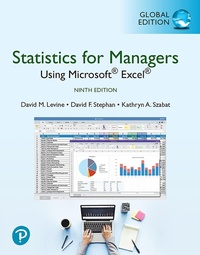
Statistics for Managers Using Microsoft Excel, Global Edition
Statistics for Managers Using Microsoft Excel
9th Edition
Published on 8. June 2020
753 pages
978-1-292-33830-9 (ISBN)
Description

For one-semester courses in Introduction to Business Statistics.
The gold standard in learning Microsoft Excel for business statistics
Statistics for Managers Using Microsoft (R) Excel (R), 9th Edition, Global Edition helps students develop the knowledge of Excel needed in future careers. The authors present statistics in the context of specific business fields, and now include a full chapter on business analytics. Guided by principles set forth by ASA's Guidelines for Assessment and Instruction (GAISE) reports and the authors' diverse teaching experiences, the text continues to innovate and improve the way this course is taught to students. Current data throughout gives students valuable practice analyzing the types of data they will see in their professions, and the authors' friendly writing style includes tips and learning aids throughout.
The book also integrates PHStat, a statistical add-in that bolsters the functions of Excel. Extensive instructor and student resources are provided, including two online-only chapters, as well as the Digital Cases referenced in the text.
The gold standard in learning Microsoft Excel for business statistics
Statistics for Managers Using Microsoft (R) Excel (R), 9th Edition, Global Edition helps students develop the knowledge of Excel needed in future careers. The authors present statistics in the context of specific business fields, and now include a full chapter on business analytics. Guided by principles set forth by ASA's Guidelines for Assessment and Instruction (GAISE) reports and the authors' diverse teaching experiences, the text continues to innovate and improve the way this course is taught to students. Current data throughout gives students valuable practice analyzing the types of data they will see in their professions, and the authors' friendly writing style includes tips and learning aids throughout.
The book also integrates PHStat, a statistical add-in that bolsters the functions of Excel. Extensive instructor and student resources are provided, including two online-only chapters, as well as the Digital Cases referenced in the text.
More details
Edition
9th edition
Language
English
Place of publication
Harlow
United Kingdom
Target group
Professional and scholarly
ISBN-13
978-1-292-33830-9 (9781292338309)
Copyright in bibliographic data and cover images is held by Nielsen Book Services Limited or by the publishers or by their respective licensors: all rights reserved.
Schweitzer Classification
Other editions
Additional editions
David Levine | David Stephan | Kathryn Szabat
Statistics for Managers Using Microsoft Excel, Global Edition
Book
08/2020
9th Edition
Pearson Education Limited
€121.80
Shipment within 10-20 days
Persons
David M. Levine is Professor Emeritus of Statistics and Computer Information Systems at Baruch College (City University of New York). He received BBA and MBA degrees in statistics from City College of New York and a PhD from New York University in industrial engineering and operations research. He is nationally recognised as a leading innovator in statistics education and is the co-author of over 15 books. He has published articles in various journals, including Psychometrika, The American Statistician, Communications in Statistics, Decision Sciences Journal of Innovative Education, Multivariate Behavioral Research, Journal of Systems Management, Quality Progress and The American Anthropologist.
Advances in computing have always shaped David Stephan's professional life. As an undergraduate, he helped professors use statistics software that was considered advanced even though it could compute only several things discussed in Chapter 3, thereby gaining an early appreciation for the benefits of using software to solve problems (and perhaps positively influencing his grades). A nearly advocate of using computers to support instruction, he developed a prototype of a mainframe-based system that anticipated features found today in Pearson's MathXL and served as special assistant for computing to the Dean and Provost at Baruch College. In his many years teaching at Baruch, Stephan implemented the first computer-based classroom, helped redevelop the CIS curriculum, and, as part of a FIPSE project team, designed and implemented a multimedia learning environment. He was also nominated for teaching honors. Stephan has presented at SEDSI and DSI DASI mini-conferences, sometimes with his coauthors. Stephan earned a B.A. from Franklin & Marshall College and an M.S. from Baruch College, CUNY, and completed the instructional technology graduate program at Teachers College, Columbia University.
As Associate Professor of Business Systems and Analytics at La Salle University, Kathryn Szabat has transformed several business school majors into one interdisciplinary major that better supports careers in new and emerging disciplines of data analysis including analytics. Szabat strives to inspire, stimulate, challenge, and motivate students through innovation and curricular enhancements and shares her coauthors' commitment to teaching excellence and the continual improvement of statistics presentations. Beyond the classroom she has provided statistical advice to numerous business, nonbusiness, and academic communities, with particular interest in the areas of education, medicine, and non-profit capacity building. Her research activities have led to journal publications, chapters in scholarly books, and conference presentations. Szabat is a member of the American Statistical Association (ASA), DSI, Institute for Operation Research and Management Sciences (INFORMS), and DSI DASI. She received a B.S. from SUNY-Albany, an M.S. in statistics from the Wharton School of the University of Pennsylvania, and a Ph.D. in statistics, with a cognate in operations research, from the Wharton School of the University of Pennsylvania.
Advances in computing have always shaped David Stephan's professional life. As an undergraduate, he helped professors use statistics software that was considered advanced even though it could compute only several things discussed in Chapter 3, thereby gaining an early appreciation for the benefits of using software to solve problems (and perhaps positively influencing his grades). A nearly advocate of using computers to support instruction, he developed a prototype of a mainframe-based system that anticipated features found today in Pearson's MathXL and served as special assistant for computing to the Dean and Provost at Baruch College. In his many years teaching at Baruch, Stephan implemented the first computer-based classroom, helped redevelop the CIS curriculum, and, as part of a FIPSE project team, designed and implemented a multimedia learning environment. He was also nominated for teaching honors. Stephan has presented at SEDSI and DSI DASI mini-conferences, sometimes with his coauthors. Stephan earned a B.A. from Franklin & Marshall College and an M.S. from Baruch College, CUNY, and completed the instructional technology graduate program at Teachers College, Columbia University.
As Associate Professor of Business Systems and Analytics at La Salle University, Kathryn Szabat has transformed several business school majors into one interdisciplinary major that better supports careers in new and emerging disciplines of data analysis including analytics. Szabat strives to inspire, stimulate, challenge, and motivate students through innovation and curricular enhancements and shares her coauthors' commitment to teaching excellence and the continual improvement of statistics presentations. Beyond the classroom she has provided statistical advice to numerous business, nonbusiness, and academic communities, with particular interest in the areas of education, medicine, and non-profit capacity building. Her research activities have led to journal publications, chapters in scholarly books, and conference presentations. Szabat is a member of the American Statistical Association (ASA), DSI, Institute for Operation Research and Management Sciences (INFORMS), and DSI DASI. She received a B.S. from SUNY-Albany, an M.S. in statistics from the Wharton School of the University of Pennsylvania, and a Ph.D. in statistics, with a cognate in operations research, from the Wharton School of the University of Pennsylvania.
Content
1 Defining and Collecting Data
2 Organizing and Visualizing Variables
3 Numerical Descriptive Measures
4 Basic Probability
5 Discrete Probability Distributions
6 The Normal Distribution and Other Continuous Distributions
7 Sampling Distributions
8 Confidence Interval Estimation
9 Fundamentals of Hypothesis Testing: One-Sample Tests
10 Two-Sample Tests
11 Analysis of Variance
12 Chi-Square and Nonparametric Tests
13 Simple Linear Regression
14 Introduction to Multiple Regression
15 Multiple Regression Model Building
16 Time-Series Forecasting
17 Business Analytics
18 Getting Ready to Analyze Data in the Future
Download the detailed table of contents
2 Organizing and Visualizing Variables
3 Numerical Descriptive Measures
4 Basic Probability
5 Discrete Probability Distributions
6 The Normal Distribution and Other Continuous Distributions
7 Sampling Distributions
8 Confidence Interval Estimation
9 Fundamentals of Hypothesis Testing: One-Sample Tests
10 Two-Sample Tests
11 Analysis of Variance
12 Chi-Square and Nonparametric Tests
13 Simple Linear Regression
14 Introduction to Multiple Regression
15 Multiple Regression Model Building
16 Time-Series Forecasting
17 Business Analytics
18 Getting Ready to Analyze Data in the Future
Download the detailed table of contents
