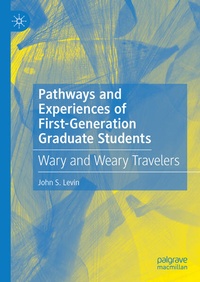
Pathways and Experiences of First-Generation Graduate Students
Description

Reviews / Votes
"Dr. John S. Levin gives voice to first-generation graduate students, in a system that has largely neglected their diverse identities and varied challenges. Anyone who identifies as or seeks to support this population should read this book." -Jenny J. Lee, Professor and Dean's Fellow for Internationalization, The University of Arizona
"John Levin's Pathways and Experiences of First-Generation Graduate Students: Wary and Weary Travelers thoughtfully considers segmented opportunities and stratification of postbaccalaureate pathways that often impede access to advanced degrees for diverse adult learners. Levin offers a glimpse of students' journeys through their testimonies sharing how they navigate identity, academic aspirations and career goals amid various constraints while weathering inequitable social and institutional structures. Levin has written a primer for anyone considering college pathways in their entirety. This text is a call to action forinterrogating postsecondary contexts to meet the needs of a frequently overlooked population in graduate education." -Eboni M. Zamani-Gallaher, University of Pittsburgh, School of Education; Associate Dean, Equity, Justice, and Strategic Partnerships; Professor, Department of Educational Foundations, Organizations, and Policy (EFOP); Executive Director, Council for the Study of Community Colleges
"The dramatic and continuing shifts in student demographics in the United States have produced an increasingly larger cohort of entering students who are racially/ethnically and economically diverse. As such, the pool of students who apply for graduate and professional schools are very different than previous cohorts of students. In his book Pathways and Experiences of First-Generation Graduate Students: Wary and Weary Travelers , Professor Emeritus John Levin draws upon his experience as a scholar and experience as an administrator in higher education to document the experiences of first-generation students in graduate/professional schools and the barriers to and facilitators of their success. Moreover, Levin suggests "remedies" to improve the institutional conditions that produce the barriers that these students face in their academic careers. This is an important read for anyone who works in graduate programs or cares about graduate/professional students." -Jeffrey F. Milem, Jules Zimmer Dean and Professor, University of California, Santa Barbara
"A thoughtful analysis by a scholar who not only knows the literature inside and out, but also by a practitioner with intimate knowledge of the challenges students face. Compelling. Insightful. Practical." -William G. Tierney, University Professor Emeritus; Founding Director, Pullias Center for Higher Education, University of Southern California
More details
Other editions
Additional editions