

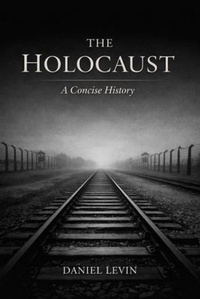
THE HOLOCAUST
Description

The Holocaust: A Concise History
By Daniel Levin
The Holocaust is often remembered through images of camps, gas chambers, and mass graves-scenes so overwhelming they can feel detached from ordinary history. This distance, while understandable, obscures a crucial truth: the Holocaust did not erupt suddenly or irrationally. It unfolded through a process.
The Holocaust: A Concise History offers a clear, disciplined account of how genocide became possible in the heart of modern Europe. Written for a broad audience, the book traces the transformation of antisemitic ideology into state policy, the erosion of legal and moral restraints, and the bureaucratic systems that enabled mass murder on a continental scale.
This is not a catalog of atrocities. It is a narrative history of mechanisms, institutions, and choices-made over time, by identifiable people, within recognizable systems.
A History of Process, Not Shock
Rather than treating the Holocaust as an incomprehensible anomaly, this book presents it as a sequence of developments:
how long-standing antisemitism was reframed as explanation
how exclusion was normalized through law
how violence was introduced incrementally
how war removed constraints
how bureaucracy transformed murder into routine
By restoring this sequence, the book makes the Holocaust more comprehensible without diminishing its moral gravity.
From Prejudice to Genocide
The early chapters examine Europe before the Holocaust and the rise of Nazi ideology, showing how economic crisis, nationalism, and political instability allowed extremist ideas to gain traction. Subsequent chapters trace the systematic exclusion of Jews from German society, the radicalization of policy during wartime expansion, and the shift from containment and exploitation to organized extermination.
Throughout, the emphasis remains on how ordinary institutions-ministries, courts, railways, police-were adapted to serve extraordinary crimes.
Resistance, Survival, and Aftermath
The book challenges the myth of Jewish passivity while avoiding romanticization. Resistance took many forms-armed, cultural, spiritual, and moral-often under conditions that made success impossible. Survival, where it occurred, was fragile and contingent, shaped by timing, geography, chance, and the actions of others.
The final chapters examine liberation, displacement, incomplete justice, and the long struggle over memory and responsibility. The Holocaust did not end neatly in 1945. Its consequences extended far beyond the collapse of Nazi power.
What This Book Offers
The Holocaust: A Concise History is written for readers seeking clarity without simplification. It avoids sensationalism, focuses on historical explanation, and treats the Holocaust not as an aberration outside history, but as a catastrophe produced within it.
The Holocaust was not inevitable.
It was made.
This book follows that process from beginning to end.
More details
Content
TABLE OF CONTENTS
Introduction
Chapter 1: Europe Before the Holocaust
Chapter 2: Hitler, Ideology, and the Normalization of Hatred
Chapter 3: From Exclusion to Containment (1939-1941)
Chapter 4: The "Final Solution"
Chapter 5: Resistance, Survival, and Choice
Chapter 6: Liberation, Aftermath, and Reckoning
Chapter 7: Memory, Meaning, and the Holocaust Today
Chapter 8: Conclusion - What the Holocaust Was, and Why It Still Matters
