

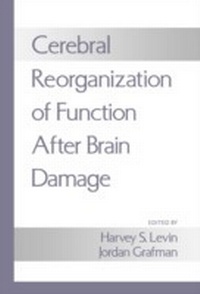
Cerebral Reorganization of Function after Brain Damage
1st Edition
Published on 20. July 2000
413 pages
978-0-19-802820-8 (ISBN)
Description

Cerebral Reorganization of Function After Brain Damage integrates basic research on neuroplasticity and clinical research on reorganization of function after brain injury, with a view toward translating the findings to rehabilitation. Historical foundations of research on neuroplasticity are presented to provide a perspective on recent findings. Leading investigators synthesize their work with results from other laboratories to provide a current update on neuroanatomic features that enhance neuroplasticity and provide a substrate for reorganization of function. The capacity for recovery from brain injury associated with focal lesions as compared to diffuse cerebral insult is discussed. Interventions such as environmental enrichment and drugs to enhance reorganization of function after brain injury have been studied in animal models and in human studies. Methodologies to study neuroplasticity are discussed including functional magnetic resonance imaging, neurophysiological measures, transcranial magnetic stimulation, and computational modeling. Implications of neuroplasticity research for innovations in rehabilitation of persons with brain injury are critically reviewed. This text will be particularly appealing to neuropsychologists, neurologists, psychologists, neuroscientists, psychiatrists, speech scientists, and other health professionals engaged in rehabilitation-related research.
More details
Other editions
Additional editions
Harvey S. Levin | Jordan Grafman
Cerebral Reorganization of Function After Brain Damage
Book
08/2000
Oxford University Press Inc
€81.71
Shipment within 15-20 days
Content
- Intro
- Contents
- Contributors
- 1. Historical Notes on Reorganization of Function and Neuroplasticity
- I. Neuroscience Research on Neuroplasticity and Reorganization of Function
- 2. Neuropsychological Indices of Early Medial Temporal Lobe Dysfunction in Primates
- 3. Cognitive Recovery from Traumatic Brain Injury: Results of Posttraumatic Experimental Interventions
- 4. Growth of New Connections and Adult Reorganizational Plasticity in the Somatosensory System
- 5. Neuroanatomic Basis for Reorganization of Function After Prefrontal Damage in Primates
- 6. Reorganization of Function After Cortical Lesions in Rodents
- 7. Rapid Reorganization of Subcortical and Cortical Maps in Adult Primates
- 8. Motor Rehabilitation, Use-Related Neural Events, and Reorganization of the Brain After Injury
- 9. Role of Neuroplasticity in Functional Recovery After Stroke
- II. Developmental Studies of Neuroplasticity
- 10. Spatial Cognitive Development Following Prenatal or Perinatal Focal Brain Injury
- 11. Neuroplasticity Following Traumatic Diffuse versus Focal Brain Injury in Children: Studies of Verbal Fluency
- 12. Cerebral Reorganization in Children with Congenital Hemiplegia: Evidence from the Dichotic Listening Test
- 13. Reorganization of Motor Function in Cerebral Palsy
- III. Techniques for Studying Neuroplasticity in Humans
- 14. The Developmental Disorders: Does Plasticity Play a Role?
- 15. Transcranial Magnetic Stimulation as a Tool for Detecting Changes in the Organization of the Human Motor System After Central and Peripheral Lesions
- 16. Methodological Issues in Functional Magnetic Resonance Imaging Studies of Plasticity Following Brain Injury
- 17. Neuroimaging of Functional Recovery
- 18. Computational Modeling of the Cortical Response to Focal Damage
- IV. Synthesis and Implications for Rehabilitation
- 19. Conceptual Issues Relevant to Present and Future Neurologic Rehabilitation
- Index
- A
- B
- C
- D
- E
- F
- G
- H
- I
- J
- K
- L
- M
- N
- O
- P
- R
- S
- T
- U
- V
- W
