

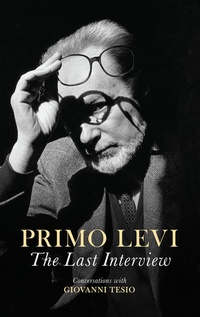
The Last Interview
Description

In a densely packed dialogue, Levi responds to Tesio's tactful and never too insistent questions with a watchful readiness and candour, breaking through the reserve of his public persona to allow a more intimate self to emerge. Following the thread of memory, he lucidly discusses his family, his childhood, his education during the Fascist period, his adolescent friendships, his reading, his shyness and his passion for mountaineering, and recounts his wartime experience as a partisan and the terrible price it exacted from him and his comrades. Though we glimpse his later life as a writer, the story breaks off just before his deportation to Auschwitz owing to his sudden death.
In The Last Interview, Levi the man, the witness, the chemist and the writer all unite to offer us a story which is also a window onto history. These conversations shed new light on Levi's life and will appeal to the many readers of this most eloquent witness to the horrors of the Holocaust.
More details
Other editions
Additional editions
Persons
Giovanni Tesio is Professor of Italian Literature at the University of Eastern Piedmont.
Content
- Introduction: Judith Woolf
- I knew Primo Levi: Giovanni Tesio
- Acknowledgements
- Monday, 17 January
- Monday, 26 January
- Sunday, 8 February
I knew Primo Levi
Creating a space for conversation requires the efforts of an alpinist.
Osip Mandelstam, Conversation about Dante
'Do you already have a plan of attack in mind?' I was asked this question in the study of an apartment on the third floor of 75 Corso Re Umberto - one of the most elegant streets in Turin - on the afternoon of 12 January 1987.
Asking it was one of the most pacific writers to have crossed, not only in a literary sense, our twentieth-century stage, one of the most authoritative witnesses to Auschwitz, a man of undoubted integrity but just as undoubtedly wounded in spirit and flesh: a master of secularism and reason, of doubt and questioning, but also of clarity and resistance, of resolve and action.
In the austerely spacious study, in that house which resembled 'many other quasi-patrician houses of the turn of the century' (as he wrote in an account later published in Other People's Trades),9 Primo Levi asked me that entirely predictable question, which nonetheless disconcerted me. But to account both for the predictability of the question and for my astonishment at hearing it put to me, I need to give some preliminary explanation.
I first encountered Primo Levi by reading If This is a Man in the Einaudi 'Corallo' edition in 1967. And ten years later I got to know him in person, because leafing through a school anthology devoted to Piedmontese writers,10 I discovered that the pages chosen by the editor did not correspond in the least with my enduring memory of the text of If This is a Man in the edition I had read. Having compared them, I was able to discover that there existed a text previous to the Einaudi edition, and that this text had been published in 1947 by the De Silva publishing house which Franco Antonicelli, one of the leading figures in Turinese anti-fascism, had founded in '42 and which had closed down in '49. Comparing the De Silva text with the first Einaudi edition of 1958, which has remained identical in subsequent reprintings, I then discovered that the variants were neither few nor insignificant. So I plucked up my courage (in Piedmontese there is a fine saying, to put on a 'bon bèch', which literally means a 'good beak') and telephoned the author, who without hesitation invited me to his house and put at my disposal an exercise book: a thick school exercise book with an olive green cover, in which I was able to check the text of the parts which had been added. And so I wrote an article,11 in truth rather hybrid and certainly not perfect (I did not take account of the chapters already published thanks to Silvio Ortona in the Vercellese Communist journal L'Amico del Popolo [The Friend of the People]), but which all the same had a modest success.
After this, I returned to question Levi again about the problem of variants. And it was he who allowed me to look not only at the handwritten exercise book in which he had composed nearly all the chapters of The Truce, but - in due course - at the typescript of The Wrench prepared for publication, which took place in '78. So I could be quite sure that he was referring to me when, with the arrival of the computer, he wrote an article called 'The Scribe' for La Stampa (later collected in Other People's Trades), in which he talks about a 'literary friend' who laments the loss of 'the noble joy of the philologist intent on reconstructing, through successive erasures and corrections, the itinerary which leads to the perfection of the Infinite'.12
After that first piece of work, others followed. First of all a 'critical portrait' published in Belfagor13 two years later. And then quite a number of reviews and interviews. So that when he was thinking of publishing the poems of Ad Ora Incerta [At an Uncertain Hour], he consulted me - it was the time when Einaudi was going through its most acute crisis, which saw the diaspora of other writers, for example Lalla Romano, who published Nei mari estremi [The Furthest Seas] with Mondadori - about finding another possible and worthy publisher, and I suggested that he should consider Garzanti, as in fact he did.
Levi was unassuming, sober, discreet and very courteous. And I was fascinated not only by the expressive precision of his books, by his wide-ranging and detailed knowledge, by his remarkable memory, but also by his receptiveness and his undoubted and special ability to communicate with precise and succinct words, in which all the same there vibrated a note which was not without some trace of melancholy: that ability of his to avoid all superfluities and to base his writing instead on a rich and ornate sobriety of language, on the plain elegance of the mot-chose.
To have got to know Levi also means this: recognizing in his written words the grain of his speaking voice: anti-rhetorical but not inert, familiar but almost festive, a monotone which was capable of expressive power.
There grew up between us something that was more than mere civility. So much so as to permit us to address each other as tu rather than lei14 and to justify the more than commonplace dedications in the books which he sent me from time to time. In short, a certain familiarity had established itself between us and a combination of circumstances led to the idea of these conversations, which I proposed to Levi at a time when I thought they might help him. I did not have a clear plan to begin with, but I was certainly applying a precept often tested and repeatedly confirmed by Levi, that 'talking is the best medicine'.15
In his Conversations with Primo Levi, Ferdinando Camon at a certain point, perhaps with reference to personal experiences later converted into fiction, says to Levi, 'You're not a depressed man, and not even anxious'. And the writer, obviously curious about this unexpected remark, replies with a question, 'Is that a feeling you get from my books or from my presence?' To which Camon replies in his turn, 'From your presence', eliciting this clarification:
In general, you're right. Since the concentration camp, however, I've had a few attacks of depression. I'm not sure if they go back to that experience, because they come with different labels, from one to the next. It may seem strange to you, but I went through one just recently, a stupid fit of depression, for very little reason: I had a small operation on my foot, and this made me think that I'd suddenly got old. It took two months for the wound to heal. That's why I asked you if the feeling came from my presence or my books.16
The interview with Camon was the result of a number of meetings which took place between '82 and '86 (the last, on a Sunday at the end of May '86, less than a year before his death). And given that it is an interview which has been ordered by themes, it is hard to say whether the statement I have just quoted belongs to the final meeting. Presumably yes, but it is not clear.
However that may be, on Christmas Eve '86 I proposed to Levi that we should put together the material for a biography which from the start we were calling 'authorized'. I had unexpectedly become aware of his breakdown and, I don't know why, the impulse came to me to suggest to him a project which, to be honest, I had not even vaguely thought about until that moment. That was how I instinctively adopted the expedient of an 'authorized biography'. And he accepted it right away, to my surprise, without making any objections.
That was why I went to his house on the afternoon of 12 January in the New Year, 1987, taking with me a little tape-recorder. And there it all began with the words, 'Do you already have a plan of attack in mind?' And I was forced to admit that I did not have a plan in mind at all - let alone a 'plan of attack' - and I certainly had not prepared, as Camon specifies that he had done for his interview, 'a systematic set of questions, issues, and problems, making sure that they were related to [his] entire life and work'.17 Instead, I aimed, for the moment, at gathering the greatest possible quantity of information and data. We did not establish any rules or procedures apart from conversing in mainly chronological order, with an eye, for the time being, more on events and people than on issues: simple directions for a journey which would discover its own best route as it went along.
After that first meeting, on 12 January 1987, there were two others, both in the afternoon, one on 26 January and the other on 8 February. I more than once turned off the tape-recorder to allow him to speak more freely about things which he was reluctant to have recorded: sometimes he asked me to do this, on other occasions I used my own initiative. Apart from that, our agreement was clear. At one particular juncture in our conversations it was Levi himself who reminded me that his confessions would have to be 'translated'. He said this to me at a moment when he explicitly acknowledged that he was 'in crisis': 'I've told you from the start that these are confessions which will need to be translated', or rather, to be interpreted.
The real difference in our conversations, as compared with other interviews, was more in the tone...
