

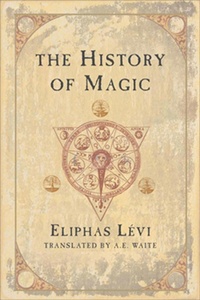
The History of Magic
Published on 23. June 2023
260 pages
978-1-60925-401-8 (ISBN)
Description

An extensive classic work on the origins of ceremonial magic throughout the world's many cultures and religions.
French occultists Alphones Louis Constant (1810-1875) was born in Paris to a shoemaker father. At age twenty-two, he entered the seminary at Saint Sulpice for an education that would prepare him for the priesthood. While he did become ordained a deacon, he found that his doubts regarding the doctrine of the Catholic Church precluded him from completing his ordination. A week before he was due to take orders as a priest, he left the Church and returned to civilian life.
Through the 1850s and 1860s, Constant developed and disseminated his growing ideas of the occult, mysticism, and the Kabbalistic school of thought. He became a ceremonial magician and developed a social circle of other mystical and occultist thinkers. Eschewing the charlatan's tricks and parlor illusions, Lévi believed that the practice of ceremonial magic required a strong will, psychic force, and powerful imagination to discover true science and influence reality. And anyone who attempted to use magic for personal gain would lead to their own destruction.
Writing under the name Éliphas Lévi-a literal translation of his name Alphonse Lewis into Hebrew-he began to share his ideas on magic with the public. In 1860, he began work on The History of Magic, an assessment and analysis of sacred magic through many past cultures. By exploring the magical components of the pagans, Kabbalists, ancient Greeks, Chinese, Indians, Catholics, and many other groups, Lévi sought to find the secret wisdom hidden within each. He also explored the secret traditions of the Illuminati, Freemasons, and the Knights Templar, among many others.
The History of Magic is an essential test for any student of ceremonial magic, revealing the truths behind the fables, allegories, and parables of these cultural traditions. Translated into English by the British poet and mystic, A.W. Waite, it was published posthumously in 1913. Waite was one of the creators of the well-known Rider-Waite Tarot Deck, one of the most widely used tarot decks in the world.
French occultists Alphones Louis Constant (1810-1875) was born in Paris to a shoemaker father. At age twenty-two, he entered the seminary at Saint Sulpice for an education that would prepare him for the priesthood. While he did become ordained a deacon, he found that his doubts regarding the doctrine of the Catholic Church precluded him from completing his ordination. A week before he was due to take orders as a priest, he left the Church and returned to civilian life.
Through the 1850s and 1860s, Constant developed and disseminated his growing ideas of the occult, mysticism, and the Kabbalistic school of thought. He became a ceremonial magician and developed a social circle of other mystical and occultist thinkers. Eschewing the charlatan's tricks and parlor illusions, Lévi believed that the practice of ceremonial magic required a strong will, psychic force, and powerful imagination to discover true science and influence reality. And anyone who attempted to use magic for personal gain would lead to their own destruction.
Writing under the name Éliphas Lévi-a literal translation of his name Alphonse Lewis into Hebrew-he began to share his ideas on magic with the public. In 1860, he began work on The History of Magic, an assessment and analysis of sacred magic through many past cultures. By exploring the magical components of the pagans, Kabbalists, ancient Greeks, Chinese, Indians, Catholics, and many other groups, Lévi sought to find the secret wisdom hidden within each. He also explored the secret traditions of the Illuminati, Freemasons, and the Knights Templar, among many others.
The History of Magic is an essential test for any student of ceremonial magic, revealing the truths behind the fables, allegories, and parables of these cultural traditions. Translated into English by the British poet and mystic, A.W. Waite, it was published posthumously in 1913. Waite was one of the creators of the well-known Rider-Waite Tarot Deck, one of the most widely used tarot decks in the world.
More details
Other editions
Additional editions
Persons
Alphonse Louis Constant, better know by his pen name Eliphas Levi, was a master of the traditional Rosicrucian interpretation of the Kabbalah. He was born in France in 1810, and through the offices of the parish priest, was educated for the church at Saint-Sulpice. He was later expelled from seminary for teaching doctrines contrary to those of the Roman Catholic Church. In 1824 Levi began studying the occult sciences, and wrote about magic and the Kabbalah for the next three decades. His other books include Transcendental Magic, Mysteries of the Qabalah, and The Book of Splendours.A.E. Waite (1857-1942) is one of the best-known authors and translators of magic and the occult. He is the creator of the Rider-Waite tarot and is the author of several books including Book of Black Magic and Pictorial Keys to the Tarot.
Content
- Cover
- Copyright
- Foreword to the 2001 Edition
- PREFACE To The English Translation
- INTRODUCTION
- BOOK I: The Derivations of Magic
- Chapter I: Fabulous Sources
- Chapter II: Magic of the Magi
- Chapter III: Magic in India
- Chapter IV: Hermetic Magic
- Chapter V: Magic in Greece
- Chapter VI: Mathematical Magic of Pythagoras
- Chaper VII: The Holy Kabalah
- BOOK II: Formation and Development of Dogmas
- Chapter I: Primitive Symbolism of History
- Chapter II: Mysticism
- Chapter III: Initiations and Ordeals
- Chapter IV: The Magic of Public Worship
- Chapter V: Mysteries of Virginity
- Chapter VI: Superstitions
- Chapter VII: Magical Monuments
- BOOK III: Divine Synthesis and Realisation of Magia by the Christian Revelation
- Chapter I: Christ Accused of Magic by the Jews
- Chapter II: The Witness of Magic to Christianity
- Chapter III: The Devil
- Chapter IV: The Last Pagans
- Chapter V: Legends
- Chapter VI: Some Kabalistic Paintings and Sacred Emblems
- Chapter VII: Philosophers of the Alexandrian School
- BOOK IV: Magic and Civilisations
- Chapter I: Magic Among Barbarians
- Chapter II: Influence of Women
- Chapter III: The Salic Laws Against Sorcerers
- Chapter IV: Legends of the Reign of Charlemagne
- Chapter V: Magicians
- Chapter VI: Some Famous Prosecutions
- Chapter VII: Superstitions Relating to the Devil
- BOOK V: The Adepts and the Priesthood
- Chapter I: Priests and Popes Accused of Magic
- Chapter II: Appearance of the Bohemian Nomads
- Chapter III: Legend and History of Raymond Lully
- Chapter IV: On Certain Alchemists
- Chapter V: Some Famous Sorcerers and Magicians
- Chapter VI: Some Magical Prosecutions
- Chapter VII: The Magical Orgins of Freemasonry
- BOOK VI: Magic and The Revolution
- Chapter I: Remarkable Authors of the Eighteenth Century
- Chapter II: Thaumaturgic Personalities of the Eighteenth Century
- Chapter III: Prophecies of Cazotte
- Chapter IV: The French Revolution
- Chapter V: Phenomena of Mediomania
- Chapter VI: The German Illuminati
- Chapter VII: Empire and Restoration
- BOOK VII: Magic in the Nineteenth Century
- Chapter I: Magnetic Mystics and Materialists
- Chapter II: Hallucinations
- Chapter III: Mesmerists and Somnambulists
- Chapter IV: The Fantastic Side of Magical Literature
- Chapter V: Some Private Recollections of the Writer
- Chapter VI: The Occult Sciences
- Chapter VII: Summary and Conclusion
- APPENDIX
- INDEX
- LIST OF ILLUSTRATIONS
- I. Portrait of Eliphas Levi
- II. The Pentagram of the Absolute
- III. The Great Symbol of Solomon
- IV. The Magical Head of the Zohar
- V. The Great Kabalistic Symbol of the Zohar
- VI. The Mystery of Universal Equilibrium & Egyptian Pantamorphic Lynx
- VII. The Bembine Tablet
- VIII. Pantacle of Kabalistic Letters
- IX. The Twenty-First Key of the Tarot
- X. Egyptian Symbols of Typhon
- XI. The Seven Wonders of the World
- XII. Disputation Between Simon the Magician and St. Peter and St. Paul
- XIII. Hermetic Magic
- XIV. The Philosophical Cross, or Plan of the Third Temple
- XV. Occult Seals and Primitive Egyptian Tarots
- XVI. The Seven Planets and thier Genii
- XVII. The Great Hermetic Arcanum
- XVIII. General Plan of Kabalistic Doctrine
- XIX. Apocalyptic Key: The Seven Seals of St. John
