

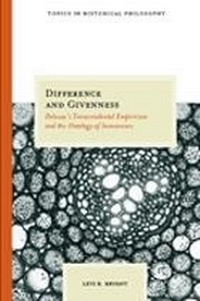
Difference and Givenness
Description

From one end of his philosophical work to the other, Gilles Deleuze consistently described his position as a transcendental empiricism. But just what is transcendental about Deleuze''s transcendental empiricism? And how does his position fit with the traditional empiricism articulated by Hume? In Difference and Givenness, Levi Bryant addresses these long-neglected questions so critical to an understanding of Deleuze''s thinking. Through a close examination of Deleuze''s independent work--focusing especially on Difference and Repetition--as well as his engagement with thinkers such as Kant, Maimon, Bergson, and Simondon, Bryant sets out to unearth Deleuze''s transcendental empiricism and to show how it differs from transcendental idealism, absolute idealism, and traditional empiricism. What emerges from these efforts is a metaphysics that strives to articulate the conditions for real existence, capable of accounting for the individual itself without falling into conceptual or essentialist abstraction. In Bryant''s analysis, Deleuze''s metaphysics articulates an account of being as process or creative individuation based on difference, as well as a challenging critique--and explanation--of essentialist substance ontologies. A clear and powerful discussion of how Deleuze''s project relates to two of the most influential strains in the history of philosophy, this book will prove essential to anyone seeking to understand Deleuze''s thought and its specific contribution to metaphysics and epistemology.
More details
Other editions
Additional editions
Content
- Intro
- Contents
- Preface
- List of Abbreviations
- Introduction
- 1. Empiricism and the Search for the Conditions of Real Experience
- 2. Bergsonian Intuition and Internal Difference
- 3. Transcendental Empiricism: The Image of Thought and the "Phenomenology" of the Encounter
- 4. First Moment of the Encounter: The Sentiendum
- 5. Second Moment of the Encounter: The Memorandum
- 6. Third Moment of the Encounter: The Cogitandum
- 7. Overcoming Speculative Dogmatism: Time and the Transcendental Field
- 8. Individuation: The Genesis of Extensities and the Other-Structure
- Conclusion
- Notes
- Bibliography
- Index
