

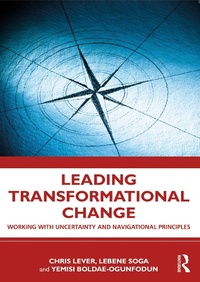
Leading Transformational Change
Working with Uncertainty and Navigational Principles
1st Edition
Published on 12. December 2023
200 pages
978-1-003-81633-1 (ISBN)
Description

Leading Transformational Change: Working with Uncertainty and Navigational Principles offers an examination of how best to manage organisational change in tumultuous times. Using the metaphor of 'navigating in uncertain waters', the book is a unique and accessible introduction to the area of leading and managing change. Readers are equipped with tools such as practical exercises and opportunities to reflect, allowing them to assess and enact positive change. Stories and real-life examples from the sea offer lively ways to apply theory to practice.
The authors examine why so often transformational change fails and how to break free of these negative patterns of behaviour. The chapters provide a deep understanding of navigational principles and step by step show how to apply this understanding to various contexts of change.
Topics cover situational analysis, best managerial practice, planning, leading change, and unexpected events. Student learning is supported and reinforced with in-text reflections, discussion questions, and learning checks.
The authors examine why so often transformational change fails and how to break free of these negative patterns of behaviour. The chapters provide a deep understanding of navigational principles and step by step show how to apply this understanding to various contexts of change.
Topics cover situational analysis, best managerial practice, planning, leading change, and unexpected events. Student learning is supported and reinforced with in-text reflections, discussion questions, and learning checks.
Reviews / Votes
Leading change with navigational principles is a much-needed topic in the times of uncertainty we live in. Written in an engaging style, it is hard not to be gripped by the practical approach the authors have taken for a highly relevant textbook.- Professor Benjamin Laker, Professor of Leadership, Henley Business School, University of Reading, UK.
Leadership is an often-elusive concept and the authors, while acknowledging that, have intelligently helped us with how leaders can see their way through the maze when it comes to leading change in uncertainty. The navigational principles argued are clear and practical, making this textbook a great manual for every student of leadership, including executives.
- Professor Christson Adedoyin, Professor of Social Work, Samford University, Birmingham, Alabama, USA.
This textbook brings out the inner workings of leading change in a way that is refreshing and practical! What a great addition to teaching and learning at both undergraduate and postgraduate levels!
- Dr Gloria Appiah, Lecturer in Entrepreneurship at Queen Mary University of London, UK.
Leading transformational change as a textbook is as much a great addition to the classroom as it the desks of every leader in a world filled with uncertainty. The authors have used practical examples that are pedagogically sound and intellectually robust without academic mumbo jumbo. I highly recommend it.
- Professor Kofi Osei-Frimpong, Associate Professor of Marketing, Africa Business School, Mohammed VI Polytechnic University, Morocco.
The book provides an accessible reading to students about tools for managing change in a tumultuous world. It identifies common reasons why change efforts fail, and challenges readers to think about how they can positively influence such efforts towards positive outcomes. This is a welcome addition to the field in how we approach and teach change.
- Dr Ian Cammack, Senior Teaching Fellow in Project Management, Lancaster University Management School, Lancaster, UK.
I was immensely impacted to see many of the ideas presented in this book so relatable in my own practice at the operational level of managing a large healthcare facility! The navigational principles argued are practical and I find this textbook an excellent manual of leadership for anyone involved in leading people in a constantly changing environment.
- Michelle Chinebuah, MPharm, MSc, Pharmacist and Store Leader, Wallgreens Boots Alliance, UK.
In this book the authors outline 3 principles of navigation set in an ever changing and systemic context. This sound simple but are in fact sophisticated and challenging. Many fail to grasp the depth and breadth required to find a way through competing, ever shifting and demanding realities. This book addresses this unlike any book on change that I have read. It has what I call a prophetic illumination. It can shine an uncomfortably bright light and challenges us to respond. The integrity, honesty and vulnerability will also provide hope throughout the pages.
- David Oliver, Businessman, International speaker and Author.
According to a former Governor of the Bank of England, we need to return to a narrative paradigm to help us in these times of extraordinary change. Becoming only reliant on data, data models and algorithms is risky because life doesn't always play to the rules we construct. The authors of this book, tell stories, ask questions, and put forward principles that help navigate familiar, unfamiliar, and uncharted waters. Take time to read through each chapter and then read them again! They are layered with insights and questions that will keep provoking and equipping.
- Peter Hay, Social Entrepreneur and Technologist
This work has the wonderful ability to hold the complexity and simplicity of life in inspiring and challenging tandem. It flows between the factual and the creative to paint an absorbing picture with both huge brush strokes and delightful detail. This book is rooted in an authentic reality that I have personally experienced during many enriching conversations.
- Hazel Marchment, Social Entrepreneur and Habitual Connector of People.
This textbook has become my 'go to' reference handbook when looking at any kind of change initiative. I love the principles so much - easy to understand and implement. We have even built the book and its content into our leadership development programme at Atlas Hotels, to great effect with delegates.
- Sarah Brocklebank, HR Director, ATLASHOTELS.
More details
Edition
1. Auflage
Language
English
Place of publication
London
United Kingdom
Publishing group
Taylor & Francis Ebooks
Target group
College/higher education
Illustrations
2 Tables, black and white; 12 Halftones, black and white; 12 Illustrations, black and white
ISBN-13
978-1-003-81633-1 (9781003816331)
Copyright in bibliographic data and cover images is held by Nielsen Book Services Limited or by the publishers or by their respective licensors: all rights reserved.
Schweitzer Classification
Other editions
Additional editions
Chris Lever | Lebene Richmond Soga | Yemisi Bolade-Ogunfodun
Leading Transformational Change
Working with Uncertainty and Navigational Principles
Book
12/2023
1st Edition
Routledge
€61.00
Shipment within 10-20 days

Chris Lever | Lebene Richmond Soga | Yemisi Bolade-Ogunfodun
Leading Transformational Change
Working with Uncertainty and Navigational Principles
Book
12/2023
1st Edition
Routledge
€205.30
Shipment within 10-20 days
Persons
Chris Lever works through consultancy, coaching training, and writing. Fundamentally, he helps people navigate familiar, unfamiliar, and the uncharted waters of a fluid world in motion.
Lebene Soga is a professor of entrepreneurship and management practice at Leeds Business School, Leeds Beckett University, UK.
Yemisi Bolade-Ogunfodun is an associate professor in organisational behaviour at the Global Business School for Health, University College London, UK.
Lebene Soga is a professor of entrepreneurship and management practice at Leeds Business School, Leeds Beckett University, UK.
Yemisi Bolade-Ogunfodun is an associate professor in organisational behaviour at the Global Business School for Health, University College London, UK.
Content
Foreword
Chapter One: Introduction
Chapter Two: Navigation Principle 1: Understanding where you are
Chapter Three: Navigation Principle 2: Understanding where you want to be
Chapter Four: Combining Principles 1 and 2: Getting Ready for the Sail
Chapter Five: Navigation Principle 3: Making the Shift
Chapter Six: Leading the Change Process
Chapter Seven: Navigating Active Interruptions
Chapter Eight: Conclusion
Chapter One: Introduction
Chapter Two: Navigation Principle 1: Understanding where you are
Chapter Three: Navigation Principle 2: Understanding where you want to be
Chapter Four: Combining Principles 1 and 2: Getting Ready for the Sail
Chapter Five: Navigation Principle 3: Making the Shift
Chapter Six: Leading the Change Process
Chapter Seven: Navigating Active Interruptions
Chapter Eight: Conclusion
