

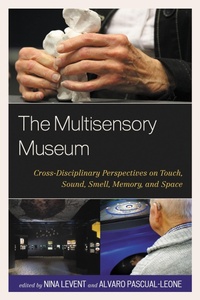
The Multisensory Museum
Cross-Disciplinary Perspectives on Touch, Sound, Smell, Memory, and Space
1st Edition
Published on 6. March 2014
1 pages
979-8-8818-5316-7 (ISBN)
Description

Recent research in the cognitive sciences gives us a new perspective on the cognitive and sensory landscape.
In The Multisensory Museum: Cross-Disciplinary Perspectives on Touch, Sound, Smell, Memory, and Space, museum expert Nina Levent and Alvaro Pascual-Leone, professor of neurology at Harvard Medical School bring together scholars and museum practitioners from around the world to highlight new trends and untapped opportunities for using such modalities as scent, sound, and touch in museums to offer more immersive experiences and diverse sensory engagement for visually- and otherwise-impaired patrons. Visitor studies describe how different personal and group identities color our cultural consumption and might serve as a compass on museum journeys. Psychologists and educators look at the creation of memories through different types of sensory engagement with objects, and how these memories in turn affect our next cultural experience. An anthropological perspective on the history of our multisensory engagement with ritual and art objects, especially in cultures that did not privilege sight over other senses, allows us a glimpse of what museums might become in the future. Education researchers discover museums as unique educational playgrounds that allow for a variety of learning styles, active and passive exploration, and participatory learning. Designers and architects suggest a framework for thinking about design solutions for a museum environment that invites an intuitive, multisensory and flexible exploration, as well as minimizes physical hurdles.
While attention has been paid to accessibility for the physically-impaired since passage of the Americans with Disabilities Act, making buildings accessible is only the first small step in elevating museums to be centers of learning and culture for all members of their communities. This landmark book will help all museums go much further.
In The Multisensory Museum: Cross-Disciplinary Perspectives on Touch, Sound, Smell, Memory, and Space, museum expert Nina Levent and Alvaro Pascual-Leone, professor of neurology at Harvard Medical School bring together scholars and museum practitioners from around the world to highlight new trends and untapped opportunities for using such modalities as scent, sound, and touch in museums to offer more immersive experiences and diverse sensory engagement for visually- and otherwise-impaired patrons. Visitor studies describe how different personal and group identities color our cultural consumption and might serve as a compass on museum journeys. Psychologists and educators look at the creation of memories through different types of sensory engagement with objects, and how these memories in turn affect our next cultural experience. An anthropological perspective on the history of our multisensory engagement with ritual and art objects, especially in cultures that did not privilege sight over other senses, allows us a glimpse of what museums might become in the future. Education researchers discover museums as unique educational playgrounds that allow for a variety of learning styles, active and passive exploration, and participatory learning. Designers and architects suggest a framework for thinking about design solutions for a museum environment that invites an intuitive, multisensory and flexible exploration, as well as minimizes physical hurdles.
While attention has been paid to accessibility for the physically-impaired since passage of the Americans with Disabilities Act, making buildings accessible is only the first small step in elevating museums to be centers of learning and culture for all members of their communities. This landmark book will help all museums go much further.
More details
Edition
1. Auflage
Language
English
Place of publication
United States
Publishing group
Bloomsbury Publishing Plc
Target group
Professional and scholarly
ISBN-13
979-8-8818-5316-7 (9798881853167)
Copyright in bibliographic data and cover images is held by Nielsen Book Services Limited or by the publishers or by their respective licensors: all rights reserved.
Schweitzer Classification
Other editions
Additional editions
Nina Levent | Alvaro Pascual-Leone
The Multisensory Museum
Cross-Disciplinary Perspectives on Touch, Sound, Smell, Memory, and Space
Book
10/2017
Rowman & Littlefield Publishers
€49.70
Shipment within 10-20 days
Persons
Nina Levent is executive director of Art Beyond Sight Collaborative in New York City, part of Art Education for the Blind. Art Beyond Sight is dedicated to making the visual arts a vital part of the lives of visually-impaired people.
Alvaro Pascual-Leone, M.D., Ph.D., is professor of neurology at Harvard Medical School; Director of the Berenson-Allen Center for Noninvasive Brain Stimulation; Program Director of the Harvard-Thorndike Clinical Research Unit; and an Attending Neurologist at Beth Israel Deaconess Medical Center - all in Boston. He is a practicing behavioral neurologist and movement disorders specialist.
Alvaro Pascual-Leone, M.D., Ph.D., is professor of neurology at Harvard Medical School; Director of the Berenson-Allen Center for Noninvasive Brain Stimulation; Program Director of the Harvard-Thorndike Clinical Research Unit; and an Attending Neurologist at Beth Israel Deaconess Medical Center - all in Boston. He is a practicing behavioral neurologist and movement disorders specialist.
Content
Introduction
Nina Levent & Alvaro Pascual-Leone
Part I: Museums & Touch
Chapter 1: Please DO Touch the Exhibits! Interactions between Visual Imagery and Haptic Perception
Simon Lacey & K. Sathian
Chapter 2: "First Hand," not "First-eye" Knowledge: Bodily Experience in Museums
Francesca Bacci & Francesco Pavani
Chapter 3: Art-Making as Multisensory Engagement: Case Studies from The Museum of Modern Art
Carrie McGee &Francesca Rosenberg
Chapter 4: Multi-sensory Engagement with Real Nature Relevant to Real Life
Molly Steinwald, Melissa A. Harding, & Richard V. Piacentini
Chapter 5: Touch and Narrative in Art and History Museums
Nina Levent & Lynn McRainey
Part II: Museums & Sound
Chapter 6: A Brain Guide to Sound Galleries
Stephen R. Arnott & Claude Alain
Chapter 7: Ephemeral, Immersive, Invasive: Sound as Curatorial Theme 1966-2013
Seth Cluett
Chapter 8: Soundwalking the Museum: A Sonic Journey through the Visual Display
Salomé Voegelin.
Chapter 9: The Role of Sensory and Mot
Nina Levent & Alvaro Pascual-Leone
Part I: Museums & Touch
Chapter 1: Please DO Touch the Exhibits! Interactions between Visual Imagery and Haptic Perception
Simon Lacey & K. Sathian
Chapter 2: "First Hand," not "First-eye" Knowledge: Bodily Experience in Museums
Francesca Bacci & Francesco Pavani
Chapter 3: Art-Making as Multisensory Engagement: Case Studies from The Museum of Modern Art
Carrie McGee &Francesca Rosenberg
Chapter 4: Multi-sensory Engagement with Real Nature Relevant to Real Life
Molly Steinwald, Melissa A. Harding, & Richard V. Piacentini
Chapter 5: Touch and Narrative in Art and History Museums
Nina Levent & Lynn McRainey
Part II: Museums & Sound
Chapter 6: A Brain Guide to Sound Galleries
Stephen R. Arnott & Claude Alain
Chapter 7: Ephemeral, Immersive, Invasive: Sound as Curatorial Theme 1966-2013
Seth Cluett
Chapter 8: Soundwalking the Museum: A Sonic Journey through the Visual Display
Salomé Voegelin.
Chapter 9: The Role of Sensory and Mot
