

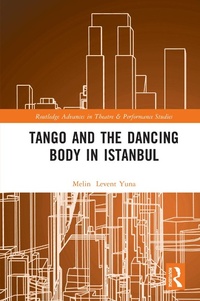
Tango and the Dancing Body in Istanbul
1st Edition
Published on 21. November 2021
196 pages
978-1-000-46993-6 (ISBN)
Description

Tango and the Dancing Body in Istanbul explores the expansion of social Argentine tango dancing among Muslim actors in Turkey, pioneered in Istanbul despite the conservative rule of the Justice and Development Party (JDP) and Tayyip Erdogan.
In this book, Melin Levent Yuna questions why a dance that appears to publicly represent an erotic relationship finds space to expand and increase dramatically in the number of contemporary Turkish Muslim tango dancers, particularly during a conservative rule. Even during the 2020 Covid-19 pandemic, tango dance classes, gatherings, and messages flourished on YouTube, Facebook, Instagram, and Zoom. Urban Turkey and its tango dance performances provide one symbol and example of how neoliberal capitalism could go hand in hand with conservatism by becoming a bridge between Europe and the Middle East. This study largely focuses on the dancers' perspective while presenting the policies of Erdogan. It presents the social characteristics of the tango dancers, the meanings they attach to their bodies and their dance as well as what this dance reflects about them - besides the policies of the Justice and Development Party. The book approaches the tango dance and its dancing body in terms of layers of meaning systems in a neoliberal and conservative context.
This study will be of great interest to students and scholars in dance, anthropology, cultural studies, and performance studies.
In this book, Melin Levent Yuna questions why a dance that appears to publicly represent an erotic relationship finds space to expand and increase dramatically in the number of contemporary Turkish Muslim tango dancers, particularly during a conservative rule. Even during the 2020 Covid-19 pandemic, tango dance classes, gatherings, and messages flourished on YouTube, Facebook, Instagram, and Zoom. Urban Turkey and its tango dance performances provide one symbol and example of how neoliberal capitalism could go hand in hand with conservatism by becoming a bridge between Europe and the Middle East. This study largely focuses on the dancers' perspective while presenting the policies of Erdogan. It presents the social characteristics of the tango dancers, the meanings they attach to their bodies and their dance as well as what this dance reflects about them - besides the policies of the Justice and Development Party. The book approaches the tango dance and its dancing body in terms of layers of meaning systems in a neoliberal and conservative context.
This study will be of great interest to students and scholars in dance, anthropology, cultural studies, and performance studies.
More details
Series
Edition
1. Auflage
Language
English
Place of publication
London
United Kingdom
Publishing group
Taylor & Francis Ltd
Target group
College/higher education
Illustrations
1 Tables, black and white; 41 Halftones, black and white; 41 Illustrations, black and white
ISBN-13
978-1-000-46993-6 (9781000469936)
Copyright in bibliographic data and cover images is held by Nielsen Book Services Limited or by the publishers or by their respective licensors: all rights reserved.
Schweitzer Classification
Other editions
Additional editions
Melin Levent Yuna
Tango and the Dancing Body in Istanbul
Book
05/2023
1st Edition
Routledge
€63.30
Shipment within 10-20 days
Melin Levent Yuna
Tango and the Dancing Body in Istanbul
Book
11/2021
1st Edition
Routledge
€206.10
Shipment within 10-20 days
Melin Levent Yuna
Tango and the Dancing Body in Istanbul
Book
10/2021
Routledge
Unfortunately, price unknown
Available (delivery time upon request)
Person
Melin Levent Yuna is a sociologist and a cultural anthropologist at Acibadem University, teaching various classes on these areas. In addition to her MA in sociology and PhD in cultural anthropology, she is a tango dancer herself, and has had a deep interest in Argentine tango dancing for many years.
Content
Preface
Introduction
I Concepts and tools: Contemporary self, identity, class, and more
A Reintroduction
II Leisure, consumption, and class - One mode of being an upper-middle class
III Becoming the conteporary tango dancer: Bailemos el Tango
IV One mode of being an upper - middle class in Istanbul - Bodies, self, and the attached meanings, Part I
V Bodies, self, and the attached meanings, Part II
VI Bodies, self, and the attached meanings, Part III
Conclusion
Index
Introduction
I Concepts and tools: Contemporary self, identity, class, and more
A Reintroduction
II Leisure, consumption, and class - One mode of being an upper-middle class
III Becoming the conteporary tango dancer: Bailemos el Tango
IV One mode of being an upper - middle class in Istanbul - Bodies, self, and the attached meanings, Part I
V Bodies, self, and the attached meanings, Part II
VI Bodies, self, and the attached meanings, Part III
Conclusion
Index
