

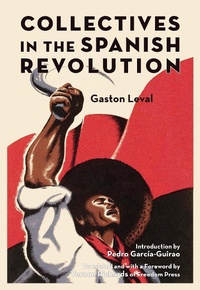
Collectives in the Spanish Revolution
Description

Revolutionary Spain came about with an explosion of social change so advanced and sweeping that it remains widely studied as one of the foremost experiments in worker self-management in history. At the heart of this vast foray into toppling entrenched forms of domination and centralised control was the flourishing of an array of worker-run collectives in industry, agriculture, public services, and beyond.
Collectives in the Spanish Revolution is a unique account of this transformative process-a work combining impeccable research and analysis with lucid reportage. Its author, Gaston Leval, was not only a participant in the Revolution and a dedicated anarcho-syndicalist but an especially knowledgeable eyewitness to the many industrial and agrarian collectives. In documenting the collectives' organisation and how they improved working conditions and increased output, Leval also gave voice to the workers who made them, recording their stories and experiences. At the same time, Leval did not shy away from exploring some of the collectives' failings, often ignored in other accounts of the period, opening space for readers today to critically draw lessons from the Spanish experience with self-managed collectives.
The book opens with an insightful examination of pre-revolutionary economic conditions in Spain that gave rise to the worker and peasant initiatives Leval documents and analyses in the bulk of his study. He begins by surveying agrarian collectives in Aragón, Levante, and Castile. Leval then guides the reader through an incredible variety of urban examples of self-organisation, from factories and workshops to medicine, social services, Barcelona's tramway system, and beyond. He concludes with a brief but perceptive consideration of the broader political context in which workers carried out such a far-reaching revolution in social organisation-and a rumination on who and what was responsible for its defeat.
This classic translation of the French original by Vernon Richards is presented in this edition for the first time with an index. A new introduction by Pedro García-Guirao and a preface by Stuart Christie offer a précis of Leval's life and methods, placing his landmark study in the context of more recent writing on the Spanish collectives-eloquently positing that Leval's account of collectivism and his assessments of their achievements and failings still have a great deal to teach us today.
More details
Other editions
Additional editions
Persons
Gaston Leval(born Pierre Robert Piller, 1895-1978) was the son of a French Communard. He escaped to Spain in 1915 during the First World War, where he met the young firebrand and writer Victor Serge and joined the Confederación Nacional del Trabajo (CNT) anarcho-syndicalist trade union organisation. Travelling in 1921 to Moscow as a CNT delegate to one of the most important organisations of the international communist movement, Leval wrote an influential report and a series of skeptical articles based on his experiences of the Bolshevik regime and attempted to spearhead action on behalf of imprisoned anarchists and socialists. After living in Argentina for much of the 1920s and '30s, Leval returned to Spain and became a militant fighter while documenting the Revolution and both urban and rural anarchist collectives.
Content
- Front Cover
- Title Page
- Copyright
- Contents
- Preface to the 2018 Edition
- Introduction
- Foreword
- Part One: Preamble
- I The Ideal
- II The Men and the Struggles
- III Material for a Revolution
- IV A Revolutionary Situation
- Part Two: Agrarian Socialisation
- V The Aragon Federation of Collectives
- 1. Graus
- 2. Fraga
- 3. Binefar
- 4. Andorra (Teruel)
- 5. Alcorisa
- 6. Mas de las Matas
- 7. Esplus
- VI Collectives in the Levante
- General Characteristics
- 1. Carcagente
- 2. Jativa
- 3. Other Methods of Operation
- VII The Collectives of Castile
- VIII Collectivist Book-Keeping
- IX Libertarian Democracy
- X The Charters
- Part Three: Industry and Public Services
- XI Industrial Achievements
- 1. Syndicalisations in Alcoy
- XII Achievements in the Public Sector
- 1. Water, Gas and Electricity in Catalonia
- 2. The Barcelona Tramways
- 3. The Means of Transport
- 4. The Socialisation of Medicine
- PART FOUR TOWNS AND ISOLATED ACHIEVEMENTS
- XIII Town Collectivisations
- 1. Elda and the S.I.C.E.P.
- 2. Granollers
- 3. Hospitalet de Llobregat
- 4. Rubi
- 5. Castellon de la Plana
- 6. Socialisation in Alicante
- XIV Isolated Achievements
- 1. The Boot and Shoemakers of Lerida
- 2. The Valencia Flour Mills
- 3. The Chocolate Cooperative of Torrente
- 4. The Agrarian Groups in Tarrasa
- Part Five: Parties and Government
- XV Political Collaboration
- XVI Libertarians and Republicans
- XVII The Internal Counter-Revolution
- Part Six: Epilogue
- XVIII Final Reflections
- Bibliographical Notes
- About the Authors
- Index
