

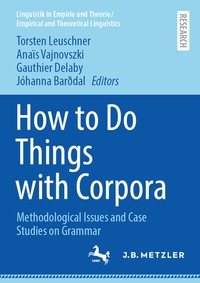
How to Do Things with Corpora
Description

Along with a renewed interest in the empirical foundations of linguistics, the increasing accessibility of large-scale corpora has sparked a surge of corpus-linguistic work on the grammar of natural languages. Corpus-based methods enhance our knowledge and understanding of individual languages, and they are theoretically significant because they allow us to test complex hypotheses on empirical and reproducible data. Spread over six thematic sections, the fifteen case studies in this book reflect on how methodological challenges and decisions affect the corpus-based analysis of grammatical patterns. They cover a wide variety of phenomena (syntax, registers, learner language, morphology, productivity, multilingualism) under different frameworks, including construction grammar, discourse analysis, and generative grammar. The contributors discuss the respective methodological and theoretical issues, proposing innovative solutions for linguistics in the 21st century.
More details
Other editions
Additional editions
Persons
Torsten Leuschner is Professor of German Linguistics at Ghent University and Visiting Reader at Queen Mary University of London.
Anaïs Vajnovszki is taking a joint PhD between Ghent University and Paris 3 Sorbonne-Nouvelle on shell nouns in French and Romanian.
Gauthier Delaby is a Ph.D. student at Ghent University. His research focuses on Construction Grammar and its application to Dutch.
Jóhanna Barðdal is Professor of Scandinavian Linguistics at Ghent University. She is founding editor of Journal of Historical Linguistics and series editor of Brill's Studies in Historical Linguistics.
Content
The Beldeko corpus as a Resource to Investigate Cohesion in German Learner Language: a Preliminary Analysis of Corpus Homogeneity.- Make it a Double: The Building and Use of the LSFB and FRAPé Corpora to Compare French Belgian Sign Language and Belgian French.- Data retrieval and sampling.- On the internal and external productivity of IAW phrases in German.- The Finnish Existential Partitive construction analyzed: comparing two applications of collostructional analysis.- Fragments as Constructions: a Corpus-Driven Proposal.- A Corpus-Based Perspective on 'Split Stimuli' in German.- Manner and reportative evidential adverbials - an annotation study on German nach-PPs.- Dime con quién te juntas y te diré quién eres - from Construction Grammar: A case study of a snowclone in Spanish.- Latvian Deverbal Nouns in ien- and -um- and Derivational Productivity: a Corpus-Based Analysis.- Syntactic Complexity across Registers in Russian.- Investigating Modality through Lexical Modals: a Corpus Study of the Brexit Political Discourse.- Case-Marking Alternation with Psychological Verbs in Spanish: Combining Different Corpus Data Sources.- Grammar "bores the crap out of me!": a Mixed-Method Study on the "X the Y out of Z" Construction and Its Usage by ESL and ENL Speakers.- Overt head marking and choice of genitive construction in Modern Hebrew: Empirical data and theoretical questions.- Reflexive Pronouns and Locative PPs in English: Evidence from 3 Corpora and Speaker Judgement.
